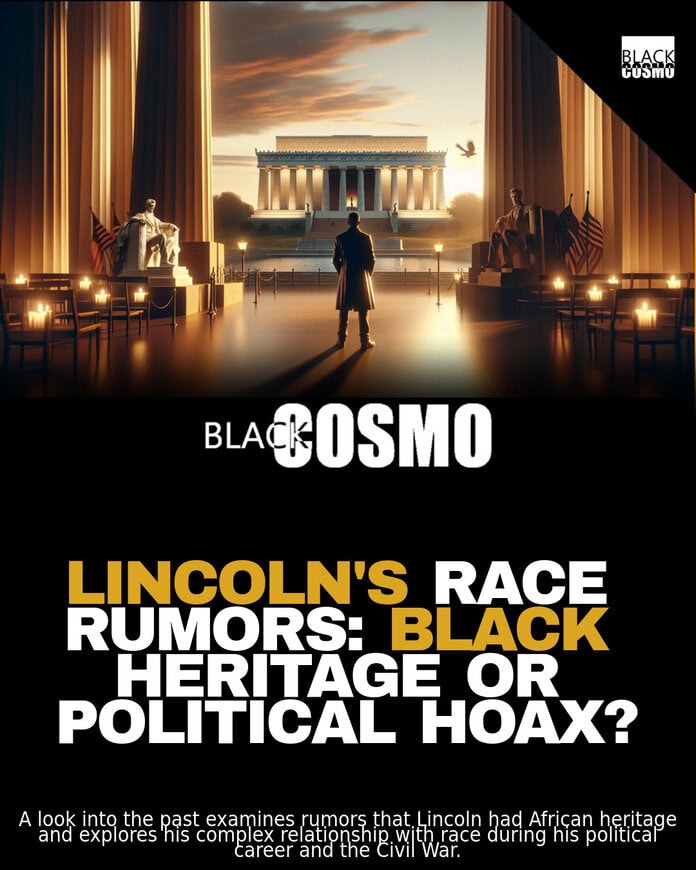
The election of Barack Obama as President of the United States in 2008 was a significant and historical moment for many Black Americans, a monumental step in the ongoing struggle for civil rights and racial equality. But some folks whispered that Obama wasn’t actually the first African-American President. Rumors have swirled for ages that Abraham Lincoln was, shall we say, of a “ruddier” complexion than others of his time. Maybe from all that time spent outdoors?
Or perhaps, some believe, his skin tone hinted at deeper “ethnic roots” and a Black lineage. So let’s dive into these century-old whispers and shed some light on Abraham Lincoln‘s evolving relationship with race and slavery.
What makes this theory so captivating is Lincoln’s central role in the Civil War. As president, he stood against the Confederacy, those southern states that seceded mainly to keep enslavement alive. His Emancipation Proclamation turned the war into a moral crusade against slavery, forever changing the nation’s path.
While the South demonized him, Black leaders like Frederick Douglass recognized his growth toward racial justice, even while pointing out that Lincoln’s initial policies – like suggesting freed Black people should colonize Africa – fell short of true equality.
Funny enough, 2024 marks the 160th anniversary of one of the biggest political media hoaxes in US history. The story has uncanny parallels to today’s disinformation age. It involved President Lincoln, a secret government scheme about race-mixing, pro-slavery politicians, and their newspaper puppets. Seems like “fake news” ain’t nothing new under the sun.
Back in February 1864, Lincoln’s re-election campaign got rocked by supposed “proof” of a secret plan to solve America’s “race problem” through miscegenation (mixing ancestry) to create a new “American race.” This “proof” came as a pamphlet urging the Republican Party (the abolitionists) to openly embrace race-mixing in Lincoln’s re-election platform.
Of course, it was all a forgery by David Goodman Croly, then-managing editor of The World, a leading pro-slavery newspaper up North. Croly masterminded the scheme, knowing the pamphlet format was a favorite of abolitionist writers, cheap and easy to produce. His trick worked; the familiar format gave the lies weight.
By the time Lincoln’s team caught on, major newspapers had dubbed the Emancipation Proclamation (his order declaring enslaved people “then, thenceforward, and forever free”) the Miscegenation Proclamation. Regardless of how that played out politically, rumors about Lincoln’s feelings toward African-Americans took on a life of their own.
Inside the White House, Lincoln was all about pragmatism and moral conviction. He wasn’t the only president wrestling with slavery’s legacy. Others, like Thomas Jefferson and Andrew Jackson, left far more overtly racist legacies. Even later presidents like Calvin Coolidge and Dwight Eisenhower would have their own civil rights reckonings.
If Lincoln were secretly Black, it would rewrite how Americans see the presidency, the Civil War, and the very identity of the United States. But so far, the evidence suggests he was white. Still, the idea has power in a nation where Black people have too often been shut out of the highest positions.
Some whispered that his mother, Nancy Hanks, had African ancestry. Others pointed to his “dark” skin, and even Lincoln himself joked about being a “long Black fellow.” But whether any of that was ancestral, who knows? Historians largely dismiss the rumors of Lincoln’s African-American heritage.
The rumors themselves, true or not, create a symbolic connection. For some African-Americans, the idea that Lincoln might have had African roots deepens the personal connection to his pivotal role in ending slavery. But let’s be real: Lincoln was a product of his time. Even as the Great Emancipator, he came from a racist family in a racist region during a racist era.
So, yeah, his early life was shaped by the prejudices around him. Despite ending slavery, Lincoln held some explicitly racist views. He opposed slavery not out of empathy, but because it clashed with his belief in the individual’s right to the fruit of their labor, which slavery denied.
Even then, he didn’t advocate for racial equality. He opposed Black voting rights, interracial marriage, and general social and political equality. And those weren’t just his personal views; it was the broader white sentiment, something he couldn’t ignore as a politician. Lincoln’s legacy is full of these contradictions. He struck a blow against slavery, but his views on race were still shaped by the era.
In the end, history paints figures in many shades, whether based on race, belief, or virtue. One thing is sure: in the annals of politics, Abraham Lincoln might be the Great Emancipator, but he was still the white man’s President, opposing slavery mainly for economic reasons.