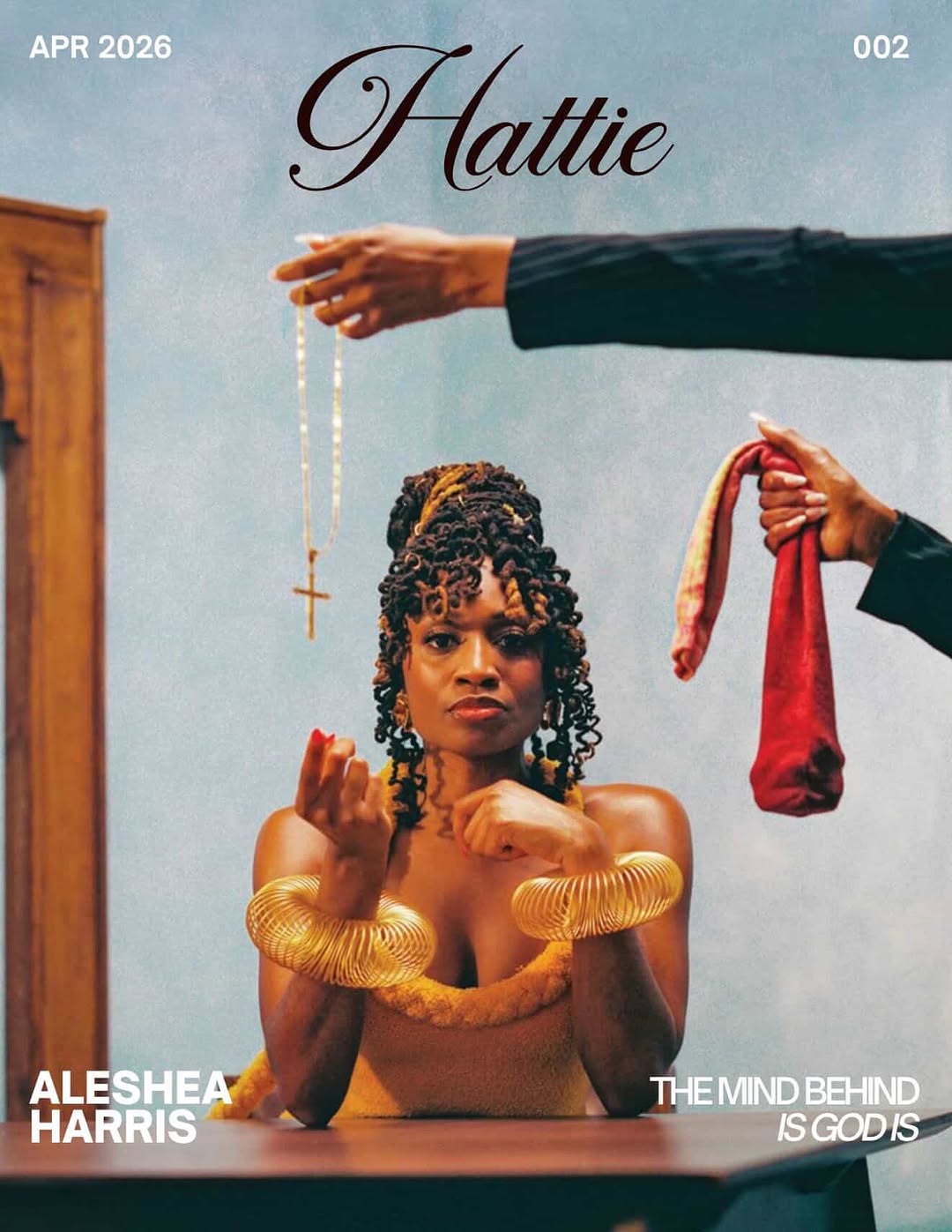
Let us talk about the weight of inheritance. Not the financial kind, but the spiritual luggage passed down from grandmothers to mothers, sitting heavy on our own shoulders. The April 2026 cover of Hattie Magazine puts that exact unspoken tension front and center. Fronting Issue 002 is none other than the acclaimed playwright Aleshea Harris. She sits entirely anchored in the frame, her gaze slicing straight through the lens. It isn’t a passive portrait. It is an active standoff.
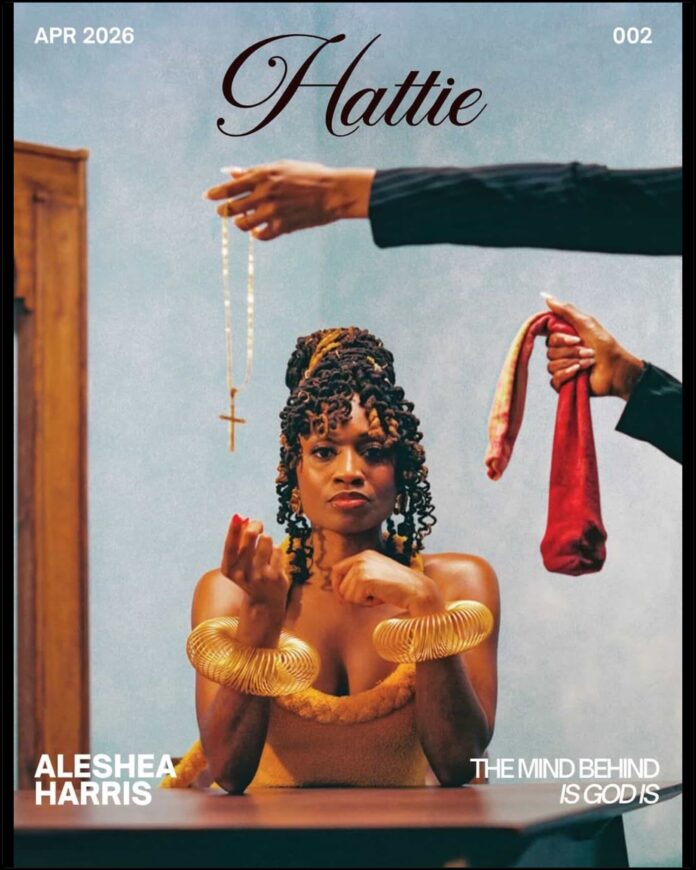
The creative direction here operates as a lesson in subtlety and confrontation. We see Harris positioned centrally, wearing an ochre-toned garment that feels less like high-fashion drapery and more like a vestment of her own making. Heavy golden bangles encircle her wrists and décolletage. The gold does not just suggest wealth. It screams ancestral reclamation. It demands to be seen as a birthright rather than a borrowed aesthetic.
But the true narrative friction lies in the periphery. Two disembodied hands reach into the frame, offering opposing spiritual anchors. From the left, a hand extends a thick gold chain bearing a crucifix. It acts as a heavy, recognizable symbol of Western Christianity and the complicated religious inheritance of the Black diaspora. From the right, another hand presents red and yellow cloths, deeply coded markers of indigenous African spiritual practices and ritualistic reverence.
She does not reach for either.
Her hands remain open, poised over her lap in a gesture of reception, yet her unblinking expression refuses the ultimatum. She is not choosing a side to appease the viewer. She is holding space for the complexity of being a modern Black woman navigating a post-colonial religious landscape. She is questioning the divine, asking what it means to be sacred without being subservient.
This visual thesis makes perfect sense when you remember exactly who Aleshea Harris is. The Hattie masthead teases “THE MIND BEHIND IS GOD IS,” nodding to her groundbreaking, award-winning play that flipped the script on divine retribution, family trauma, and the limits of forgiveness. In her written work, she crafts worlds where Black people, particularly Black women, refuse to be polite victims. They claim their fury. They question the very nature of godhood. The Hattie cover operates on the exact same frequency.
For a long time, the editorial spaces occupied by Black talent relied on proximity to white validation. We smiled. We wore the clothes they told us to wear. We softened our edges so mainstream audiences would not feel intimidated. That era is dead. What we see on this cover is the pulse of our current culture. Black adults living in major urban hubs are actively dismantling the rigid dogma they grew up with. We are questioning the pulpit. We are researching our lineages. We are synthesizing our own belief systems, wearing the gold cross and lighting the sage at the same time, or tossing both aside entirely.
The team behind this shoot understood the assignment down to the smallest detail. Editor-in-Chief and Creative Director Cleopatra’s Daughter constructed a deeply intentional set, working alongside producers Sherean Jones and Eva. The lighting, courtesy of Jacques Ketchens, casts a shadowless, unapologetic clarity over the subject. Hair by Rashida Shabazz and makeup by All In A Days Werk give Harris an elevated, regally unbothered finish. The wardrobe styling by Brooklyne uses that ochre palette to ground the gold accessories, turning the playwright into a monument. And the story inside, penned by Danielle Young, promises to match the visual gravity with equally sharp prose.
There is no desperation to be liked in this image. No pleading for an audience to understand. It sits quietly in its power, daring anyone to project their own insecurities onto it. It forces a pause. When you scroll past the noise of daily content, a cover like this arrests your momentum. It asks you what you are inheriting, what you are discarding, and what you are brave enough to build for yourself. This isn’t just an editorial spread. It is a mirror held up to a generation currently mid-stride in defining their own salvation.