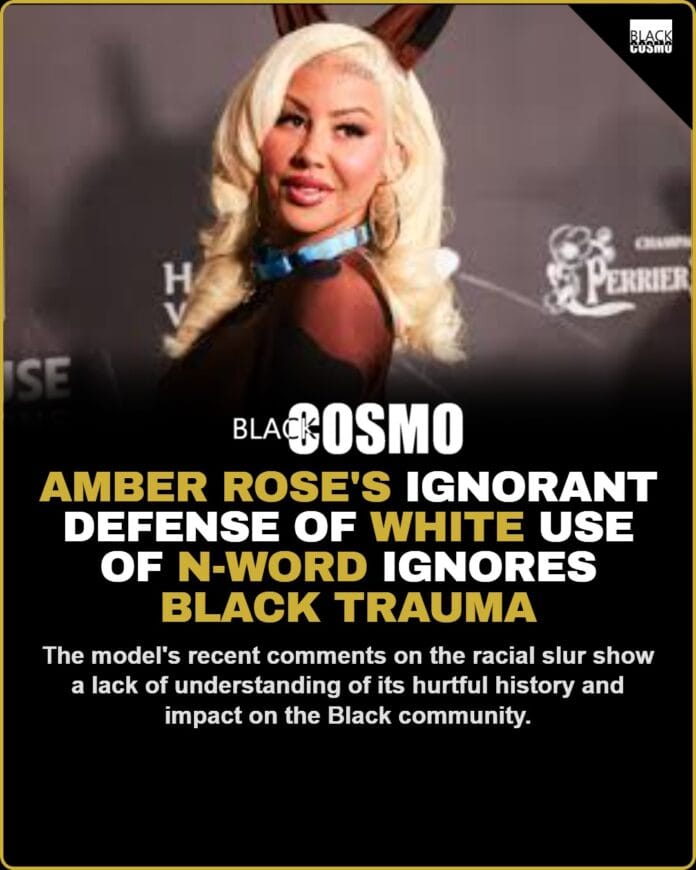
Amber Rose, the model and media personality, recently found herself at the center of controversy after defending the use of the n-word by non-Black people. Her comments, made during an appearance on the “No Jumper” podcast, didn’t just spark backlash—they reopened a conversation that never really goes away.
Amber Rose argued that the word should be “free” for everyone to use, framing it as a modern “term of endearment.” But that framing skips over something critical: context. The n-word didn’t start as slang, it didn’t start as culture—it started as a weapon. And for many Black people, it still carries that weight, no matter how casually it’s used in music or online.
This is where the disconnect keeps happening. When Black people say, “We don’t like hearing non-Black people use that word,” it’s often met with eye rolls, accusations of being “too sensitive,” or the familiar deflection: “Here comes the race card.” But that response isn’t just dismissive—it’s a refusal to engage with history and lived experience.
Empathy requires more than just acknowledging that racism existed—it means understanding how its language still lives today. The n-word is tied to centuries of violence, humiliation, and systemic exclusion. It was used to strip identity, to enforce hierarchy, and to remind Black people where they were “supposed” to stand in society. That doesn’t disappear just because the word shows up in a song or gets repurposed within the community.
And that’s the part that often gets misunderstood: reclamation is not the same as permission. When Black people use the word among themselves, it exists within a shared cultural context shaped by history, nuance, and lived reality. When non-Black people use it, that context isn’t there—and that absence matters.
Too often, the reaction isn’t curiosity or reflection—it’s defensiveness. Conspiracy thinking creeps in: “People are just trying to control speech,” or “This is about division.” But for many Black people, the request is actually simple: respect a boundary rooted in history. Not everything needs to be debated, deconstructed, or turned into a free speech argument.
This is why empathy matters. Not performative empathy. Not the kind that shows up only when it’s convenient. Real empathy asks: “Why does this matter to you?” and then actually listens to the answer. It doesn’t immediately pivot to justification, comparison, or dismissal.
Amber Rose’s comments hit a nerve not just because of what she said, but because they echo a larger pattern—where Black discomfort is minimized and then reframed as overreaction. And when that happens, the conversation stops being about a word and starts being about whether Black people are allowed to define what respect looks like for themselves.
Public figures, especially those who have benefited from Black culture and community, carry a responsibility to understand these dynamics before speaking on them. Influence without awareness doesn’t just miss the mark—it can actively reinforce the very tensions people claim they want to move past.
At the end of the day, this isn’t about “cancelling” anyone or policing language for the sake of control. It’s about recognizing that history doesn’t disappear just because it’s uncomfortable—and that respect sometimes looks like restraint.
So the real question isn’t “Why can’t everyone say it?” It’s: why is it so hard to accept that you don’t need to?