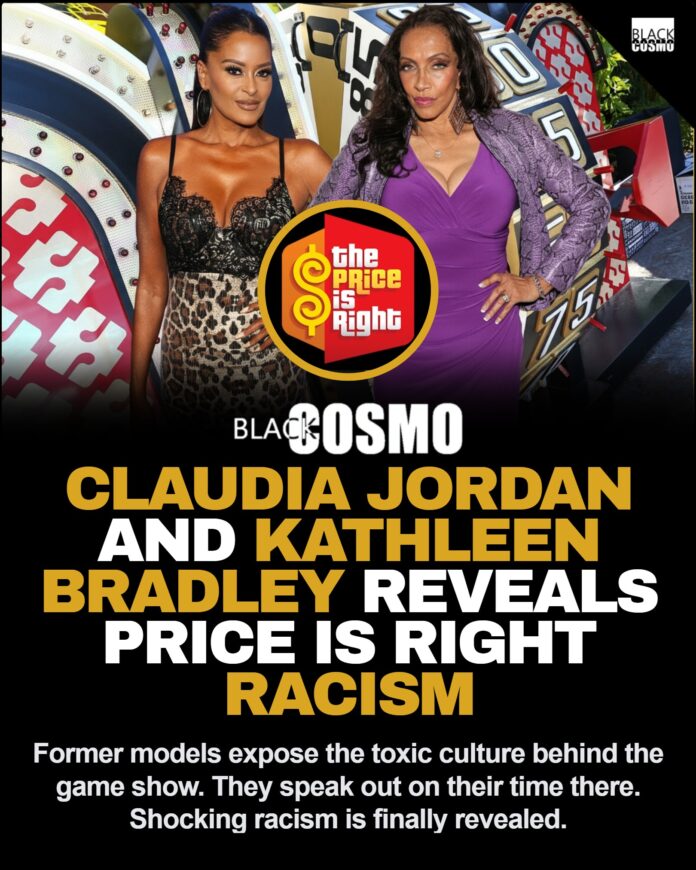
For decades, audiences across America tuned into daytime television to watch eager contestants “come on down” to the stage. But recently, former “Barker’s Beauties” Claudia Jordan and Kathleen Bradley have shattered that wholesome and innocent image of the iconic show. In a new E! docuseries titled “Dirty Rotten Scandals,” the two iconic models are finally breaking their silence about the severe racism and sexism behind The Price Is Right. The long-running game show, hosted by the late Bob Barker, was reportedly a toxic, highly prejudiced workplace for Black women.
Claudia Jordan, who made history by becoming the second full-time Black model on the series, did not hold back in her harrowing interviews. Alongside Bradley, she revealed that the bright smiles viewers saw on their television screens masked a dark, deeply prejudiced environment off-camera. Their shocking revelations have sparked a massive online conversation across social media platforms, proving that accountability has no expiration date, even for beloved television classics.
Let’s explore the disturbing details of what these women endured during their tenure, shedding light on the rampant racism and sexism behind The Price Is Right.
Kathleen Bradley Breaks Barriers and Faces Severe Backlash
Kathleen Bradley made television history in 1990 when she became the first full-time Black model to join the cast of “The Price Is Right.” While her presence on screen was a major milestone for representation in daytime television, Bradley recently confessed that the behind-the-scenes reality was far less glamorous. In the revealing E! docuseries, she shared that she faced intense pushback not just from bigoted viewers, but from the very people who ran the show on a daily basis.
Bradley revealed that she quickly became aware of racist fan mail directed at her simply for being a Black woman on the program. Even more disturbing, she alleged that when the models were out of the room, members of the production team routinely used the N-word during their private meetings. “It was just not a good feeling,” Bradley expressed during her emotionally charged interview. To be a trailblazer often means enduring the brunt of systemic prejudice, and Bradley’s testimony underscores the immense emotional toll it took to maintain a smiling facade while working in such a hostile, degrading environment. Furthermore, she mentioned experiencing inappropriate behavior from a “handsy” stagehand, emphasizing that the toxic culture extended far beyond verbal abuse to include physical harassment and unwanted advances.
The Disturbing Experiences of the Second Black Model
A decade after Bradley’s groundbreaking debut, the show hired another Black model, and fans hoped things would be different. Unfortunately, the new addition quickly learned that the deeply ingrained racism and sexism behind The Price Is Right had not improved in the slightest. In fact, her accounts of working under producer Phil Wayne and host Bob Barker paint a picture of blatant discrimination and severe sexual harassment that was allowed to go completely unchecked.
During her explosive interviews for “Dirty Rotten Scandals,” she disclosed specific, racially charged comments made by the production team. She recalled instances where producer Phil Wayne would ask her to perform a “reverse Oreo” by standing exactly between two white models. Additionally, she was subjected to offensive and hypersexualized stereotypes about Black women’s bodies. She claimed that Wayne referred to her as the “ass model,” using the vicious stereotype to justify his inappropriate desire to grab and feel her body on set. This horrific blend of racial fetishization and sexual harassment highlights exactly how vulnerable women of color were on the set, left without proper support or human resources protection.
A Culture of Retaliation and Systemic Bias
The toxic workplace was not limited to the treatment of the models alone. The highly anticipated E! docuseries also delves into alarming claims of racial bias significantly affecting the show’s casting choices and on-screen representation. According to the brave women speaking out, there were strict, unspoken limitations on the number of Black contestants allowed to participate in the audience or on stage at any given time—a deeply discriminatory rule allegedly enforced directly by Bob Barker himself.
When Black contestants were selected, they were often chosen based on stereotypical archetypes rather than genuine enthusiasm. The second Black model noted that whenever a prize had a “Black connotation,” she was deliberately assigned to model it, describing it as an offensive “inside joke” among the producers. This systemic bias infected every single layer of the production.
Furthermore, reporting these abuses was virtually impossible and highly dangerous for their careers. When she attempted to report a physical assault to a female producer, she quickly learned that there was a pervasive spirit of retaliation. “If you report someone, you better just count your days,” she stated, noting that producers would immediately begin documenting fabricated or minor issues to justify firing the accuser. The psychological toll of wondering what trick a producer would pull each day left her mentally and physically drained.
The Legacy of Bob Barker Reexamined
For decades, Bob Barker was celebrated as the ultimate television host, a beloved grandfatherly figure who encouraged viewers to “help control the pet population.” However, the accounts from these Black women, alongside past allegations from other “Barker’s Beauties” like Dian Parkinson and Holly Hallstrom, reveal a much darker and more sinister legacy.
Hallstrom famously recalled how Barker’s alleged racism became a major point of contention when he discovered that a former model he had been intimately involved with had also dated Black men. Barker reportedly harbored deep-seated prejudices, allegedly claiming that Black men were “unhealthy” or “diseased.” These disturbing, overtly racist beliefs seemingly trickled down into every aspect of the show’s production, creating an environment where discrimination was normalized and protected by the powers that be.
Why Speaking Out Matters Today
While some critics might question the necessity of bringing up decades-old grievances, the courageous decision to expose the racism and sexism behind The Price Is Right is crucial for industry-wide accountability. Both women boldly emphasize that their participation in the docuseries is about far more than just rehashing the past; it is about empowering other women to stand up against oppressive power dynamics in the modern era.
“I just want it to be more common for women… to speak out against the powers that be,” one of the models passionately noted. Bradley added a poignant reflection that people need to care about how they treat others because “the tables always turn.”
In the wake of these earth-shattering revelations, the entire entertainment industry is forced to reckon with the harsh reality that many of its most beloved, nostalgia-inducing institutions were built on a foundation of exclusion, exploitation, and abuse. The bravery of these former models ensures that the true, unvarnished history of daytime television is finally told. They remind us all that behind the flashing lights, cheering crowds, and fabulous showcase showdowns, real people were fighting desperately for their dignity, respect, and fundamental human rights. Their story serves as a powerful testament to unyielding resilience and a stark, undeniable warning that toxic workplace cultures will eventually be brought into the light of truth.