
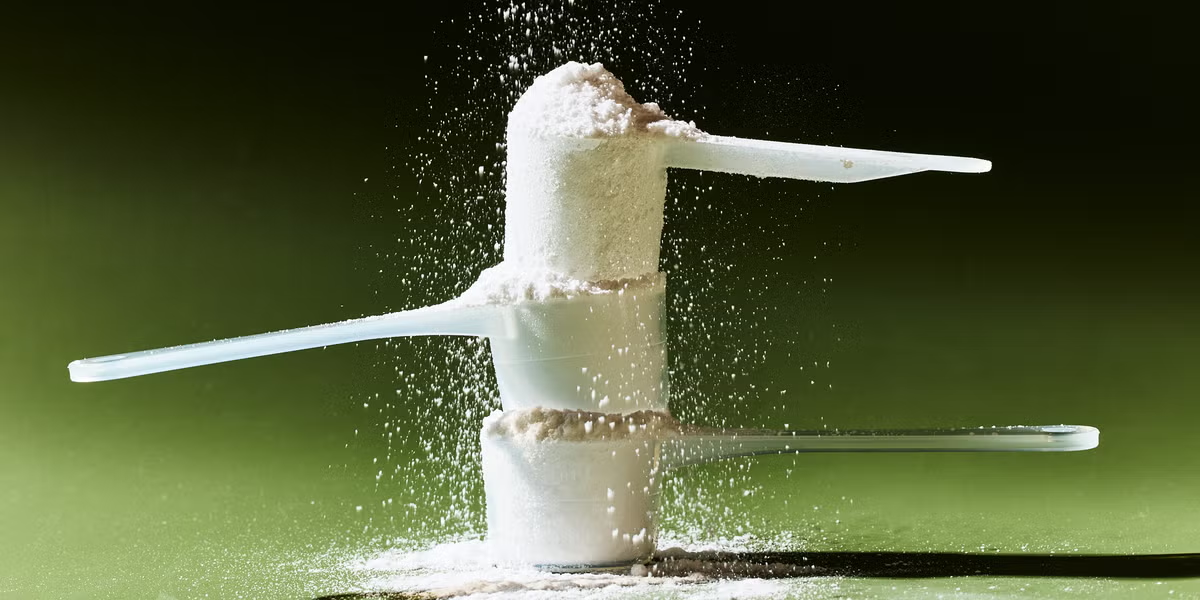
For a lot of gym folks, creatine monohydrate has lived in that no-drama, always-delivers category. Five grams a day has long been the standard because it helps saturate muscles, support ATP production, and give your workouts a little more fuel when it is time to push through that last rep.
Now the conversation is getting bigger. People are asking whether creatine monohydrate might do more than support strength and recovery, with early research looking at brain health, mental fatigue, and even mood-related benefits. The buzz is real, but the science still needs room to breathe.
For years, the case for creatine and physical performance has been solid. It has been one of the most researched supplements in fitness, and that reputation did not come out of nowhere. Pair it with smart training and enough protein, and it can support muscle growth, recovery, and strength across different ages and training levels.
What is newer is the interest in higher doses for benefits beyond the gym. Researchers have started studying creatine in connection with cognitive function, traumatic brain injury, depression symptoms, and long COVID. The logic is simple enough: your brain also uses ATP for energy, so increasing creatine availability may help support how it functions under stress.
That possibility has wellness influencers talking loud. Some have framed creatine as a major tool for focus, planning, and overall brain performance. A few are even suggesting daily intakes as high as 25 grams. That kind of advice spreads fast online, especially when people are looking for an edge in both fitness and mental clarity.
But researchers who actually study creatine say the hype needs context. Darren Candow, PhD, who has published extensively on creatine, says these super-high doses are overhyped and very specific to certain situations. In other words, what may be useful in a clinical setting is not automatically something everybody needs in their shaker bottle.
What the Research Actually Says
Candow points out that the lowest dose shown to increase brain creatine levels in one study was four grams a day, and that was in people with long COVID. A lot of the promising brain-related research is tied to people dealing with specific health challenges, not necessarily healthy adults trying to optimize their Monday morning focus.
Scott Forbes, PhD, another longtime creatine researcher, says the data looks more consistent when the brain is stressed. Even then, the number of studies in each category is small. The findings are interesting, but still early.
Forbes notes there is only one published trial looking at creatine after traumatic brain injury, and the same goes for Alzheimer’s research. Depression has a bit more data behind it, with a few randomized controlled trials, but it is still far from settled science. Promising does not mean proven.
One reason brain studies often use much higher doses is that creatine does not move into the brain as easily as it does into muscle. Researchers say the blood-brain barrier makes the process slower, so bigger doses may be needed in studies trying to measure a real cognitive effect.
The good news is that the old fear around creatine and kidney damage has largely been debunked in healthy people. Recent reviews suggest that even at 10 grams a day, long-term creatine supplementation appears to be well tolerated and does not increase the risk of major side effects compared with placebo.
Still, safe does not always mean necessary. Taking 20 or 25 grams a day can be expensive, inconvenient, and honestly a lot to deal with if you are using powder or capsules.
For many people, there may be no need to go far beyond the classic five grams. Candow says he personally takes 10 grams a day because he believes that amount may support muscle, bone, and brain health.
Creatine Beyond Muscle
Some early research suggests creatine may help change bone geometry in a way that could make bones stronger. Experts stress that creatine alone is not likely to do much for bone health unless it is paired with resistance training and regular movement.
Some researchers also say splitting the dose may help. Instead of taking 10 grams all at once, two separate five-gram servings throughout the day may offer a more practical approach while still supporting muscle and possible cognition-related benefits.
At the same time, experts stress that five grams daily is still a very strong option. If that amount works for you and your stomach handles it well, there may be no reason to increase it.
Bottom line: creatine remains one of the most reliable supplements for muscle performance across the lifespan. The brain and bone research is intriguing, especially for people dealing with fatigue or specific health stressors, but it is not time to treat every viral claim like gospel.