The conversation surrounding diaspora linguistic styles has taken a sharp turn. British-Nigerian actor David Oyelowo recently faced heavy pushback following his comments on a popular podcast where he attempted to trace the history of Black American speech patterns. The resulting controversy prompted a quick and necessary David Oyelowo Southern accent apology, as the actor walked back his claims about the roots of regional dialects.
The situation began during an appearance on the One54 Africa podcast, where David Oyelowo was asked to demonstrate his command of different vocal styles. When shifting his focus to the American South, his analysis stumbled. He attempted to explain the dialect by telling the hosts that slowing down a Nigerian accent and infusing it with historical subservience and slavery creates the familiar Southern drawl. That framing, which equated centuries of organic language development with forced compliance, immediately struck a sour note with listeners across the country.
Oyelowo was initially trying to respond to a popular skit by comedian Druski. That parody had teased Black British performers who easily land prestige roles in Hollywood projects set in the American South. In discussing the sketch, Oyelowo suggested the debate over casting was fueled by a scarcity mindset. He then tried to demonstrate his own process for vocal shifting. He stated that slowing down a Nigerian accent and adding elements of bondage and submission produces the Southern voice. He even performed the transition on camera, dropping his chin and dragging out his vowels to illustrate the physical shift. The visual and verbal demonstration did not sit well with the audience.
Critics and cultural commentators responded swiftly. Writer Demetria L. Lucas pointed out on social media that the actor’s comments felt like a caricature come to life. Many observers argued that labeling Black Southern speech as inherently subservient completely ignores the structural and historical beauty of African American Vernacular English. Linguists have long documented how Southern dialects grew from sophisticated West African grammatical rules, Caribbean exchanges, and creative adaptation. It was never a product of passivity or submissive styling. Reducing this complex communication system to a slowed-down version of another language with trauma mixed in is both historically inaccurate and culturally dismissive.
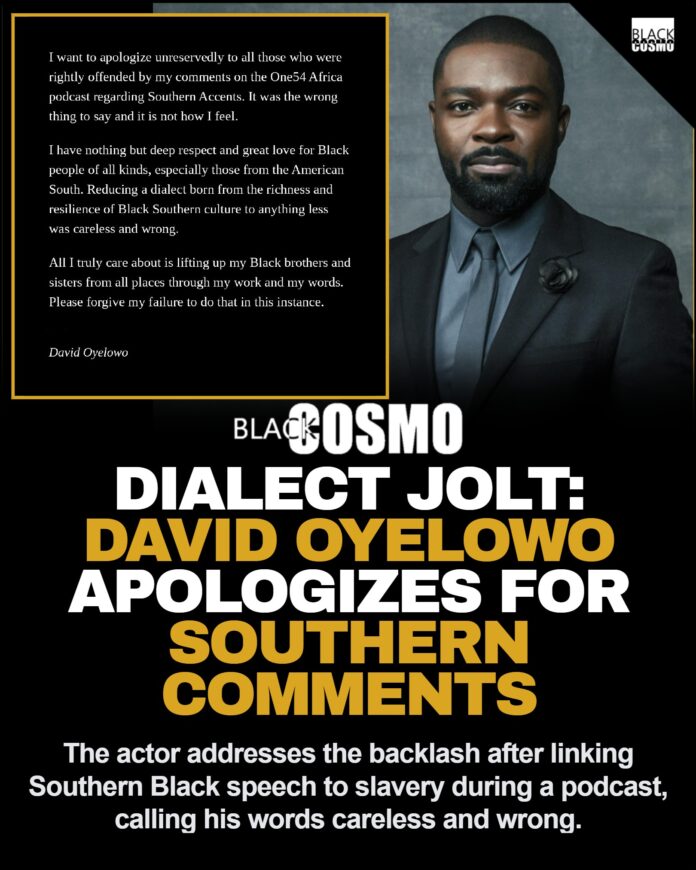
Recognizing the depth of the offense, the actor issued his official statement on Instagram to address the situation directly. In the David Oyelowo Southern accent apology, he acknowledged that his remarks were careless and wrong, offering an unreserved apology to those who were rightly offended. He clarified that reducing a dialect born from the richness and resilience of Black Southern culture was a grave mistake, and he reaffirmed his love for the regional community. He asked for forgiveness, stating his desire to support and elevate members of the diaspora rather than create divisions through careless commentary.
Linguistic tension within the diaspora is not new, and this incident points to the delicate nature of cultural translation. When actors move between global identities, preparing for a role requires deep humility. Treating dialects as simple vocal components without understanding their social dignity risks alienating the very communities being portrayed. Audience feedback from this situation demonstrates that viewers demand more than vocal mimicry. They expect an appreciation of the lived history behind the words spoken on screen. Moving forward, the conversation serves as a poignant reminder of the care needed when navigating shared cultural spaces.
Editor’s Picks: Enrich your daily routines and expand your horizons with our curated lifestyle selections. Discover outstanding titles in Black literature, elevate your personal aesthetic with high-quality luxury fashion, upgrade your audio workspace with an elite condenser microphone for podcasting, or simplify your space with essential home essentials.