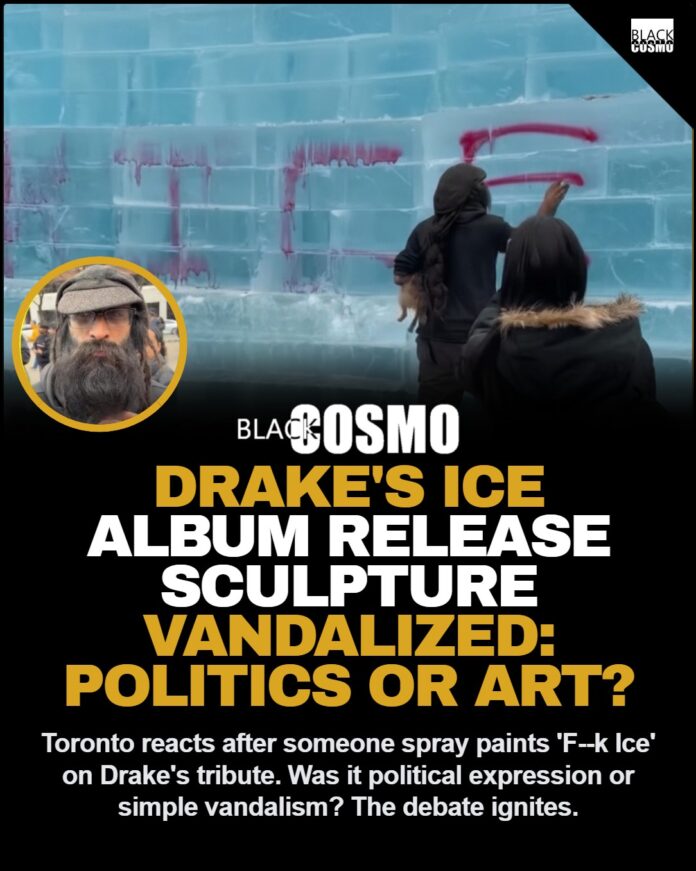
Toronto’s freezing temperatures usually preserve things perfectly, but the cultural climate heated up incredibly fast when a temporary ice sculpture—erected to celebrate the highly anticipated album release of hip-hop’s most polarizing titan—became the city’s most fiercely debated flashpoint. Originally intended as a sleek, celebratory promotional piece and a literal monument to the 6 God’s latest musical era, the frozen structure barely lasted 48 hours before it was radically transformed. Under the cover of the city’s buzz, someone grabbed a can of spray paint and blasted “F—k Ice” across the pristine, frozen canvas. Overnight, what was meant to be a transient pop-culture spectacle morphed into a raw, unfiltered stage for radical political expression—or, depending on who you ask, a brazen target of street vandalism. Captured by the lens of @boroughsoundtv and rapidly amplified across social media timelines by rtntoronto#RTN, the viral moment ignited a fiery, city-wide conversation. The overarching question hanging heavy in the biting Toronto air: When does an album promo become a legitimate canvas for political commentary? And more importantly, is it ever truly off-limits to bring the harsh realities of the marginalized into the sanitized sphere of mega-stardom?
The plot thickened significantly when the alleged graffiti artist was abruptly confronted on the streets by local cameraman @djzartv. In today’s hyper-connected, clout-driven digital age, this tense confrontation instantly became a secondary viral spectacle, generating just as much heated discourse as the spray-painted message itself. Was this an example of street-level journalism at its finest—a necessary and legitimate attempt to hold the provocateur accountable and understand the raw motivations behind the brazen act? Or was it an aggressive, intimidating attempt to silence and police a dissenting, politically charged voice? The answer heavily depends on which side of the digital aisle you sit on. This gripping video, now circulating endlessly and sparking countless quote-tweets, adds a deeply compelling, complex layer to the already chaotic narrative surrounding the legendary Drake Ice Sculpture incident. For some within the culture, the camera served as an instrument of community accountability; for others, it felt like an unwarranted surveillance of radical street expression.
The sheer swiftness and audacity with which this promotional art piece was defaced immediately raises potent questions about the vulnerability of public art installations, especially those attached to massive, multi-million-dollar celebrity rollouts. Was the noticeable lack of heavy security around the sculpture an intentional choice to keep it organically accessible to the fans, or simply a staggering logistical oversight by the label? Regardless of the intent, the “F—k Ice” message is an undeniably brilliant, albeit controversial, double entendre. On the surface, it’s a literal, cheeky rejection of the frozen monument itself. But on a much deeper, systemic level, it serves as a glaring, unmistakable indictment of Immigration and Customs Enforcement (ICE) and its historically devastating policies that disproportionately target and traumatize Black and Brown communities. By deliberately targeting a massive, globally recognized symbol of pop culture, the vigilante artist actively sought to hijack the algorithm. They forced a crucial, uncomfortable dialogue about draconian immigration policies right into the center of a mainstream cultural moment. It was an undeniably bold, disruptive move designed to shatter the illusion of escapism that celebrity culture so often provides.
But does this disruptive act qualify as high-concept street art, or does it ultimately boil down to common vandalism? Within the Black diaspora and the broader urban art community, this line has historically been beautifully blurry. Some cultural critics passionately argue that any form of disruptive expression—especially when it gives a voice to the voiceless against systemic oppression—deserves to be celebrated as vital, necessary art, regardless of the medium or the legality of its location. Conversely, purists and defenders of the original creative vision maintain that defacing another artist’s public work is fundamentally disrespectful and inherently counterproductive, no matter how righteous the underlying political message might be. This intense debate inevitably echoes much larger, deeply entrenched conversations about the absolute limits of freedom of speech, the boundaries of artistic expression, and the moral responsibility of global superstars to acknowledge the political climate of the world they profit from. Toronto boasts one of the most vibrant, diverse, and culturally rich art scenes on the globe, yet this fleeting incident casts a long, fascinating shadow that is forcing a necessary introspection upon the entire creative community.
Diving beneath the immediate shock value of the spray-painted defacement, the incident unearths profound, underlying questions regarding cultural ownership, authenticity, and representation. As an undisputed global icon, the artist at the center of this controversy represents vastly different things to incredibly diverse demographics. For a massive segment of his global fanbase, he is the ultimate embodiment of Canadian triumph, boundless musical innovation, and a shining testament to Black commercial excellence on the world stage. However, for a more critical faction of the culture, his massive empire sometimes represents the hyper-commercialization and sanitization of Black culture for mass, corporate consumption. The jarring juxtaposition of the gritty, politically charged “F—k Ice” message plastered directly over a pristine, label-funded image creates a staggering, multi-layered commentary on the intersection of race, immigration, and modern cultural identity. It is a visual disruption that practically demands our collective attention and forces us to look critically at the pedestals we build, regardless of where we personally stand on its artistic merit, its tactical effectiveness, or its strict legality.
The initial wave of 39 impassioned comments cited by rtntoronto#RTN in the immediate aftermath serves as a perfect microcosm of the wildly diverse spectrum of opinions surrounding this icy controversy. In the comment sections, you will find staunch loyalists vehemently condemning the act as a destructive, entirely disrespectful attack on a hometown hero’s momentous album release. A quick scroll down, and you will discover radical thinkers and activists loudly applauding the defacement as a masterful, genuinely powerful statement against systemic border injustice and state-sanctioned violence. And, naturally, there are those who simply shrug off the entire saga as just another fleeting symptom of our internet-fueled, outrage-driven era. Yet, regardless of your personal stance or political leanings, this unforgettable ice sculpture saga stands as a profound reminder of the power of visual disruption. It proves that art—even in its absolute most fleeting, melting, and ephemeral forms—possesses the unmatched power to act as a catalyst for explosive dialogue, necessary debate, and cultural reckoning. The ice itself may have inevitably melted away into the Toronto concrete, but the cultural conversation it sparked is one that the city, the hip-hop community, and the diaspora at large desperately needs to keep having.