
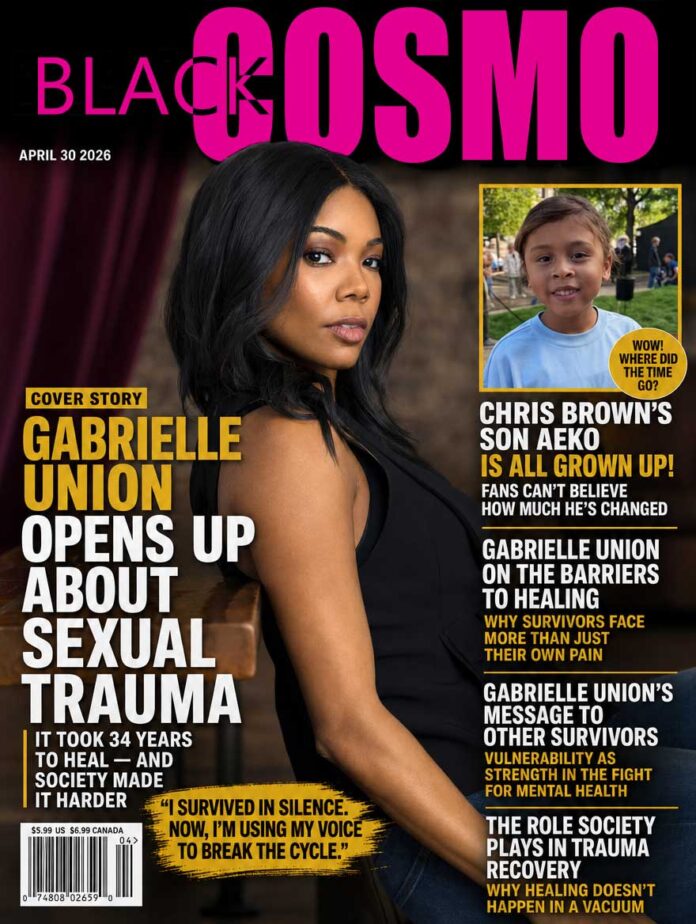
For 34 years, Gabrielle Union carried something most people could not see. On the outside, she was every definition of a woman who had made it — a thriving Hollywood career, a high-profile marriage to NBA star Dwyane Wade, four children, a bestselling memoir, and a platform that millions listened to. Inside, her nervous system had never left a Payless shoe store in Los Angeles, where at 19 years old, she was raped at gunpoint during a summer shift.
She did everything right. She started therapy three days after the attack. She kept going back, year after year, couch after couch. She told her story publicly. She put her trauma into words in her own book. By every measure of what we tell survivors to do, Gabrielle Union did it. And still, for over three decades, she could not fully heal.
Now 53, she is finally naming why — and what she wants other women to understand before another 34 years slip by.
The Backyard That Broke the Silence
It was not a dramatic moment that brought Union to her breaking point. It was a sunny afternoon and a little girl doing cartwheels in the backyard.
Union’s youngest daughter, Kaavia, was playing outside — the kind of ordinary, golden childhood moment a mother should be able to hold and enjoy. Instead, Union’s mind was already three steps ahead, running through catastrophic scenarios, bracing for a fictitious threat to break through the gates and destroy everything she had built.
“I can’t watch you do cartwheels if I’m thinking about a fictitious criminal mastermind who somehow thwarts security and comes through the back gate,” she said during a recent conversation with Lashauna Cutts, a licensed clinical social worker and senior clinical director at Nema Health. “I can’t parent. I can’t be present like that.”
That is what untreated PTSD actually looks like — not always crisis, not always visible, but a mind that is permanently locked in a state of emergency. A body that never fully came home from the worst day of its life.
What she discovered, after beginning a specialized trauma treatment program through Nema Health in October, was a version of herself she had not met before. The hypervigilance quieted. The heaviness that had settled into the walls of her home — so normalized she had stopped noticing it — began to lift.
“It’s created a peace in our home, in our marriage that everyone is appreciative of,” she said. “I clearly was not as aware of the heaviness that existed in our house. Now I’m just watching cartwheels. I can be present enough to actually hear what she’s saying.”
What 34 Years Actually Means
Sit with that number for a moment. Thirty-four years.
This is a woman with the financial resources to access any therapist, any program, any level of care that exists. She had the vocabulary, the willingness, and the courage to be open about her experience. She had every advantage a survivor could hope to have — and she still spent over three decades in an active trauma response because the right, specialized treatment was never made clear or accessible to her.
“I lived with PTSD for 34 years after being sexually assaulted at 19. I did everything I was supposed to do — all the therapy, year after year — and recovery still felt out of reach,” Union wrote in a recent post sharing her story. “What I didn’t know, and what most people don’t know, is that there’s a treatment designed specifically for trauma. It took me 34 years to find it. I wouldn’t wish 34 years of suffering on anyone.”
That gap in awareness is not accidental. It is systemic. The medical establishment has a long, documented history of dismissing Black women’s pain, underserving their emotional wounds, and assuming that strength means they require less care — not more. What looks like resilience from the outside is often simply a woman who was never given another option.
The Numbers Behind the Silence
Union’s story is deeply personal. It is also devastatingly common.
Research shows that roughly eight out of ten Black women will experience some form of trauma in their lifetimes. Nearly one in five Black women are survivors of rape. Forty-one percent have experienced sexual coercion or other forms of unwanted sexual contact. Black girls face disproportionately higher rates of childhood sexual and physical abuse, and as they grow older, Black women are more likely to encounter intimate partner violence and other forms of sexual harm.
Despite these numbers, roughly 58% of Black adults who need mental health support will never seek it.
The reasons are not simply personal reluctance. They are cultural, historical, and structural. Black women have been socially conditioned from birth to carry pain without complaint — to be strong, to be steady, to push through. The “strong Black woman” stereotype is not a compliment. It is a cage. It pressures women to suppress their emotions, resist help, and place everyone else’s needs above their own healing. It teaches survival as a substitute for living.
Unhealed trauma does not stay neatly contained. It surfaces as chronic anxiety, emotional dysregulation, physical pain, inflammation, autoimmune disruption, and strained relationships. It sits in the body long after the mind has tried to move on. It changes how a woman loves, how she parents, how safe she feels in her own skin on an ordinary Tuesday afternoon.
There Is More Than Talk Therapy
One of the most critical points Union is making is one that does not get nearly enough attention: talk therapy alone is not always enough, and it was never designed to be the only tool.
For 34 years, she processed her trauma verbally — returning again and again to the events and the feelings, which is valuable work. But she did not know that treatments specifically engineered to target the neurological and physiological roots of post-traumatic stress disorder existed. She did not know because no one told her, which is itself a systemic failure.
Her work with Nema Health involves brief, focused sessions — often just 10 to 15 minutes — paired with assigned exercises that can extend to nearly an hour. The work is so engaging that Union often completes multiple sessions in a single day. Cutts, her therapist, noted that the transformation she witnessed in Union was nothing short of radical. Union was so moved by her progress that she became an investor and strategic advisor for the company.
The point is not that one platform or one treatment is a universal answer. The point is that options exist. Specialized, evidence-based, trauma-informed care is available — and far too many women, especially Black women, have never been told it is there for them.
What She Wants You to Know
Union is not sharing her story for sympathy. She is sharing it as a map — an imperfect, hard-won map for the women who are still lost in the same fog she lived in for more than three decades.
“No two traumas are the same,” she wrote. “But if yours has changed how you live, how you love, how you feel safe in your own body — you deserve real care.”
That sentence is doing a great deal of work. It is dismantling the idea that you have to have suffered enough, or waited long enough, or proven your pain loudly enough to deserve real healing. It is a direct challenge to the silence that kills — the kind of quiet suffering that looks functional from the outside while something essential is dying on the inside.
If you have been managing rather than healing, surviving rather than living, protecting yourself from invisible threats in the middle of the most beautiful moments of your life — her words are for you.
You are not too strong to need help. You are not too far along to start over with better tools. And you should not have to spend 34 years finding the care you deserved from the very beginning.
The Conversation Starts Here
April is Sexual Assault Awareness Month, but the conversation Gabrielle Union is opening does not belong to a single month. It belongs to every Black woman who has been handed the cape of resilience and told that wearing it with grace was the same thing as healing.
It is not. And more of us need to say that out loud.
If her story resonates — if you recognized yourself in the backyard, bracing instead of breathing, managing instead of present — talk about it. Tell a friend. Tell a therapist. Tell your doctor and, if they dismiss you, tell another one. Ask specifically about trauma-informed care. Ask what treatments exist beyond talk therapy. Push for the specialized support you deserve.
Healing is not a luxury reserved for the lucky few. It is something every survivor is owed. And it should never, under any circumstances, take 34 years.
If you or someone you know needs support, the RAINN National Sexual Assault Hotline is available 24/7 at 1-800-656-HOPE (4673) or online at rainn.org. For Black women seeking culturally affirming mental health care, Therapy for Black Girls offers a therapist directory and community resources.