
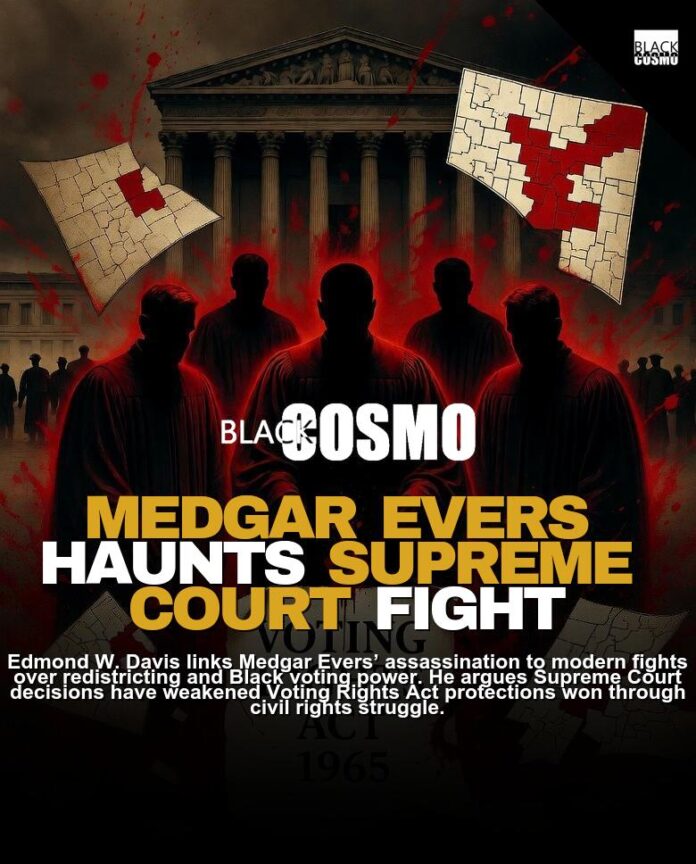
Medgar Evers did not die for a history lesson. His 1963 assassination remains a brutal flashpoint in a war for Black political power that has simply traded burning crosses for bureaucratic maneuvers. The old racial battles over access and autonomy never vanished from the American South. They just put on a suit. What once looked like night-riding terror and mob violence now functions quietly through courtroom gavels, partisan redistricting, and the steady erosion of voting protections won entirely through Black blood and sacrifice.
The New Weaponry of Disenfranchisement
Drawing a straight, undeniable line from Evers bleeding out in his Jackson driveway to the current assault on the ballot box reveals a chilling reality. The tactics carry a higher polish today, but the objective remains exactly the same. Rifles and physical intimidation have been swapped for sophisticated district maps and deliberate judicial rulings designed to gut the Voting Rights Act piece by piece. For Black voters across the country, the threat no longer announces itself with a megaphone. It arrives buried in legal procedure and complex state legislature votes.
Framing the fight this way strips the polite veneer off modern policy debates. Voting access is not an abstract partisan issue. It is a grinding, generational struggle over who gets to exist as a full citizen. The system learned how to preserve deep inequalities without relying on the crude public hatred of the Jim Crow era. The so-called “ghosts of Mississippi” are not just memories haunting the Delta. They are active political forces, speaking a new language to achieve an old outcome.
The Defiance of Memory
At the core of this ongoing fight stands Myrlie Evers-Williams. For decades, she served as the ultimate symbol of refusal—a widow who rejected the idea that a murder could be swept under the rug of polite Southern society. Justice only survives when someone demands the truth stay above ground. Right now, as political fatigue sets in and the rollback of civil rights feels heavy, her persistence offers a clear blueprint. Refusing to forget is an act of rebellion. Community organizing and raw, honest storytelling remain essential tools against systemic erasure.
For Black Cosmopolitans, this reality stretches far past a single court docket or a specific state limit. It confirms a fundamental rule of American life: the second Black progress threatens to shift real, tangible power, the rules of the game will change. Acknowledging Medgar Evers requires looking past the sepia-toned image of a civil rights martyr. It means staring directly at the unfinished, dangerous work he left behind. The driveway where he fell still points toward a ballot box that remains fiercely guarded.