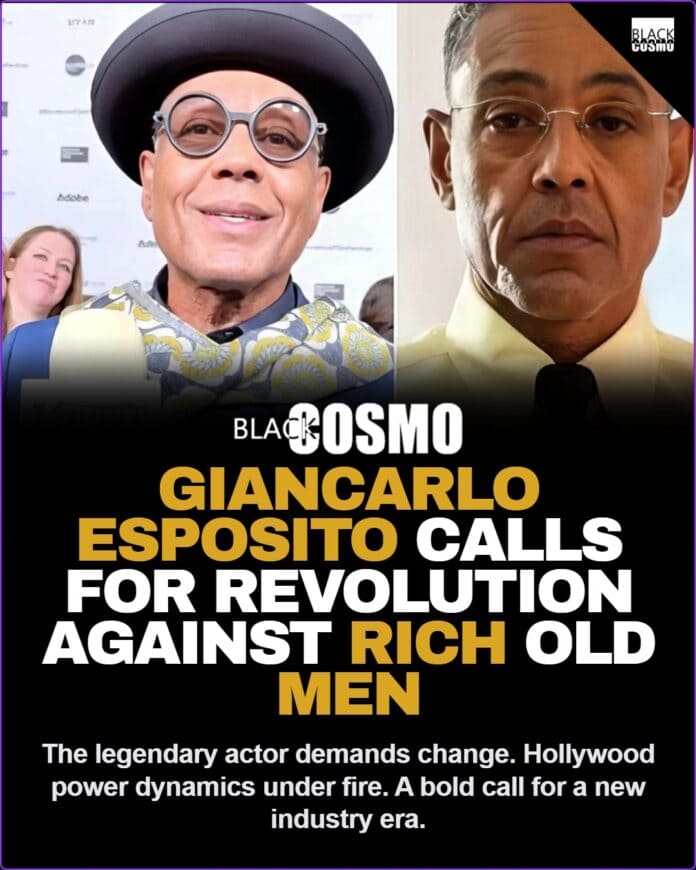
In a moment that has instantly reverberated across social media and the entertainment industry, the legendary actor Giancarlo Esposito has drawn a line in the sand. Taking the stage to accept a Career Achievement Award, Esposito did not offer the standard platitudes of gratitude. Instead, he delivered a fiery, unadulterated indictment of the current power structures governing Hollywood. His message was clear, concise, and revolutionary: the era of the “very rich old white men” exerting total control must come to an end.
The speech, delivered with the same commanding presence that has made him a household name, addressed the systemic gatekeeping that continues to stifle diverse voices. As the audience listened in rapt attention, Giancarlo Esposito articulated a frustration felt by many Black creatives and artists of color. He argued that true inclusion isn’t just about placing diverse faces in front of the camera, but about dismantling the archaic boardroom hierarchies that dictate which stories get told and who gets to tell them.
The Call for a New System
Esposito’s comments specifically targeted the demographic that has historically held a monopoly on decision-making power. By explicitly naming “very rich old white men,” he stripped away the polite euphemisms often used in industry discourse. He framed the situation not as a plea for a seat at the table, but as a demand for a completely new table. “It is time for a revolution,” Esposito declared, emphasizing that the current model is unsustainable and unrepresentative of the global audience that consumes entertainment today.
This wasn’t just a critique of casting; it was a critique of capital. Esposito highlighted how financial leverage is used to curate culture, often filtering out authentic Black narratives in favor of what these gatekeepers deem profitable or safe. His call for a “revolution” suggests a need for independent financing, Black-owned studios, and a shift in how value is assigned to creative projects.
A Career Built on Command
Why does Esposito’s voice carry such weight? Because he has navigated this system for decades, delivering iconic performances in Breaking Bad, The Mandalorian, and The Boys. He has played the villain, the boss, and the mastermind, often portraying characters who understand the mechanics of power better than anyone else. Seeing him turn that analytical, piercing gaze toward the real-life industry machinery is a powerful moment for Black Hollywood.
His speech resonates because it comes from a veteran who has reached the pinnacle of success yet refuses to pull the ladder up behind him. Instead, he is using his platform to expose the cracks in the foundation. He acknowledges that while he has succeeded, the path remains unnecessarily treacherous for the next generation of talent due to the stranglehold of the old guard.
The Industry Reaction
The reaction to Esposito’s words has been swift and polarized, as is to be expected when someone challenges the status quo so directly. Social media has lit up with support from fellow actors, writers, and directors who have long whispered these sentiments in private. The hashtag #EspositoRevolution began trending within hours, with fans praising his courage to speak truth to power.
Conversely, the silence from the major studios is deafening. The specific demographic Esposito called out—the executive class—has yet to issue formal responses, likely hoping the news cycle will move on. However, the viral nature of the clip suggests that this conversation is not going away. By framing the issue as a “revolution,” Esposito has galvanized a movement that demands tangible action rather than corporate performative allyship.
What Comes Next?
The question now remains: what does this revolution look like? For Esposito and his supporters, it likely involves a push for more executive ownership among people of color. It means greenlighting risky projects that don’t fit the traditional mold. It implies a transfer of power, not just a sharing of it.
As we move further into 2026, the landscape of cinema and television is at a breaking point. Audiences are savvy; they know when diversity is tokenism versus when it is structural. Giancarlo Esposito has vocalized the quiet part out loud, challenging the “very rich old white men” to step aside or be pushed aside by the inevitable tide of progress. This speech may very well be remembered as the spark that ignited a new era of equity in entertainment.