
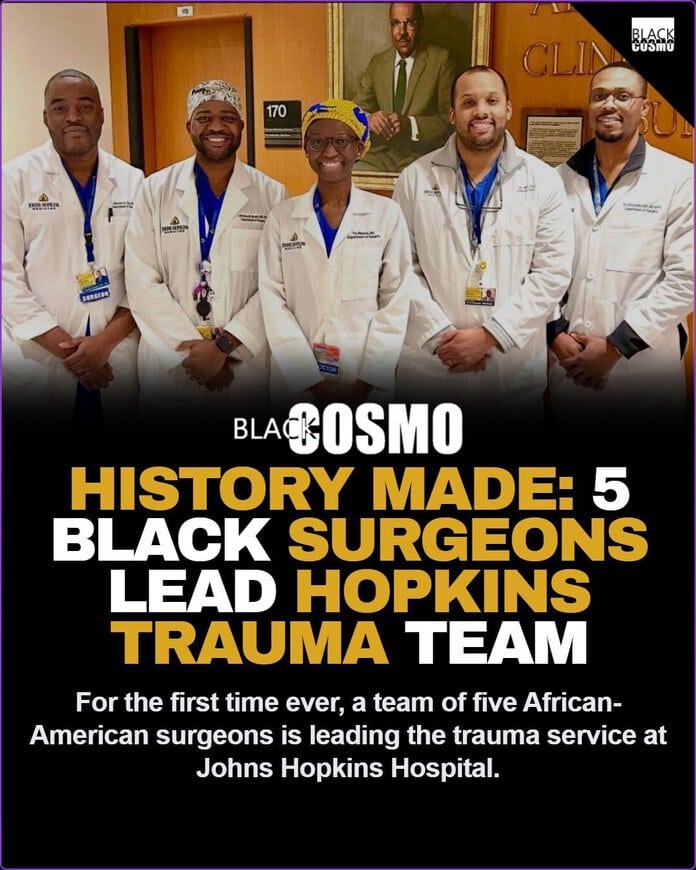
In a moment that is being celebrated across the medical community and beyond, a powerful shift has taken place at one of the world’s most prestigious medical institutions. For the first time in its storied history, the five African-American surgeons comprising the leadership team are steering the trauma service at Johns Hopkins Hospital. This milestone is not just a win for diversity; it is a testament to excellence, resilience, and the changing face of medicine in America.
The image of this all-Black leadership team has sparked joy and admiration across social media, highlighting a level of representation that was once unimaginable in the high-stakes world of trauma surgery. As this team of five African-American surgeons takes the helm, they are redefining what leadership looks like at an institution that has stood in Baltimore since 1889. Their presence in these roles sends a resounding message to aspiring medical professionals everywhere: the glass ceiling is shattering.
A Historic Milestone in Medicine
Trauma surgery is widely considered one of the most demanding and intense fields in medicine. It requires split-second decision-making, immense skill, and nerves of steel. For decades, the field—much like the broader medical profession—has been predominantly white and male. According to the Association of American Medical Colleges (AAMC), Black physicians make up only about 5% of the active physician workforce in the United States, with an even smaller percentage specializing in surgery.
To have five African-American surgeons leading a single service unit at a top-tier hospital like Johns Hopkins is statistically rare and culturally monumental. It represents a concentration of talent that speaks to the excellence existing within the Black medical community, often despite systemic barriers to entry in medical education and residency placement.
Healing Historical Wounds
The significance of this achievement is amplified by the location. Johns Hopkins Hospital has a complex history with the African-American community in Baltimore. While it was founded with the intention of serving the indigent regardless of race, the relationship has been fraught with tension and mistrust, most notably highlighted by the story of Henrietta Lacks. Lacks, a Black woman, had her cancer cells harvested at Hopkins in 1951 without her consent—cells that went on to change the course of modern medicine (HeLa cells).
Seeing a team of Black surgeons leading the trauma service today offers a narrative of reclamation and progress. It suggests a future where the leadership within the hospital better reflects the demographics of the diverse community it serves. Representation in healthcare is proven to improve patient outcomes, particularly for Black patients who often feel unheard or marginalized in medical settings. Having leadership that looks like the community can build bridges of trust that have been long in need of repair.
Black Excellence on the Frontlines
The rise of this team is a celebration of individual brilliance and collective power. These surgeons have navigated grueling medical schools, competitive residencies, and high-pressure fellowships to reach the pinnacle of their careers. They are now responsible for saving lives in one of the busiest trauma centers in the country, dealing with gunshot wounds, car accidents, and critical injuries on a daily basis.
Their leadership also provides mentorship for the next generation. Representation matters because it allows young Black students to visualize themselves in white coats, holding scalpels, and running departments. You cannot be what you cannot see. Today, students at Howard, Meharry, and medical schools across the globe can look at the trauma service at Johns Hopkins and see a reflection of their own potential.
The Social Media Reaction
As news of this historic team broke, social media platforms lit up with praise. Users on X (formerly Twitter), Instagram, and LinkedIn shared photos and stories, using hashtags like #BlackExcellence, #MedTwitter, and #RepresentationMatters. The viral nature of this news proves how hungry the public is for positive, transformative stories coming out of the Black community.
One user commented, “This is what our ancestors dreamed of. To occupy spaces that were once closed to us and to lead with excellence.” Another noted, “This isn’t just history for Hopkins; it’s history for America.”
Looking Toward the Future
While we celebrate this moment, it serves as a reminder that the work of diversity, equity, and inclusion in medicine is far from over. This team is a beacon of success, but they are also the exception rather than the rule in many hospitals across the nation. The hope is that this “first” will not be the “last,” and that hospitals nationwide will continue to prioritize recruiting and promoting diverse talent.