Jada Fatigue Is Real And The Internet Isn’t Hiding It Anymore
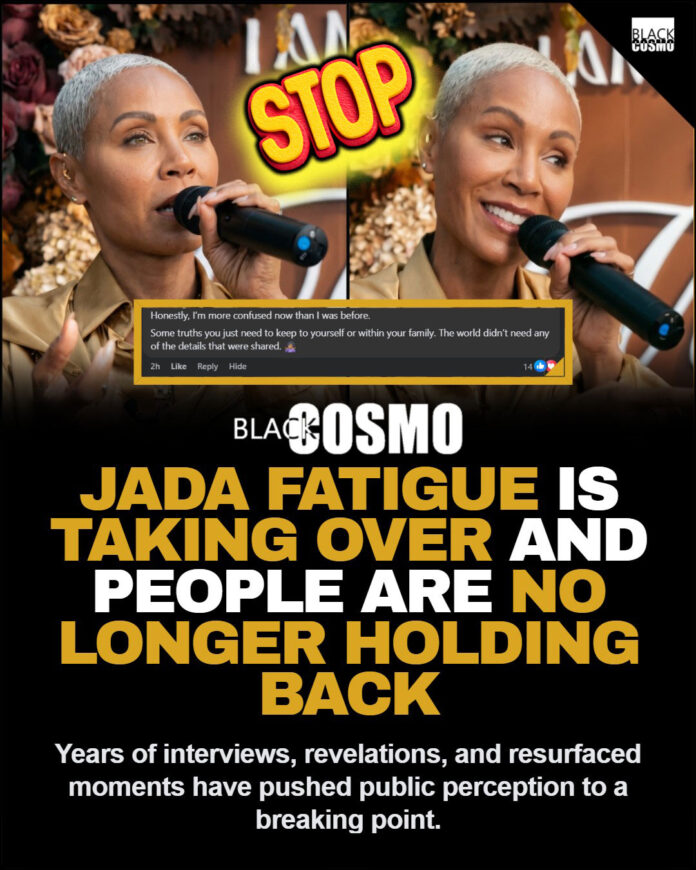
At some point, the conversation around Jada Pinkett Smith stopped being about curiosity… and started becoming exhaustion. Years of interviews, revelations, and resurfaced moments have pushed public perception to a breaking point and what started as conversation has turned into full-blown cultural fatigue.
Call it what it is: Jada Fatigue.
And if you’ve been anywhere near social media lately, you’ve seen it. Not subtle. Not nuanced. Just loud, repetitive, and increasingly unified. What used to be debate has turned into dismissal. What used to trend as jokes like #FreeWill is now, for many, a genuine sentiment.
This didn’t happen overnight. It’s been building. Layer by layer. Interview by interview. Revelation by revelation.
From Transparency to Overexposure
There was a time when openness felt refreshing. The “entanglement” era sparked conversation about relationships, honesty, and healing. But years later, the tone has shifted. What once felt like vulnerability now reads, to many, as overexposure.
And the public is asking a simple question: when does transparency become too much?
We talked about her breakdown on the burden of happiness, the deeper narrative has always been about control of image, of truth, of perception. But the more the story evolves, the less control it seems anyone has over how it’s received.
The #FreeWill Era Wasn’t Just a Meme
At first, #FreeWill lived in the same space as internet humor exaggerated, dramatic, easy to laugh off. But over time, something changed.
People stopped laughing.
As covered in our report on the viral backlash, that hashtag evolved into a real perception: that Will Smith wasn’t just in a complicated marriage, but a publicly uncomfortable one.
Fair or not, that narrative stuck. And every new interview, every new detail, doesn’t reset the story it reinforces it.
What The Audience Is Actually Saying
Scroll through the comments and a pattern emerges. Not just criticism but fatigue.
“Honestly, I’m more confused now than I was before.”
“Some truths you just need to keep to yourself.”
“We so over this! Just get a divorce.”
“She said all that, just to say nothing.”
“This could have just stayed private.”
There’s frustration in the tone, but also something deeper: disengagement. People aren’t just disagreeing anymore — they’re tuning out.
The Shift From Criticism to Character Judgement
The language has also escalated. Words like “toxic,” “narcissistic,” and “manipulative” are no longer fringe opinions — they’re common descriptors in comment sections across platforms.
That escalation says more about the audience than it does about the individual. It reflects how quickly public figures can shift from admired to analyzed… then from analyzed to resented.
And in this case, much of that resentment centers on one recurring idea: that private matters were turned into public narratives, repeatedly.
Why This Keeps Coming Back
Here’s the cycle:
- New interview or resurfaced clip
- Old wounds reopened
- Social media reacts
- Debate turns into backlash
- Backlash reinforces existing perception
Then it resets.
This is why Jada Fatigue isn’t fading — it’s compounding.
The Bigger Conversation We’re Avoiding
There’s another layer here people don’t always say out loud.
Why does this story hit so hard?
Because for years, Will and Jada represented something bigger — Black love, longevity, partnership, success. When that image cracked, it didn’t just feel like celebrity gossip. It felt like a shift in something cultural.
And now, every new detail feels less like insight… and more like erosion.
So Where Does It Go From Here?
That’s the question no one seems to have the answer to.
Because at this point, it’s not about one interview. Or one revelation. Or one moment.
It’s about accumulation.
Jada Fatigue isn’t about what was said. It’s about how often it keeps being said.
And the audience? They’ve made one thing clear:
They’re tired.
Join the Conversation
Is this unfair scrutiny… or the natural result of overexposure?
Has the narrative been misunderstood or has the audience simply had enough?
Let’s talk about it.