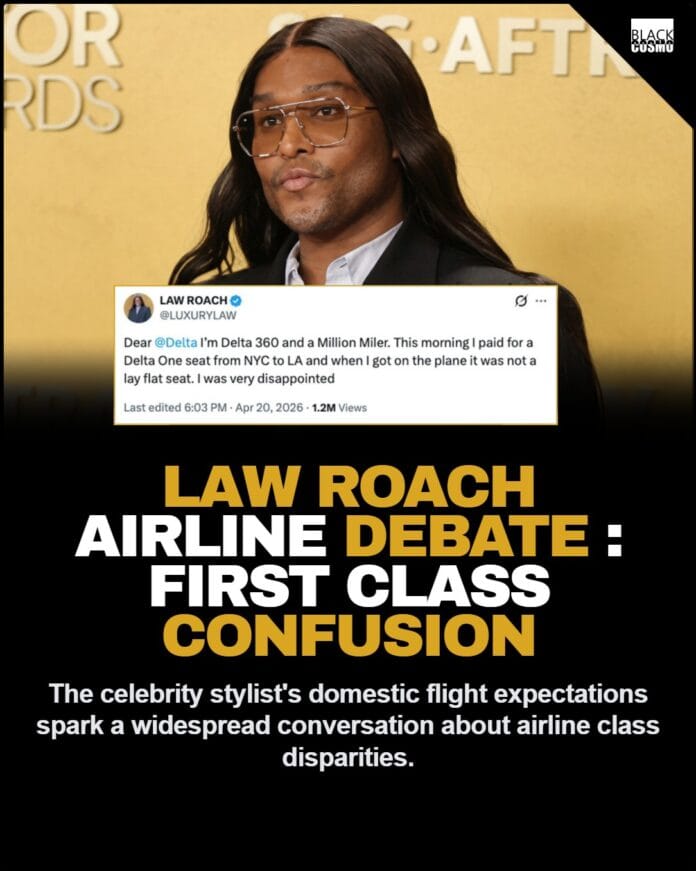
Chile, the internet is still buzzing! Our fave image architect, Law Roach, found himself at the center of a swirling social media storm after a recent travel experience. The tea? Apparently, there was a major misunderstanding about what constitutes “first class” on a domestic versus an international flight, specifically regarding those coveted lay-flat seats. And honey, the opinions are *strong* out here. A quick Google search for Law Roach and “Black Cosmopolitan” will show you just how much this has blown up.
Did Law, who’s used to styling A-listers and jet-setting around the globe, have a right to expect the full Delta One experience? Or was this a case of champagne wishes on a domestic beer budget? This whole situation surrounding how Law Roach navigated paying for first class has really tapped into a deeper conversation about class, privilege, and the often-opaque world of luxury travel. It’s like we’ve opened a can of worms, and everyone’s got something to say.
Let’s be real, airline ticketing is confusing AF. Even seasoned travelers get tripped up by the fine print. We often assume first class means the ultimate luxury experience, and while domestic first class offers perks like priority boarding, more legroom, and better snacks (hopefully!), it doesn’t always equate to the fully reclining, pod-style seats you find on international routes. We’re talking about the Delta One experience, the kind where you can sip champagne in your pajamas and arrive feeling like you just had a spa day. The catch? Delta One is usually reserved for those long-haul international flights, the ones that take you across oceans and continents. It’s easy to see how the confusion arises, especially when airlines aren’t always transparent about these distinctions. But as we know, the internet doesn’t always give grace.
Some folks are coming to Law Roach‘s defense, arguing that he simply made an honest mistake. After all, airline branding can be deliberately vague, designed to create a sense of luxury without actually delivering it. They argue that he’s a busy man, used to a certain standard, and a simple misunderstanding is understandable. Others, however, see this as a glaring example of celebrity entitlement. They believe that assuming a certain level of service, regardless of the actual offering, reflects a disconnect from the realities that most travelers face. It’s the perception that he thought his celebrity status would automatically guarantee the best of the best, regardless of the ticket he purchased.
The online discourse is a masterclass in contrasting viewpoints. You’ve got Team Law, who are pointing out the ambiguity of airline ticketing and the potential for genuine confusion. They’re saying, “Hey, it’s easy to assume you’re getting a certain level of luxury when you’re shelling out big bucks for a premium ticket.” Then you’ve got the critics, who are side-eyeing the situation and arguing that someone as well-traveled as Roach should know the difference between domestic and international first class. They see his perceived disappointment as a display of elitism, a further illustration of the chasm between the haves and have-nots. It’s a whole class war playing out in the comments section.
The truth, as it often does, likely lies somewhere in the middle. Maybe there was a genuine miscommunication on Law’s part, fueled by a life of experiencing top-tier travel. Or perhaps there was an unspoken expectation that didn’t align with the reality of the situation. Ultimately, this incident has highlighted the complexities and inconsistencies within the airline industry, and the often-fraught relationship between celebrities and the public’s perception of their lifestyles. The fact that Law Roach paid for first class and didn’t receive the *international* first-class experience he anticipated became a major flashpoint sparking discussions of classism.
But this conversation is bigger than just one flight. It raises broader questions about luxury travel, who gets access to these premium experiences, and the potential for miscommunication and misaligned expectations. It forces us to examine our own biases and assumptions about wealth, privilege, and the realities of travel in the 21st century. Airlines themselves bear some responsibility here. They need to be clearer about their class distinctions, providing more transparent information about what passengers can expect when they purchase a first-class ticket. Clearer communication could prevent these kinds of misunderstandings in the future, saving everyone a lot of headaches (and social media backlash). Ultimately, the Law Roach incident is a prime example of how social media can amplify even the smallest travel mishaps into a larger commentary on class, privilege, and the ever-evolving landscape of modern travel. It’s a reminder that even in the skies, perception is everything, and the internet never forgets.