
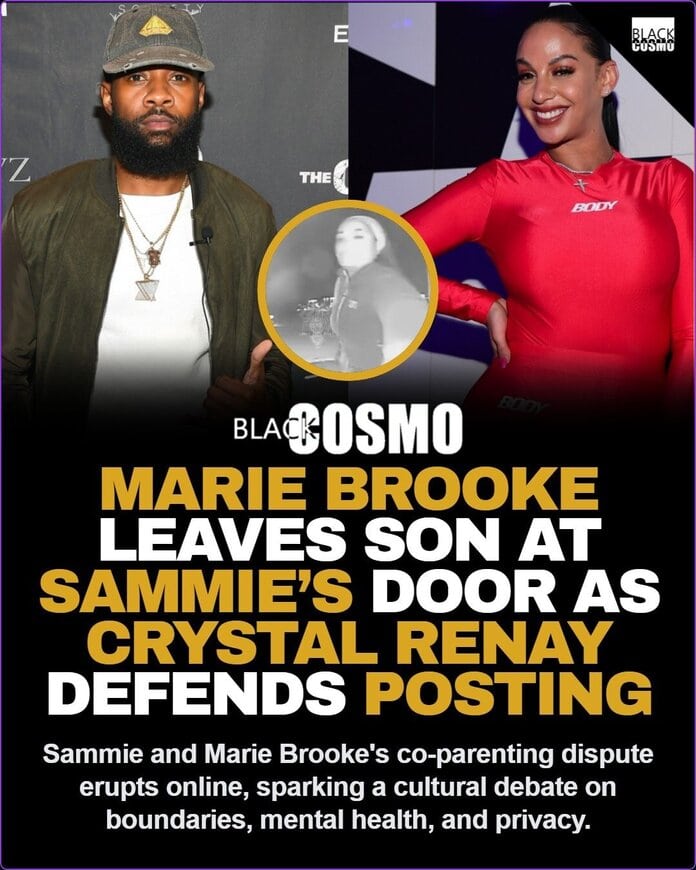
Marie Brooke Explains Leaving Her Son At Sammie’s Door As Crystal Renay Defends Posting Home Footage (Video below)
The situation escalated to a boiling point when Sammie was publicly accused by Marie Brooke of being an absentee father. In retaliation, his friend Crystal Renay (ex-wife of Ne-Yo) took to Instagram to defend him, releasing shocking home security footage. The viral video seemingly showed Marie Brooke dropping off the infant in a car seat on the singer’s doorstep in the middle of the night in freezing 38-degree weather, ringing the bell, and walking away. This explosive moment has forced the culture to examine the often-messy realities of modern domestic disputes.
The situation quickly became a classic public standoff, characterized by swift legal rebuttals and social media retaliation:
The Allegation: Marie Brooke publicly labels her ex as an unsupportive father who abandoned his responsibilities during a critical medical period for their infant.
The Legal Defense: Durante Partridge, the singer’s attorney, issued an exclusive statement shutting down the “deadbeat” claims, insisting his client approaches fatherhood with “care, intention, and consistency”.
The Retaliation: Crystal Renay enters the chat, posting the home security footage to vindicate her childhood friend of over two decades, stating: “YOU dropped your newborn son off in 38-degree weather on his front porch… and left”.
The Response: Sammie broke his silence, commenting that he tried to “save her” and “spare my son,” while Marie Brooke fired back, accusing him of weaponizing her postpartum depression.
The Weaponization of Social Media in Domestic Disputes
This escalating Sammie co-parenting drama highlights a disturbing trend in modern relationships: the weaponization of social media and home surveillance in domestic disputes. Ring cameras and home security systems, originally designed for safety, are now frequently used as tools for public vindication. When Crystal Renay released the footage, it shifted the narrative instantly. However, it also crossed a major ethical boundary regarding familial privacy.
In Black culture, the concept of “the village” is sacred. Traditionally, family disputes, especially those involving the well-being of a child, were handled within the confines of the home or through the mediation of elders. Today, the village has been replaced by the timeline. The court of public opinion is unforgiving, and the nuances of mental health—specifically postpartum depression—are often flattened into viral hot takes. Marie Brooke’s claim that her mental health struggles were being weaponized against her opens up a crucial dialogue about how we treat Black mothers navigating the immense pressures of early motherhood.
A Cultural Dialogue on Black Co-Parenting and Privacy
Why does this matter so deeply to Black culture? Because at the center of this digital tug-of-war is a five-month-old Black boy, Legend Lee Bush. The detrimental impact these public fallouts have on children caught in the crossfire cannot be overstated. When private co-parenting struggles are broadcasted to millions, the digital footprint lasts forever. One day, Legend will be old enough to search his name, and the first results will be the worst, most vulnerable moments of his parents’ relationship.
Furthermore, this incident forces us to examine the role of third parties in co-parenting dynamics. Crystal Renay’s intervention, while framed as an act of loyalty to a friend she’s known since the 6th grade, ultimately amplified a private crisis into global entertainment. Boundary-setting is paramount in blended families and co-parenting situations. When friends and extended family members insert themselves into the narrative, the toxicity inevitably multiplies, leaving the child as the ultimate casualty.
Moving Forward: Healing Over Hashtags
The overarching lesson from this Sammie co-parenting drama is the urgent need for offline healing. Co-parenting is inherently difficult; it requires laying down one’s ego, establishing firm boundaries, and prioritizing the child above all else. When domestic grievances are dragged into the digital public square, nobody truly wins. The likes, comments, and shares are fleeting, but the emotional damage inflicted on the family unit endures.
As a culture, we must demand better for our children. We must encourage mediation, therapy, and private resolution over public exposure. Black families deserve the grace to navigate their lowest moments with dignity, shielded from the unforgiving glare of the internet. True accountability does not require an audience; it requires the quiet, difficult work of putting the child first.