
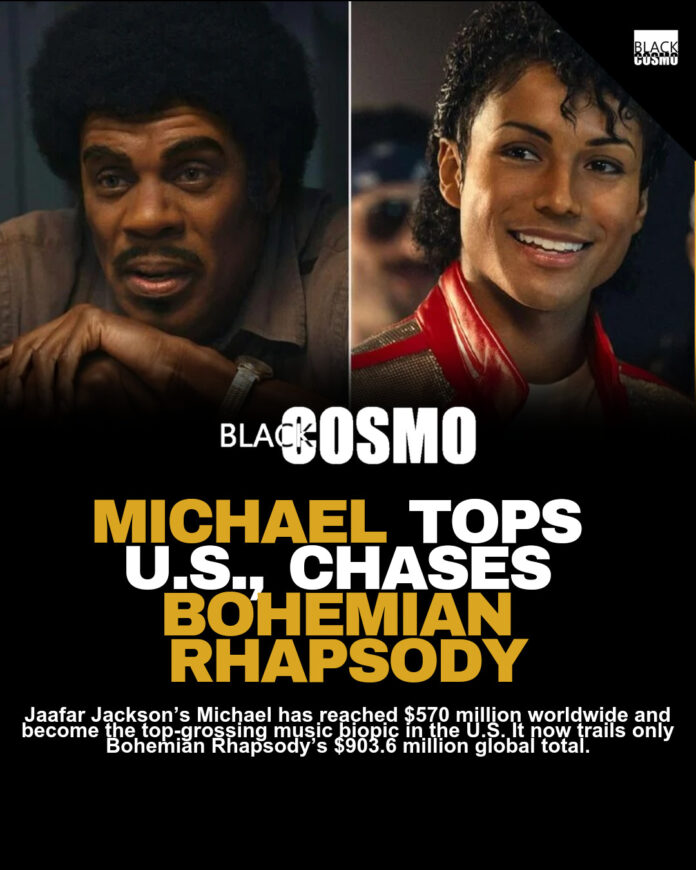
Michael is making serious box office history. The Jaafar Jackson-led biopic has now pulled in $570 million worldwide, putting it in rare territory as only the second music biopic ever to cross the $500 million mark. For a film centered on one of pop culture’s most influential and controversial icons, that kind of turnout says a lot about audience curiosity, star power, and the lasting reach of Michael Jackson’s legacy.
What makes the run even more notable is how strong the movie has been at home. In the United States, the film has earned $238.9 million, officially passing “Bohemian Rhapsody” to become the top-grossing music biopic domestically. That’s a major milestone, especially since its opening weekend nearly doubled the Freddie Mercury film’s debut. With a worldwide launch of $217 million and steady week-to-week holds, this has looked less like a quick nostalgia play and more like a full-scale event release.
There is still one crown left to chase. “Bohemian Rhapsody” remains the worldwide champ with $903.6 million, so the gap is still significant. But the race is not over yet. The biopic still has key international markets left to open in, including South Korea and Japan, and its relatively modest drop from its second to third weekend suggests solid word-of-mouth. If that momentum continues, the movie could keep closing the distance in a real way.
The financial picture is already clear, though. With a reported production budget of $155 million, the film has comfortably passed the usual profitability benchmark. Industry math often says a movie needs to make back roughly two to two-and-a-half times its budget to get safely into the black, and this one has done that with room to spare. Behind the scenes, the production also drew attention for reportedly changing its ending and reshooting material tied to the sexual abuse allegations that have long complicated public conversations about Jackson. That context makes the movie’s commercial success even more layered.
Even with all that momentum, the film did not take the top weekend spot, landing in third behind “The Devil Wears Prada 2” and the new “Mortal Kombat II.” Still, the bigger story is staying power. Box office wins like this do not happen by accident, especially in a crowded market where sequels, nostalgia properties, and family blockbusters are all fighting for space.
For Black audiences especially, movies like Michael hit differently because they sit at the crossroads of memory, music, celebrity, and cultural ownership. Whether people are showing up for the artistry, the mythology, or the debate, the response proves that stories tied to Black global icons still carry enormous power at the box office and in the culture.