
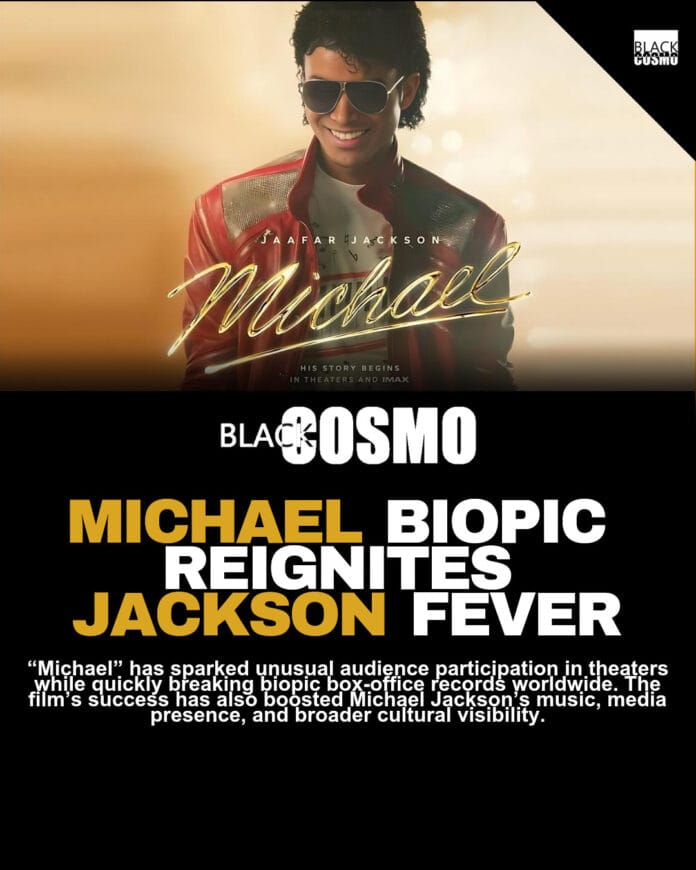


The response to Michael Jackson on the big screen has been unusually physical. People are showing up in theaters ready to sing, dance, and relive a catalog that has never really left public life. In some cities, that energy spilled into organized flash mobs. Inside cinemas, screenings of “Michael” have started to feel less like passive moviegoing and more like a shared pop-cultural ritual.
That helps explain why Michael Jackson remains such a singular draw. The new biopic, produced by Graham King and directed by Antoine Fuqua, was expected to do well. Few would have guessed it would hit with this kind of force. The trailer alone reportedly pulled massive global viewership after its February 2, 2026 debut, and the movie’s early box office numbers have put it in franchise territory, not just biopic territory.
There is a bigger cultural mood at work here too. Audiences are tired, distracted, and looking for something familiar that still feels grand. “Michael” arrives as a glossy piece of entertainment, but also as an escape valve. For a couple of hours, viewers get precision choreography, childhood ambition, superstardom, and songs embedded so deeply in popular memory they barely need introduction.
That kind of pull is rare. It is less about nostalgia in the simple sense and more about recognition. Jackson’s music still circulates across generations, across playlists, across dance studios, across wedding receptions. You do not need a curated reading list on pop history to understand his reach. You just need to hear the opening notes of a hit and watch what happens in the room.
The film’s success has already boosted the wider Jackson economy. Streams are up. Catalog sales are moving. Commemorative magazine issues are back on shelves. Broadway’s “MJ” is part of that renewed attention, as are estate-backed documentaries, stage productions, and posthumous releases. It is a reminder that Jackson’s legacy functions almost like its own media ecosystem.
And yes, some of the audience excitement has been fueled by spectacle. Moviegoers are dressing up, dancing in the aisles, and treating screenings like an event. That kind of behavior can sound gimmicky on paper, but in practice it speaks to how deeply this artist still lives in public imagination. Think less museum exhibit, more living archive.
There is also a specific thrill in seeing Jaafar Jackson take on the lead role. The family resemblance gets attention first, naturally, but the more interesting part is the work. By most accounts, he trained hard to capture the physical intensity the role demanded, and on screen he reportedly brings more than mimicry. Outside the film’s promo circuit, he has avoided turning himself into a full-time Michael replica, which is smart. It keeps the performance separate from the man.
Not everyone has been swept up without reservations. Critics have pointed out historical compressions and omissions, especially around Motown-era details and the shaping of the Jackson 5 story. Those objections are valid. Music biopics often trade precision for momentum, and “Michael” appears to do that in places. For viewers who care about the archival record, those choices can land like a wrong note in a spoken word performance, small but impossible to ignore.
Still, the movie’s commercial strength suggests that many audiences are not showing up for a fact-checking exercise. They are showing up for scale, emotion, choreography, and the pleasure of hearing songs that still feel hardwired into culture. That does not erase the more difficult parts of Jackson’s story, and it should not. But it does explain why the film has been largely critic-resistant.
Part of the fascination is that Jackson remains both omnipresent and unresolved. His influence on stagecraft, music video language, dance vocabulary, and artist branding is everywhere. Contemporary pop still borrows from his silhouette. His business instincts are studied too, right alongside the mythmaking. He sits in culture the way certain books do, whether they are Afrofuturism classics from an independent press or a hip hop biography everyone pretends they were first to discover. Foundational. Debated. Constantly reintroduced.
That is why claims that “Michael Jackson is back” miss the point a little. He never really left. His choreography still shows up in today’s stars. His short-film sensibility is now basic grammar for pop visuals. His style, somewhere between military tailoring and pure statement piece glamour, still echoes in stagewear, from the sharp lines of a tuxedo blazer to the flash of gold plated jewelry and Tom Ford sunglasses on a red carpet built to telegraph iconography.
There is a practical side to all this too. Legacy has become a business model in Hollywood, and “Michael” may be one of the clearest examples yet. Lionsgate has already indicated that follow-up material is well underway, with a second installment partially shot during production of the first. If the appetite holds, this could become a full-scale franchise around one entertainer’s life and afterlife in culture. That would have sounded excessive once. Now it sounds plausible.
What makes the moment interesting is not just the money. It is the way the film has reopened conversation about what audiences want from a biopic. Some want historical rigor. Some want emotional immersion. Some want both and rarely get it. With “Michael,” many viewers seem content to step into the fantasy for a night, then carry the music back home, where it settles into ordinary life again, somewhere between a cold brew in the kitchen, meal prep containers stacked in the fridge, and a late-night debate over what parts of the legend still belong to memory and what parts belong to marketing.
Messy, huge, unresolved. Very Michael.
★e★