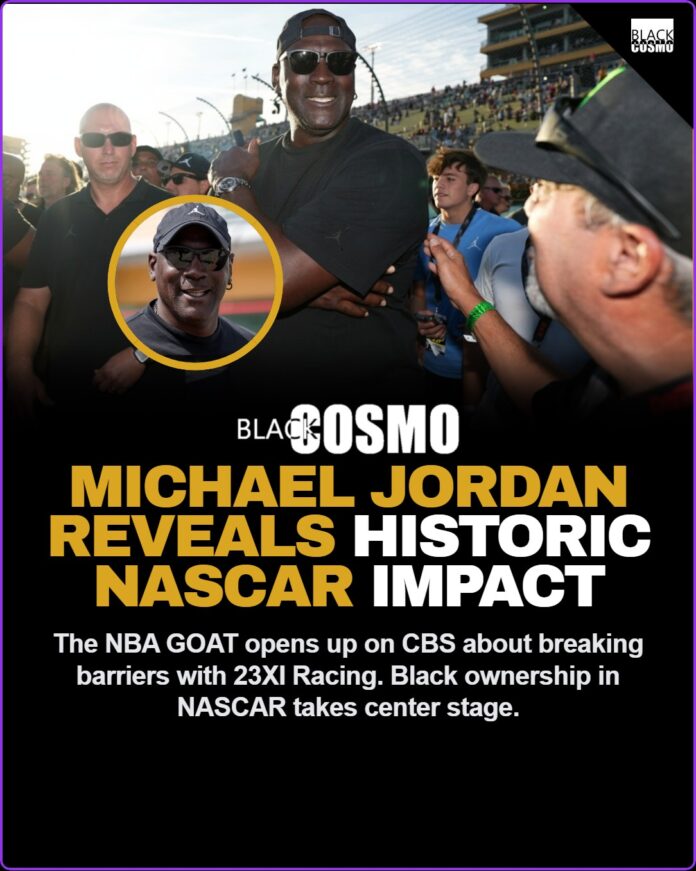
The sports world is witnessing another legendary chapter as Michael Jordan discusses his historic run. In a highly anticipated and deeply revealing CBS interview, the undisputed NBA GOAT broke down his unprecedented transition from the hardwood to the racetrack. His transformative role in the Michael Jordan NASCAR era marks a profound shift for Black representation and financial empowerment in historically white-dominated arenas.
Known globally for his unmatched basketball legacy and relentless competitive drive, Michael Jordan has fully embraced his latest challenge as the sole Black majority owner in stock car racing with 23XI Racing. This venture isn’t just about the thrill of speed or adding another trophy to his expansive collection; it is fundamentally about breaking racial barriers and asserting Black ownership where it has historically been ignored, suppressed, or entirely absent.
Breaking Barriers in a White-Dominated Sport
For decades, NASCAR has struggled with diversity. The legacy of Wendell Scott, the first African American driver to win a race at NASCAR’s highest level, stood as an isolated beacon of Black excellence in a sport deeply rooted in Southern white culture. Today, Jordan is taking up that mantle, not just as a participant, but as a power player at the ownership table. By forming 23XI Racing alongside Denny Hamlin, Jordan injected an unprecedented level of capital, visibility, and cultural relevance into the sport. He is challenging the status quo from the top down, forcing the motorsports world to adapt to a new era of inclusivity and diverse leadership.
During the exclusive CBS interview, Jordan spoke candidly about what it takes to navigate these uncharted waters. He detailed the systemic challenges he faced upon entering the sport and how his relentless pursuit of greatness—the exact same mentality that earned him six NBA championships—has been crucial in legitimizing his team. With drivers like Bubba Wallace behind the wheel, 23XI Racing has already shattered ceilings, proving that Black-owned teams can be fierce, undeniable contenders on the track.
Generational Wealth and Black Ownership
When examining the Michael Jordan NASCAR impact, it becomes evident that this move is a masterclass in building generational wealth and asserting economic dominance. Historically, Black athletes have been the labor force driving multi-billion-dollar sports industries, while the ownership suites remained devoid of melanin. Jordan’s transition from an athlete and brand ambassador to an NBA owner (formerly with the Charlotte Hornets), and now to a NASCAR majority stakeholder, serves as the ultimate blueprint for the modern Black athlete.
Ownership dictates the rules, controls the revenue streams, and determines who gets a seat at the table. By planting his flag in NASCAR, Jordan is opening doors for Black engineers, pit crew members, marketers, and executives. He is creating an entire ecosystem of opportunity that previously did not exist for African Americans in stock car racing. This is about structural change. It is about taking the capital earned through extraordinary athletic talent and leveraging it to buy the table itself.
The Intersection of Hip-Hop Culture and Motorsports
Beyond the financial and structural implications, 23XI Racing has successfully merged Black culture with NASCAR in ways that were once unimaginable. From custom Jordan Brand car wraps to partnerships with urban streetwear labels and hip-hop artists attending races, the cultural crossover is palpable. Jordan has made NASCAR “cool” to a demographic that had never previously paid attention to the Daytona 500 or the Cup Series. He is expanding the audience, bringing Black culture’s massive influential power into the paddocks.
In his CBS sit-down, Jordan emphasized that his legacy is no longer just about the fadeaway jumper or the iconic sneakers. It is about what he leaves behind for the next generation of Black entrepreneurs and sports enthusiasts. His drive to win in NASCAR is fueled by the desire to prove that greatness is transferable, and that Black excellence refuses to be confined to traditional spaces. The cultural significance of watching a Black-owned car cross the finish line in first place resonates far beyond the racetrack—it is a symbol of triumph, resilience, and unparalleled vision.