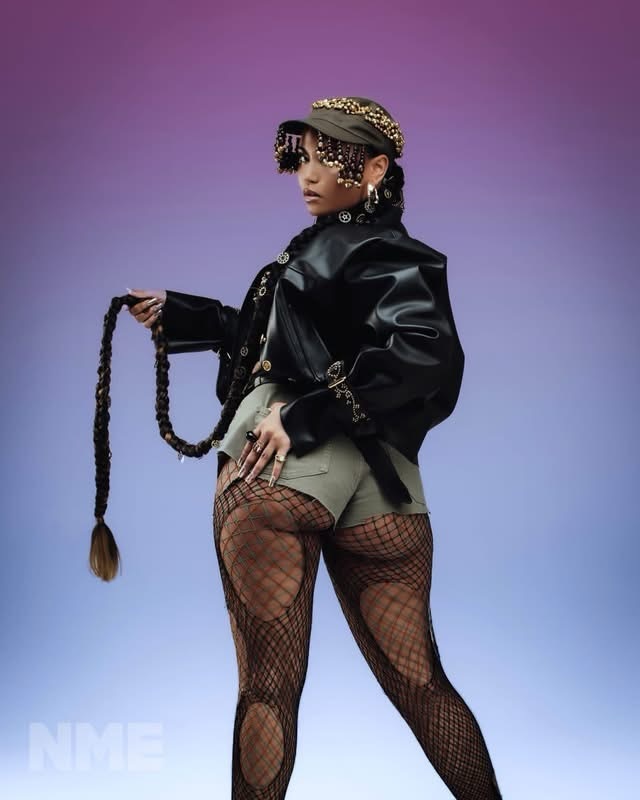

The timeline is exhausting right now. Between manufactured rollouts and hyper-curated aesthetics that feel more like marketing decks than art, a moment of visual quiet feels like a direct rebellion. Enter Moliy. For her latest feature in NME Magazine, penned by Kynnsian and captured through the lens of photographer Shotbynee, the alté provocateur bypasses the usual industry theatrics. She goes straight for the gut. There is no aggressive posturing here. No desperate grasp for virality.
Moliy sits in the liminal space of the golden hour, letting the natural elements do the heavy lifting. The photography mimics the texture of memory rather than the clinical perfection of a digital billboard. You can practically feel the late-afternoon heat radiating from the frame. The saturated, lens-shattering intensity bypasses a literal depiction of a subject. It moves directly into the realm of sensory memory. It represents that specific, fleeting frequency of youth where the world feels both infinitely large and claustrophobically intimate.
The music industry thrives on constant visibility. Artists today are expected to stay online, stay viral, and stay performing — even when the cameras are supposedly off. Every thought becomes content. Every emotion becomes branding. But what makes this NME editorial feel so striking is how completely it rejects that cycle.
She isn’t reaching for the viewer’s attention. In fact, she barely acknowledges it at all. Her gaze drifts away from the lens, her body folded inward as if we’ve interrupted a private moment rather than stepped into a carefully constructed photoshoot. There’s something beautifully unguarded about it. The slightly parted lips, the protective positioning of her arm, the way the sunlight settles unevenly across her skin — none of it feels over-directed. It feels lived in.
That restraint is what gives the image its power.
The styling team clearly understood that this was never meant to be a loud fashion moment. Stylist Elshhyy keeps things intentionally minimal, allowing the artist’s presence to carry the frame rather than overwhelming her with excessive accessories or heavy-handed concepts. A simple woven bracelet rests softly against her skin, grounding the softness of the image in something tactile and real. Makeup artist Simmi leans toward natural texture instead of perfection, letting the warmth of the light interact honestly with the skin. Even the hair, directed by Shamara Roper, moves freely — untouched by the stiff perfectionism that dominates so much of modern editorial imagery.
Together, the team created something increasingly rare: space for the artist to simply exist.
That’s what makes this collaboration with NME feel culturally significant beyond aesthetics alone. Historically, African artists entering Western editorial spaces have often been flattened into spectacle. The expectation was usually loudness — louder prints, louder styling, louder performances of identity that fit neatly into Western ideas of “African cool.” But this spread refuses all of that. Instead of performance, it gives us introspection. Instead of excess, it offers stillness.
Even the photography itself leans into imperfection. The lens flare, the softened focus, the visible grain — it all feels intentional. There’s a reason film-inspired imagery has returned so heavily across fashion and music editorials lately. People are exhausted by hyper-polished perfection. We crave texture now. We want images that breathe. Images that feel touched by human hands rather than processed into digital sterility.
This editorial understands that instinct perfectly. It doesn’t chase flawlessness. It chases feeling.
And emotionally, the image lands somewhere between exhaustion and longing. There’s a quiet melancholy woven through it — not sadness exactly, but the awareness that moments disappear while we’re still inside them. It captures that strange modern desire to slow life down before it slips away completely.
In an era where everyone is trying to dominate the timeline, this spread chooses silence instead. And somehow, that silence says far more.