
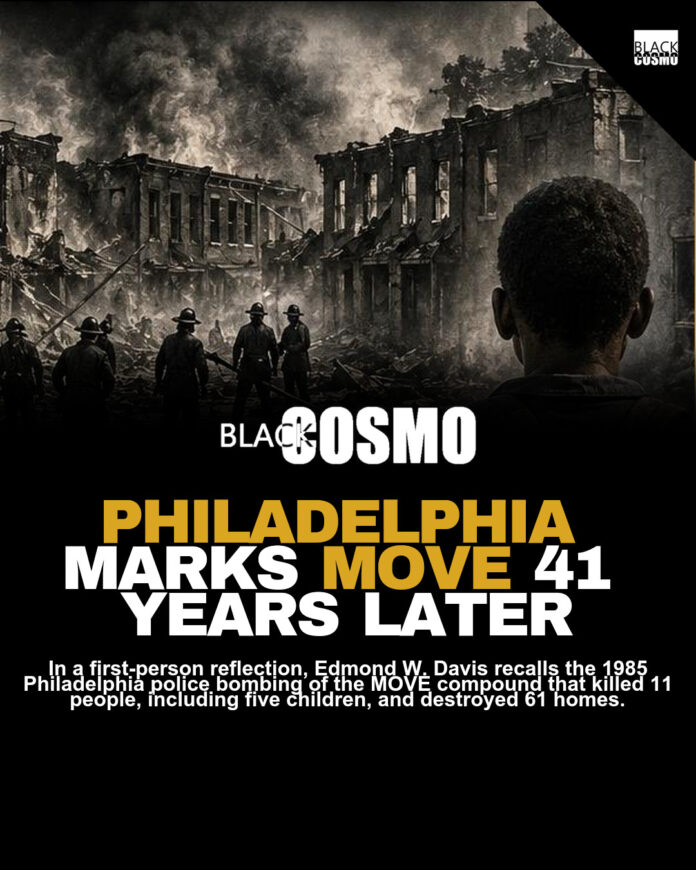
MOVE bombing still sits in American history like an open wound, and 41 years later it remains one of the clearest examples of what happens when state power turns violently against a Black community. What happened in Philadelphia on May 13, 1985 was not just a tragic police operation or a political failure. It was a residential neighborhood attacked by the city sworn to protect it, leaving 11 people dead, including five children, and 61 homes destroyed.
The original reflection from Edmond W. Davis makes that history feel immediate, not distant. Writing from the perspective of someone who was a 9-year-old in West Philadelphia at the time, he recalls the helicopters, the sirens, the fear in the air, and the reality of seeing his city transformed into a battlefield. That personal memory matters because too often this event is reduced to a quick mention in discussions about policing, race, or urban unrest, when in truth it deserves to be treated as a defining chapter in modern American state violence.
The confrontation centered on MOVE, a radical Black liberation and back-to-nature organization that had long been in conflict with Philadelphia officials. But whatever tensions existed, Davis makes the moral point plainly: no disagreement with a group justifies dropping an explosive device on a civilian block. The city’s decision, followed by the choice to let the fire spread, created devastation that still haunts Philadelphia’s public memory.
What makes this history especially painful is the absence of accountability. No one served criminal time for the deaths and destruction. The essay also places the event in a larger national pattern, connecting it to earlier episodes in which Black communities were terrorized, erased, and then pushed to the margins of mainstream memory. That framing is important because it resists the urge to treat Philadelphia as some shocking exception instead of part of a deeper American tradition.
Davis also raises the questions that continue to linger: who made the final call, why military-style tactics were used in a neighborhood, why the fire was not immediately stopped, and why this history still is not taught with the seriousness it deserves. Those questions are not just about the past. They speak directly to how cities narrate violence, whose pain is archived, and how Black families are expected to move on without real repair.
For BlkCosmo readers, the lesson of the MOVE bombing is bigger than commemoration. It is about refusing sanitized versions of history and insisting that public memory make room for truth, grief, and accountability. If a city wants to celebrate its pride, culture, and legacy, it also has to face the names, neighborhoods, and lives it failed.