The Oscars In Memoriam Black omissions conversation is back — and this year it stings more than usual because the Academy had every opportunity to get it right and chose not to. The 98th Academy Awards aired March 15 and opened its In Memoriam segment with Isiah Whitlock Jr. — a Spike Lee collaborator and character actor audiences genuinely loved. That opening felt intentional. It felt like the Academy was saying, “We see you.” And then the next several minutes made clear that they absolutely did not.
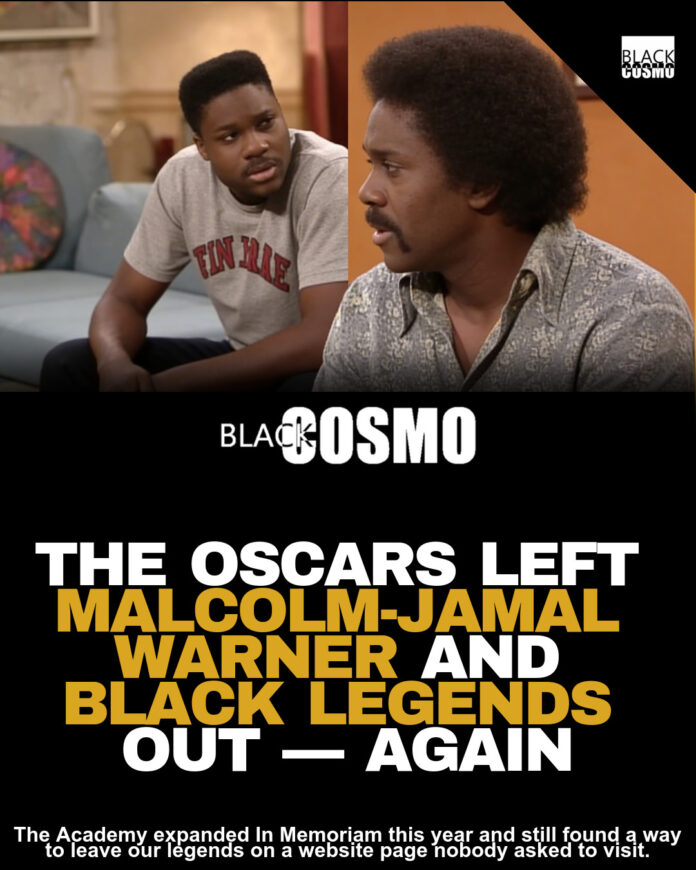
Malcolm-Jamal Warner — who played Theo Huxtable on one of the most culturally significant Black television series ever made and also appeared in films including Fool’s Gold — did not make the broadcast. Sanford and Son icon Demond Wilson did not make the broadcast. Blaxploitation actress Judy Pace, who passed away the very morning of the Oscars at 83, did not make the broadcast. Jazz legend and vibraphone pioneer Roy Ayers, actress and activist Lynn Hamilton, TV personality Ananda Lewis, and soul singer Angie Stone — all absent from the screen. All of them tucked quietly onto the Academy’s website. A digital footnote.
The “TV Work” Excuse Does Not Hold Up
Every year the Academy and its defenders reach for the same explanation: these names were left out because they were primarily television personalities, not film figures. The Oscars is a film ceremony. We get it. But that argument has a ceiling, and this year the ceiling collapsed.
Malcolm-Jamal Warner had film credits. Demond Wilson had film credits. The Academy’s own producers acknowledged going into this year’s ceremony that 2025 had been a devastating year of losses — so significant that they extended In Memoriam specifically to accommodate the volume. Extended it. And still, when the cameras rolled, the names that got cut were disproportionately Black. That is not a coincidence. That is a pattern. And the people in this audience have been watching this pattern for years.
In 2024, Lance Reddick and Ron Cephas Jones were left off the telecast. In 2025, horror icon Tony Todd was buried on the website. Now in 2026, it is Malcolm-Jamal Warner and Demond Wilson. At some point the pattern stops being an oversight and starts being a policy — whether the Academy intends it that way or not.
Who the Academy Made Room For
To understand what the omissions actually mean, you have to look at who did get extended tributes. Rob Reiner and his wife Michele Reiner received a full, personalized sendoff delivered by Billy Crystal. Robert Redford. Diane Keaton. Catherine O’Hara. Robert Duvall. These are respected artists, and their legacies deserve honoring. Nobody is arguing against that.
What the audience is asking — plainly, repeatedly, every single year — is why the math never seems to work out in the same direction for Black artists. The segment was expanded. The Academy had more time than usual. They made choices about who to feature with extended footage and who to shuffle off to a URL. And once again, the Black names clustered on the wrong side of that decision.
What These Names Meant to Black Culture
If you grew up in a Black household, Theo Huxtable was not just a TV character. He was the version of a Black teenage boy that the world finally got to see represented with nuance, humor, and a family that loved him without conditions. Malcolm-Jamal Warner put that on screen week after week and made it land. You do not get to claim you honor the film and television community and then quietly park his name on a webpage.
Demond Wilson gave you Lamont Sanford — a character who balanced warmth and humor and a complicated relationship with his father that resonated deeply with Black families across generations. Roy Ayers gave the world “Everybody Loves the Sunshine,” one of the most sampled records in hip-hop history. Angie Stone was a Grammy-nominated R&B powerhouse. Ananda Lewis was a face on your television screen representing Black women in media at a time when that representation was rare and meaningful.
These are not footnotes. These are pillars. And your community deserves to say that out loud every time the Academy tries to make them disappear into a website scroll.
The Accountability Has to Keep Coming
TheGrio, OkayPlayer, and Black Twitter moved fast on this story — and that matters. When the community documents these omissions in real time, names a pattern across multiple years, and refuses to let the Academy’s PR framing close the conversation, it forces a reckoning. It does not fix the problem overnight, but it makes the problem visible in ways that cannot be ignored forever.
The Oscars will be back next year. There will be another In Memoriam segment. There will be another round of decisions about who gets a moment on screen and who gets a hyperlink. What you do between now and then — talking about it, naming it, demanding better — is exactly the kind of cultural accountability that moves the needle. Even when it is slow. Even when it is frustrating. Keep going.