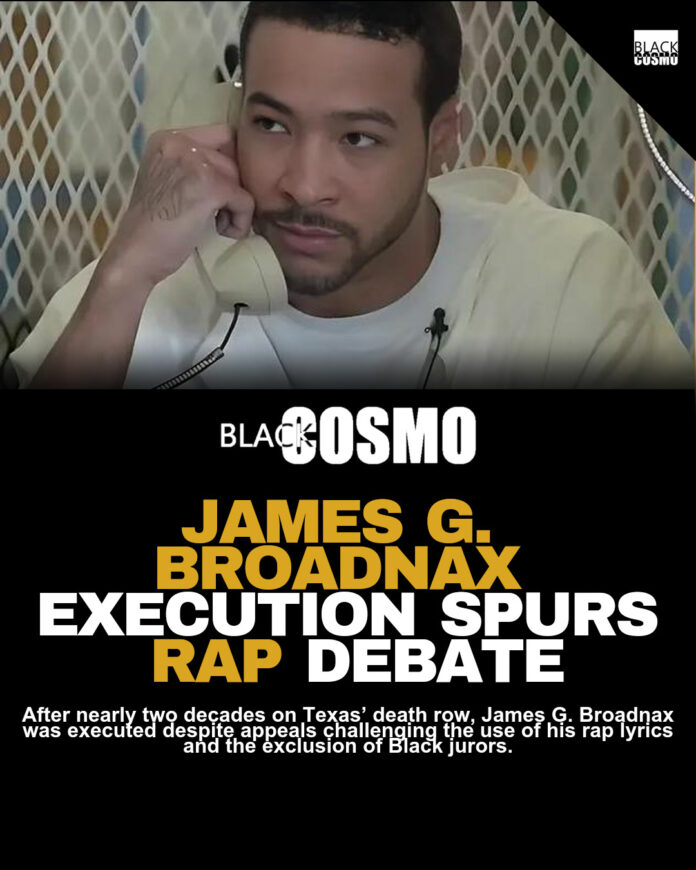
The execution of James G. Broadnax on April 30 has reignited urgent questions about race, art, and justice in America. After spending nearly two decades on death row in Texas, his case drew national attention not only because of last-minute appeals, but because prosecutors had used pages of his handwritten rap lyrics during sentencing to help argue for the death penalty.
Broadnax was convicted in 2009 by a nearly all-white jury in a robbery and double murder case tied to the 2008 killings of Stephen Swan and Matthew Butler in suburban Dallas. His legal team argued for years that Black jurors were improperly excluded and that presenting his lyrics as evidence of criminal mentality was unconstitutional. Those lyrics were not used to prove guilt in the original trial phase, but were shown during sentencing, where jurors were asked to decide whether he should live or die.
The case also gained new attention after a sworn 2026 statement from Broadnax’s cousin and co-defendant, Demarius Cummings, who said he was the one who pulled the trigger. Cummings had already been sentenced to life without parole and said he felt compelled to correct the record after learning the execution was imminent. Reports surrounding the case also pointed to DNA evidence that linked Cummings to the murder weapon and a victim’s clothing, while excluding Broadnax.
Scholars and advocates have long warned that rap lyrics are treated differently from other forms of creative expression in court. Violent imagery in film, fiction, or heavy metal rarely gets framed as a literal confession, but rap is often read through stereotypes that cast Black expression as inherently criminal. That double standard has shown up in hundreds of cases across the country, especially when prosecutors want to shape how juries feel about a defendant rather than what the evidence actually proves.
For Black audiences, this story lands in a familiar and painful place. It is about more than one trial or one verdict. It speaks to how Black art is still misread as autobiography, how bias gets dressed up as common sense, and how cultural misunderstanding can carry life-or-death consequences. The legacy of James G. Broadnax now sits inside that larger conversation, where the policing of Black expression remains deeply entangled with the policing of Black life.