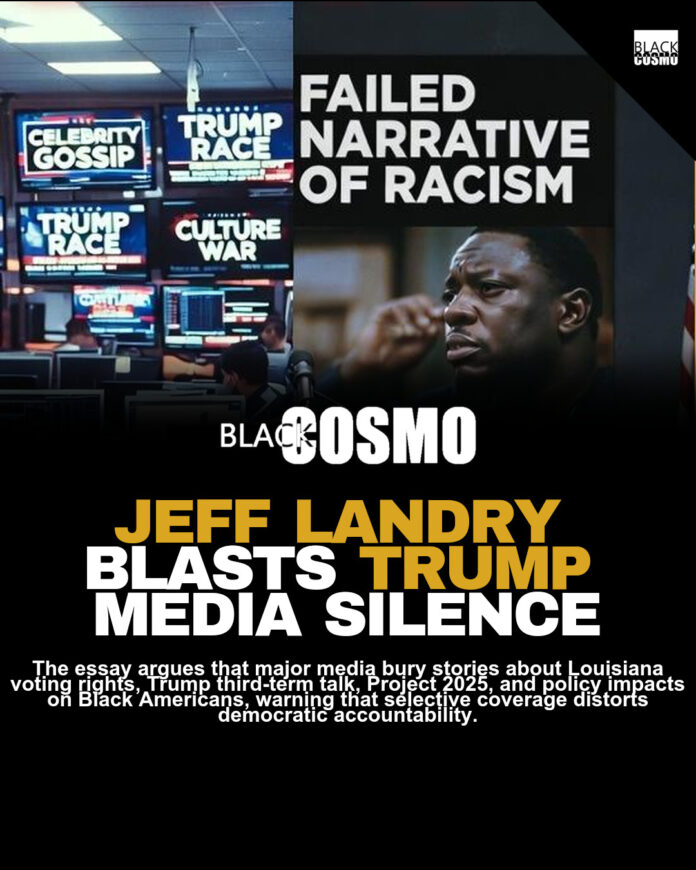
Edmond W. Davis is making a forceful case that America’s real media problem is not a shortage of information, but a pattern of selective attention that keeps some of the most consequential stories out of the center of public debate. In his commentary, he argues that while audiences are flooded with headlines every day, too many stories tied to democracy, race, and power get softened, sidelined, or buried altogether.
His piece points to several examples that he believes deserve far more national scrutiny. Among them are Louisiana Gov. Jeff Landry’s dismissal of racism as a “failed narrative,” efforts by Rep. Andy Ogles to introduce a constitutional amendment that could open the door to a Trump third term, and the broader political architecture connecting the 1971 Powell Memo to today’s Project 2025. Taken together, the argument is that these are not isolated news items. They are connected signs of how power organizes itself, shapes public conversation, and tests what the public will tolerate.
He also spends time on the long tail of institutional strategy. By tying the Powell Memo to decades of conservative policy planning, donor coordination, judicial influence, and media ecosystem building, the essay suggests that Americans are often encouraged to react to single moments instead of seeing the infrastructure behind them. That framing matters, especially for readers trying to understand why certain policy agendas seem to arrive fully formed, backed by money, messaging, and legal strategy long before election day.
Another major thread in the piece is the impact of Trump-aligned politics on Black communities. The focus is not just on rhetoric, but on policy outcomes involving voting rights, civil service changes, attacks on diversity efforts, education, and the weakening of civil-rights protections. The point is that these developments are often covered as separate issues, when in reality they can hit the same communities again and again in ways that are deeply structural.
What makes the commentary resonate is that it speaks to a feeling many Black and brown audiences already know well: not every silence is accidental, and not every buried story is unimportant. Edmond W. Davis is essentially asking readers to think harder about who decides what becomes urgent, what gets normalized, and what disappears before it ever becomes a real national reckoning. For a BlkCosmo audience, that question lands close to home, because media visibility has always been tied to whose lives, history, and political reality are treated like they matter.