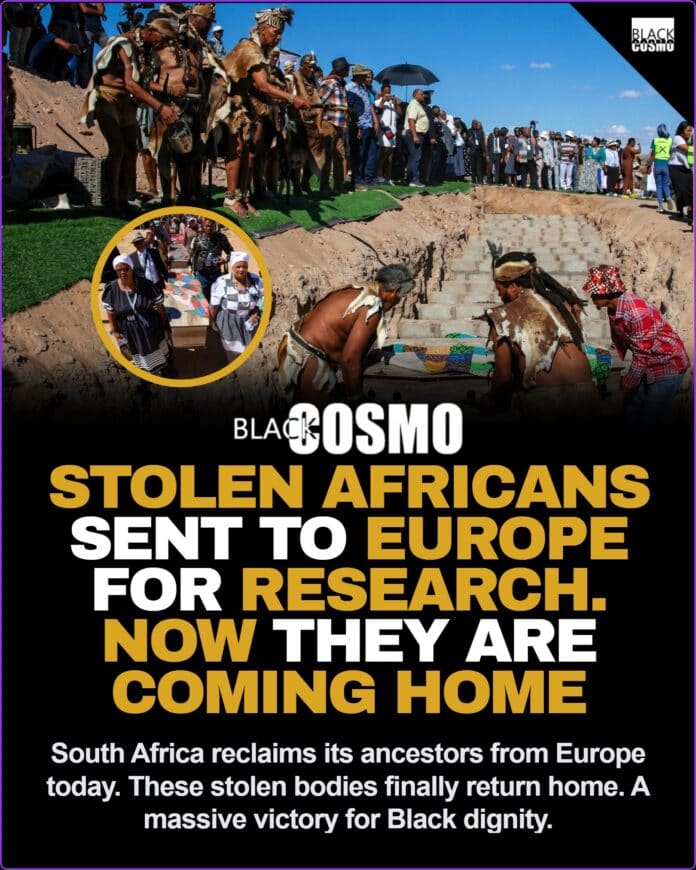
In a deeply emotional and long-overdue ceremony today, South Africa reclaimed a stolen piece of its soul. After decades—and in some cases, over a century—of being held captive in European and local institutions for grotesque, racist scientific research, the Khoi and San remains were finally laid to rest in their ancestral soil. The somber yet triumphant reburial took place at the historic Kinderlê Monument in Steinkopf, Northern Cape, marking a defining moment for the African diaspora. South African President Cyril Ramaphosa officiated the sacred event, standing alongside descendant communities, traditional leaders, and government officials to welcome these ancestors home. This is not merely a historical correction; it is a profound reclamation of Black dignity and a powerful act of restorative justice.
Speaking with unwavering resolve, Cyril Ramaphosa condemned the historical atrocities that treated human beings as mere specimens. He highlighted that the exhumation and export of these bodies were deeply rooted in European racial superiority and scientific racism. During the late nineteenth and early twentieth centuries, colonial forces ruthlessly dug up graves, tearing ancestors from the earth to trade, study, and display them in Western museums. The President emphasized that this repatriation is a crucial step toward healing the deep wounds inflicted by colonialism and apartheid, restoring the fundamental humanity that was brutally stripped from these indigenous people in life and death.
The ancestral Khoi and San remains of these sixty-three individuals represent a fraction of the thousands of Indigenous bodies illegally removed during colonial conquest. Five individuals, along with sacred heritage objects like plaster face-casts and a smoking pipe, were repatriated from the Hunterian Museum at the University of Glasgow in Scotland following intense negotiations that began in 2022. The remaining ancestors had been stored locally at the Iziko Museums in Cape Town since the 1920s. For the Khoi and San people—the earliest inhabitants of southern Africa—this dark chapter is a visceral reminder of land dispossession, cultural erasure, and unimaginable violence. Yet, today’s ceremony at Kinderlê, a site tragically known for the 1867 massacre of Nama children, transforms a landscape of sorrow into a sanctuary of peace, reconciliation, and profound spiritual closure.
Why does this matter so deeply to Black culture worldwide? Because the desecration of the Khoi and San remains is emblematic of a broader, systemic exploitation that has plagued the African diaspora for centuries. Western institutions built their wealth, prestige, and so-called scientific advancements on the literal backs and bones of Black and Indigenous bodies. From the tragic exhibition of Sarah Baartman to the countless unnamed ancestors hidden in the archives of European universities, the commodification of African bodies was designed to uphold a global hierarchy of white supremacy. By demanding and securing the return of our ancestors, South Africa is sending an unequivocal message to the world: our bodies are sacred, our history is ours to protect, and our dignity is non-negotiable.
This victory is deeply rooted in the African philosophy of Ubuntu—the recognition of our shared humanity. As descendant communities guided the reburial process, ensuring that every cultural and spiritual protocol was honored, they demonstrated the unyielding resilience of African traditions. The Northern Cape Reburial Task Team and various Khoi and San cultural groupings played an indispensable role in providing oversight, proving that true restorative justice cannot be dictated by former colonizers; it must be led by the affected communities. This grassroots leadership is a blueprint for other nations and marginalized groups fighting to reclaim stolen artifacts, sacred objects, and human remains from Western museums.
Ultimately, the repatriation of these ancestors serves as a rallying cry for the ongoing fight against colonial exploitation. While the return of sixty-three individuals is a monumental triumph, the struggle is far from over. Thousands of bodies and priceless cultural artifacts remain imprisoned in foreign display cases and storage vaults. Today’s historic reburial empowers the global Black community to continue demanding absolute accountability and full restitution. We honor these ancestors not just by returning them to the earth, but by fiercely continuing their resistance against erasure. Their spirits can finally rest, knowing that their descendants have reclaimed their legacy and fortified the unbreakable foundation of global Black excellence and pride.