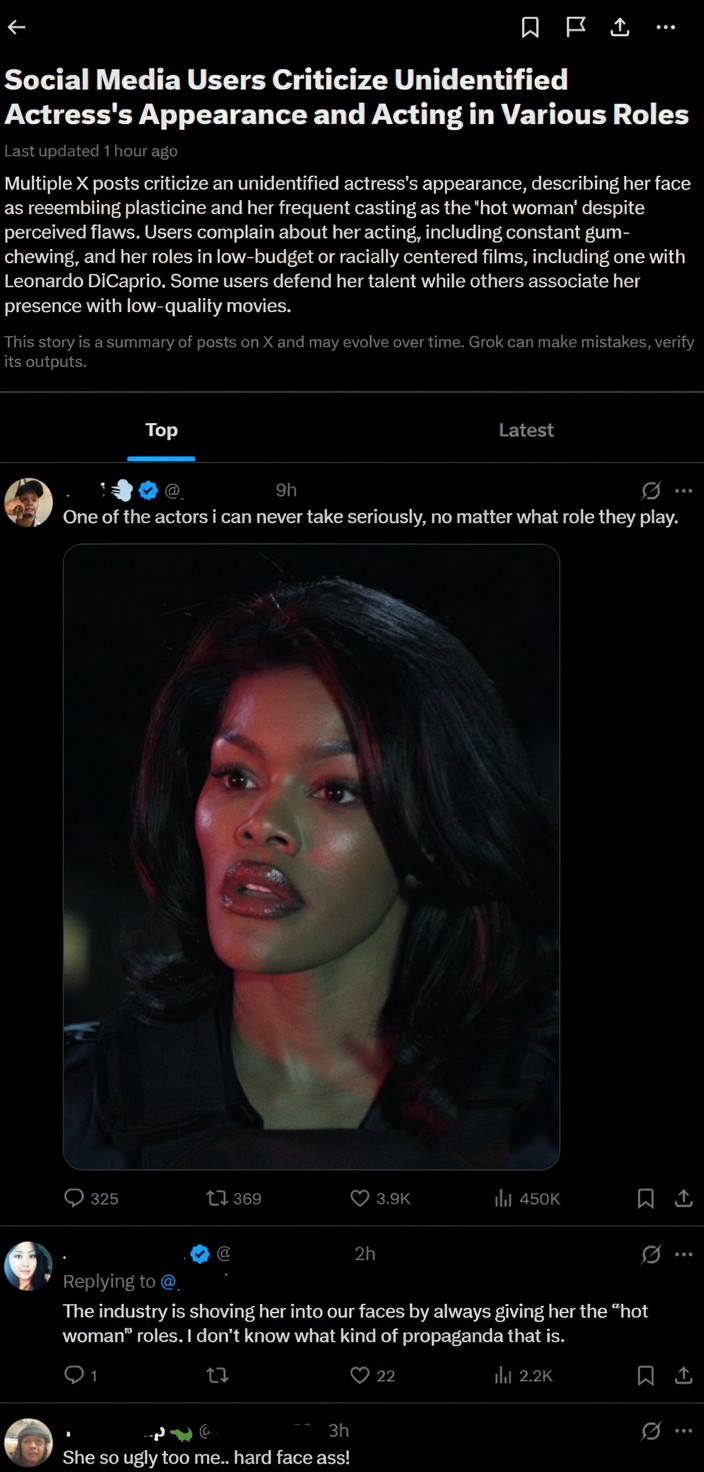

The internet is once again proving that a Black woman’s success cannot exist without relentless, unprovoked scrutiny. Discussions surrounding Teyana Taylor have dominated timelines recently, with users dissecting her every move, facial expression, and film choice. Despite winning her first Golden Globe for her performance in Paul Thomas Anderson’s One Battle After Another, Teyana Taylor finds herself at the center of a heavily polarized debate. This sudden wave of Teyana Taylor acting criticism has morphed a season of celebration into a masterclass on how society polices women of color in elite Hollywood spaces. From complaints about her on-screen characterizations to bizarre grievances over her real-life joyous reactions, the discourse has become exhausting.
To understand the sheer absurdity of the situation, we have to look at the recent 2026 Academy Awards. The acclaimed star was nominated for Best Supporting Actress, ultimately losing to Hollywood veteran Amy Madigan. Instead of sitting with a stoic, disappointed face, she immediately leaped from her seat to give Madigan a wildly enthusiastic standing ovation. Later in the evening, when her film won Best Picture, she happily embraced her director. Almost instantly, Twitter became a warzone. Critics called her behavior extra, dramatic, and shockingly, ghetto. Some users claimed she was doing too much and acting inappropriately for a prestigious environment like the Oscars. This Teyana Taylor acting criticism quickly expanded from her roles to her off-screen personality, forcing us to ask: why is a Black woman’s genuine joy and sportsmanship viewed as a threat?
Beyond her awards season etiquette, the detractors have also zeroed in on her filmography. Twitter users have flooded comment sections to complain about her past roles in what they unfairly categorize as low-budget or racially centered films. Many pointed to her hilarious, meme-worthy debut as a gum-smacking, nagging baby mama in Tyler Perry’s Madea’s Big Happy Family, using it to undermine her current dramatic prowess. The constant gum-chewing critique even resurfaced recently when she was spotted at the Golden Globes animatedly chatting with co-star Leonardo DiCaprio. She later laughed off the viral moment, jokingly explaining that they were both just chewing their invisible gum and enjoying the night. Yet, for her fiercest online critics, these petty moments are weaponized as evidence that she lacks the refinement expected of a leading Hollywood actress.
Even her critically acclaimed role as Perfidia Beverly Hills in One Battle After Another hasn’t escaped the vitriol. Some audiences have accused the film of oversexualizing her, claiming her character is merely an embodiment of fetishized misogynoir. However, she has fiercely defended the role against this specific wave of Teyana Taylor acting criticism. She reminded audiences that Perfidia is a complex woman battling postpartum depression who uses her sexuality as a weapon for survival in a male-dominated world. As the actress bluntly put it, people often overlook the harsh realities of what strong Black women endure, expecting them to be perfectly manicured victims rather than flawed, multidimensional survivors.
When you combine the complaints about her enthusiastic Oscars celebrations, the policing of her body and roles, and the elitist sneering at her cultural roots, the core issue becomes glaringly obvious. The so-called constructive feedback is heavily masked misogynoir. Black women in the entertainment industry are historically expected to shrink themselves, be grateful just to be in the room, and perform a palatable version of modesty that doesn’t upset the status quo. By refusing to conform to these rigid, Eurocentric standards of decorum, she has made herself a target for those who are unsettled by her unyielding authenticity.
Ultimately, the ongoing Teyana Taylor acting criticism reveals far more about the public’s internalized biases than it does about her talent or character. She is a multifaceted artist—a director, choreographer, and award-winning actress—who has seamlessly transitioned from R&B stages to the silver screen. Whether she is delivering raw, emotional performances in A Thousand and One or joyously celebrating her peers at the Dolby Theatre, she remains unapologetically true to herself. The real problem isn’t her gum-chewing, her acting, or her energy; it’s a society that still hasn’t learned how to handle a Black woman who knows her worth and refuses to dim her light for the comfort of others.