
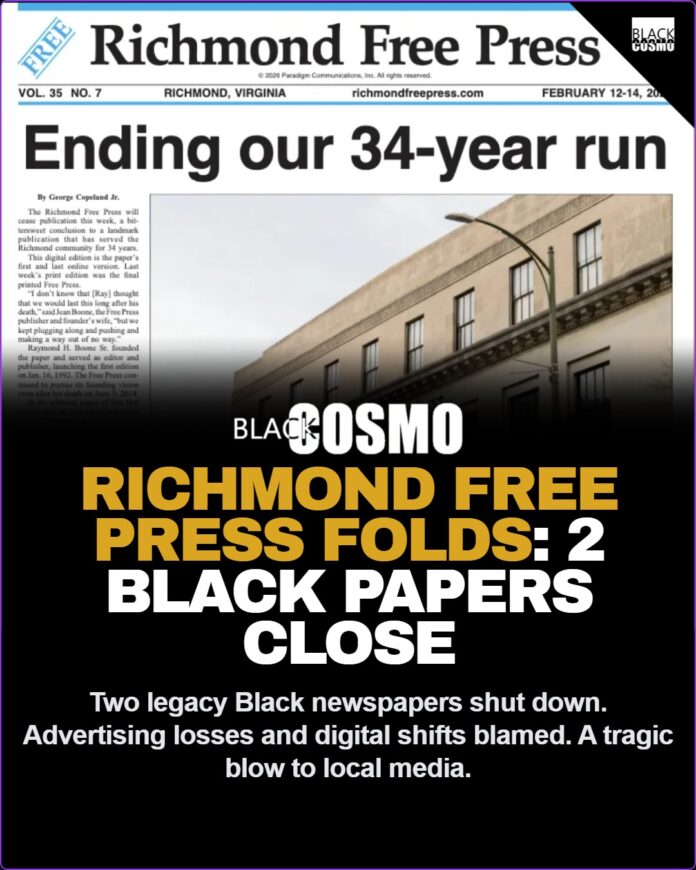
In February 2026, the media landscape suffered a devastating blow as two legacy Black newspapers close, citing insurmountable financial pressures. Among these historic publications is the Richmond Free Press, a pillar of African American journalism in Virginia that has served its community faithfully for 34 years. Alongside the Portland Skanner, which operated for half a century in Oregon, these simultaneous closures signal a deepening, nationwide crisis within independent, minority-owned local journalism.
The sudden shutdown of the Richmond Free Press highlights a broader, troubling trend affecting community media across the United States. Founded in January 1992 by Jean Patterson Boone and her late husband, Raymond H. Boone Sr., the publication had long been a vital voice against injustice in the former capital of the Confederacy. However, rapidly changing media consumption habits, dwindling print advertising revenues, and a challenging economic climate ultimately forced both esteemed news organizations to end their decades-long runs, leaving their respective communities without trusted watchdogs.
The Storied History of Two Media Giants
Both publications held profound historical significance in their regions. In Virginia, Raymond Boone left his position as a journalism professor at Howard University to establish a paper that would champion the First Amendment for all citizens, especially those marginalized by mainstream, pro-segregationist media. Following his passing in 2014, Jean Boone courageously continued the mission, keeping the publication alive alongside a dedicated staff. Under her leadership, the free weekly paper remained a steadfast defender of civil rights, holding local officials accountable and preserving the everyday history of Black neighborhoods, churches, and civic organizations.
Meanwhile, on the West Coast, Bernie and Bobbie Dore Foster launched the Portland Skanner in 1975. For nearly five decades, it stood as one of Oregon’s only Black-owned publications. It valiantly transitioned to a digital-only format in 2023, attempting to adapt to the modern era. Yet, as Bernie Foster recently explained, the rapid and unforgiving changes in technology and content distribution made survival impossible. When iconic institutions like these legacy Black newspapers close, decades of institutional memory, cultural preservation, and fearless advocacy vanish overnight.
Financial Pressures and Systemic Inequities
The primary catalyst for these heartbreaking shutdowns is a drastic collapse in advertising revenue. In a heartfelt farewell message on Instagram, Jean Boone stated unequivocally, “We know for sure that we do not have the advertising support to continue.” She noted that major advertising agencies and corporate sponsors have increasingly shifted their budgets toward large-revenue, national platforms, effectively leaving small, weekly community papers on the cutting room floor.
Furthermore, structural inequities continue to plague the industry. Despite temporary spikes in corporate diversity pledges following the racial justice movements of 2020, much of that financial momentum has evaporated. A recent government report highlighted that Black-owned media receives only a minuscule fraction of federal advertising dollars—a staggering 14% of the $14.9 billion budget is allocated to small disadvantaged businesses overall, with Black media securing the lowest share. According to leaders at the National Newspaper Publishers Association (NNPA), more than 200 of their 250 member outlets are currently experiencing severe financial distress, suggesting these recent closures are merely the tip of the iceberg.
A National Crisis in Local Journalism
The demise of these esteemed institutions is not happening in a vacuum. It is part of a catastrophic national pattern. Since 2005, the United States has lost nearly 3,500 newspapers, resulting in over 270,000 lost journalism jobs. Today, tens of millions of Americans live in expanding “news deserts”—regions completely devoid of reliable, localized reporting. Esosa Osa, founder and CEO of Onyx Impact, a nonprofit focused on Black communities, called the recent shutdowns “heartbreaking,” emphasizing that the loss of two foundational publications in a single month is completely unacceptable.
These closures represent far more than the end of business operations; they signify the loss of a civic lifeline. Black newspapers have historically filled critical gaps in coverage, reporting on housing inequities, educational disparities, and voting rights with a perspective that mainstream outlets often overlook. They function as living archives, preserving the monumental achievements and everyday history of neighborhoods, fraternities, sororities, and small businesses. When these presses stop rolling, local governments face less scrutiny, and marginalized voices lose a powerful megaphone that has historically galvanized civil rights movements.
Looking Ahead: Can the Black Press Survive?
Despite this grim reality, the fight for community journalism is far from over. The Black Press has survived the era of Jim Crow, the turbulence of the civil rights movement, and the initial shockwaves of the digital revolution. However, combating the modern platform economy will require aggressive reinvention. Industry advocates are calling for diversified revenue models, enhanced philanthropic support, and a renewed commitment from local communities and advertisers to invest in independent media before more heritage institutions are erased.
While the physical pages of these two specific outlets may no longer circulate, their profound impact on American journalism and civil rights remains indelible. Their archives will continue to educate future generations about the enduring struggle for equality and representation. As publishers, reporters, and readers navigate this challenging landscape, the tragic reality that we are watching legacy Black newspapers close must serve as an urgent wake-up call. Preserving the vital tradition of the Black Press is not just about saving newspapers; it is about safeguarding democracy, truth, and community empowerment for generations to come.