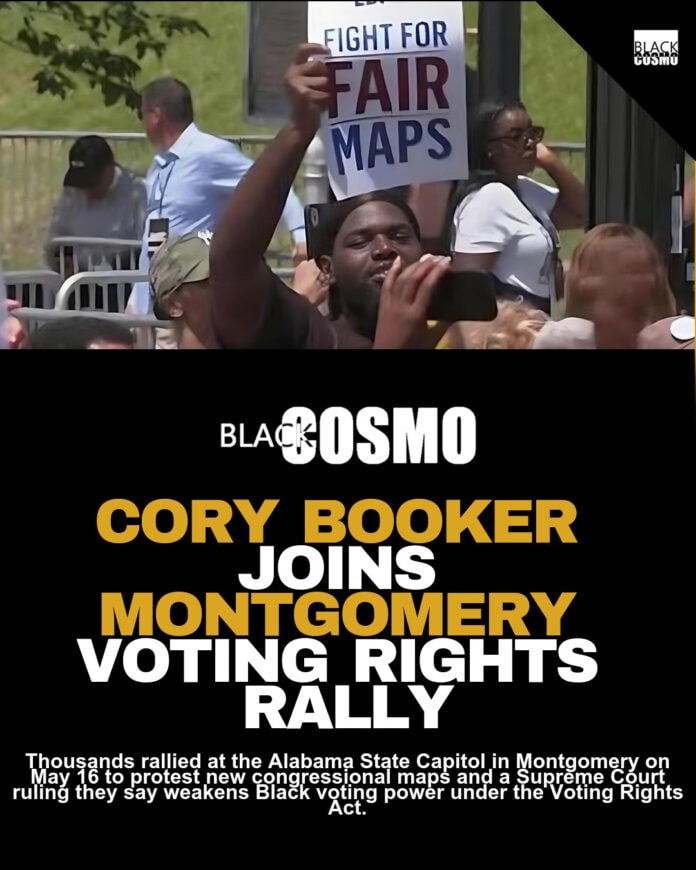
On May 16, 2026, All Roads Lead to the South turned Montgomery, Alabama, into a powerful gathering place for people demanding that voting rights remain protected. Thousands showed up outside the Alabama State Capitol, a site layered with the history of both the Confederacy and the civil rights movement, to protest new congressional maps and a recent Supreme Court decision that critics say weakens Black political representation.
The energy of the day was rooted in both memory and urgency. Demonstrators packed the streets with signs calling for fair maps and equal access to the ballot, while speakers reminded the crowd that this was not just about one state or one election cycle. With live music, faith leaders, and chants rising through downtown Montgomery, the event carried the spirit of a mass civic call to action rather than a routine protest.
Senator Cory Booker delivered one of the day’s most talked-about speeches, calling the city “sacred soil” and warning that civil rights gains are never guaranteed. Organizers and attendees connected the moment to the long fight that brought the Voting Rights Act into existence in the first place. The protest came after a Supreme Court ruling in late April that opponents say opened the door for states to redraw districts in ways that dilute Black voting power, especially across the South.
Alabama’s 2nd Congressional District sat at the center of much of the concern. A federal court had previously ordered a map that gave Black voters a fairer chance to elect a candidate of their choice, but the legal landscape shifted after the high court’s ruling. That change has fueled deep anxiety among voting rights advocates who see the latest redistricting battles as part of a broader attempt to roll back hard-won representation.
Online reaction reflected just how divided the country remains on these questions. Supporters framed the demonstration as a necessary defense of democracy, while critics dismissed it as partisan theater. Still, the scale of the turnout made one thing clear: for many Black voters and allies, this fight is deeply personal, tied to history, power, and the right to be fully counted in American life.
What made All Roads Lead to the South resonate so strongly is that it tapped into something bigger than a single rally. It reminded people that the struggle over voting rights is never just legal language on paper; it shapes whose voices matter, whose communities are heard, and what democracy actually looks like for Black America.