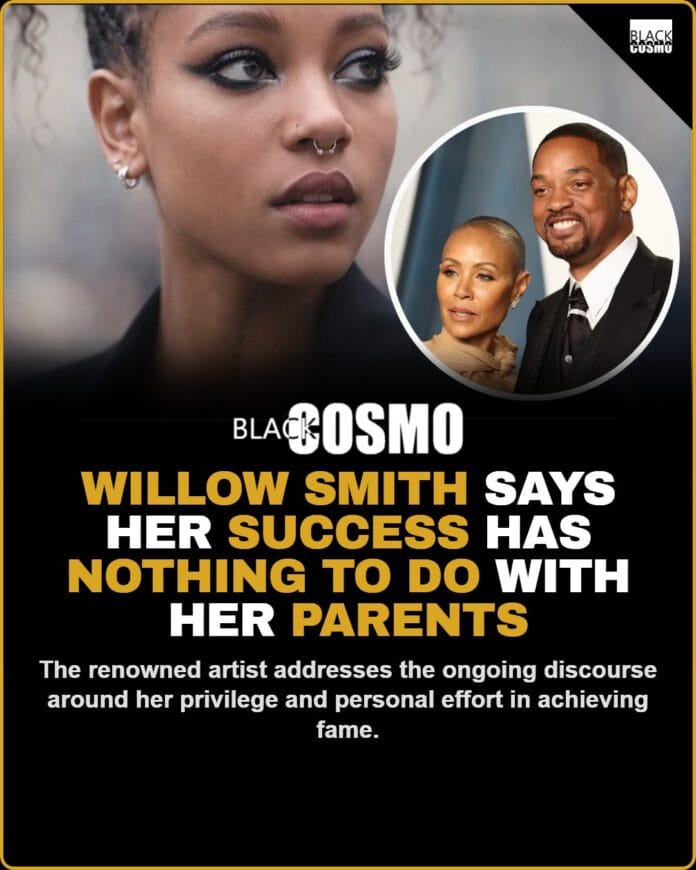
Willow Smith is once again at the center of the ‘nepo baby’ discourse, as the renowned artist openly confronts the perception that her success is solely tied to the fame of her renowned parents, Will Smith and Jada Pinkett Smith. In a candid interview, Willow addresses the ongoing debate, asserting that her achievements stand on their own merits, despite the privilege that came with her lineage.
The ‘nepo baby’ debate has been raging on, with many questioning the role of family connections in the entertainment industry. Willow acknowledges that the perception of her privilege has followed her for years, even fueling her work ethic. However, she now says she no longer feels the need to prove anything, confident that her artistry and talent have earned her rightful acclaim.
Willow’s comments have once again divided opinions, reigniting the discussion around where privilege ends and personal effort begins. Some argue that Willow’s success is undeniably facilitated by her famous parents, while others applaud her for owning her journey and dismissing the ‘nepo baby’ label.
As the daughter of two of the most recognizable figures in pop culture, Willow has certainly benefited from the spotlight and resources that come with her family legacy. However, she has also carved out her own distinct path, establishing herself as a versatile and acclaimed artist in her own right. From her music career to her forays into acting and fashion, Willow has consistently demonstrated her creative prowess and unwavering work ethic.
The ‘nepo baby’ debate is far from over, and Willow’s perspective adds another layer to the ongoing discourse. By acknowledging her privilege while also asserting her own merits, she invites us to consider the nuances of success and the complex relationship between opportunity and personal agency.
Ultimately, Willow’s journey serves as a reminder that talent, dedication, and authenticity can transcend the limitations of familial connections. As Black Cosmopolitans, we are drawn to stories that celebrate individual excellence and challenge preconceived notions of success. Willow’s candid reflections on her experience contribute to this vital conversation, inviting us to re-examine our own biases and perspectives.
![[gold]Marlon Wayans[/gold] discusses [gold]Druski's[/gold] viral comedy skit](https://blkcosmo.com/wp-content/uploads/2026/04/gold-marlon-wayans-gold-discusses-gold-druski-s-go-696x870.jpg "Marlon Wayans Reacts To Druski’s Viral Skit")