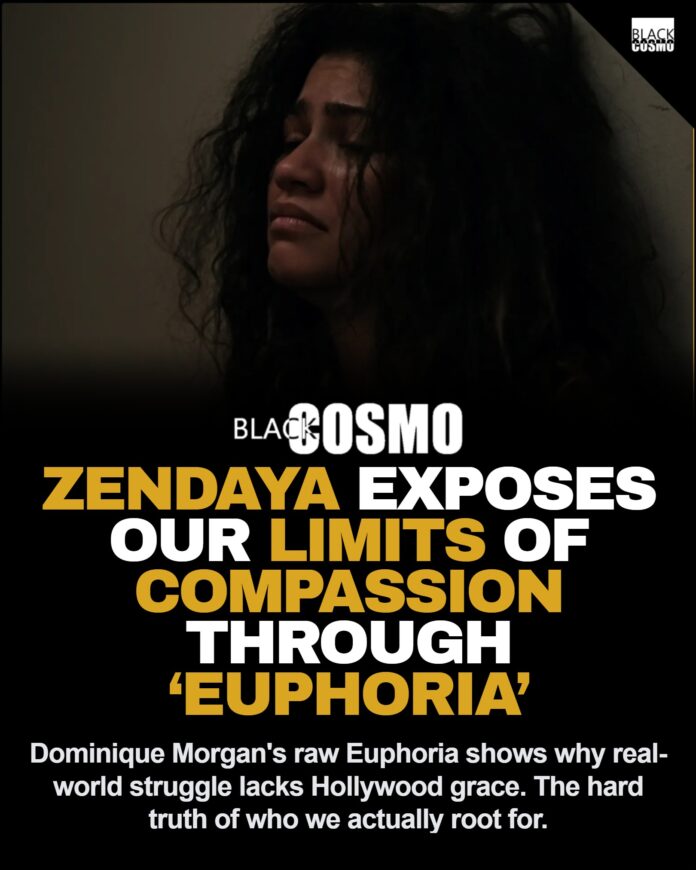
The heavy debate surrounding the series finale of Euphoria has laid bare some uncomfortable truths about how we extend grace, exposing the strict limits of our compassion when dealing with real-world struggle. For days, viewers have argued intensely over the fate of Rue Bennett, the young protagonist who spent the series navigating profound grief, trauma, and a deeply fractured reality. Many viewers passionately rooted for her recovery, desperate to see her find peace and a happy ending. But this collective hope raises a difficult question: were we actually rooting for a complex, struggling Black girl, or were we simply charmed by the star power of Zendaya?
This is the central point raised by writer Dominique Morgan in an op-ed for MadameNoire. Morgan suggests that we easily imagine redemption when the pain is packaged inside an actress as beloved as Zendaya. Her portrayal of Rue has earned massive acclaim, often styled off-screen in curated luxury fashion that elevates her status. Yet, the op-ed points out that in the real world, the grace we offer to a beautiful, televised figure is rarely extended to the woman standing in a local methadone line. When the cameras turn off, the limits of our compassion become starkly visible.
To ground this bias, Morgan draws a sharp contrast between how history remembers Elvis Presley and Whitney Houston. Presley is remembered as a tragic genius who struggled with his demons. His addiction is treated as a sorrowful footnote to his career. Houston, on the other hand, is routinely reduced to a cheap punchline. Some people still casually refer to her with derogatory slurs before they ever speak of her unmatched talent as Whitney Elizabeth Houston. This disparity speaks volumes. We possess a culturally coded tier of who deserves empathy, and Black women are historically placed at the very bottom of that list.
Real life does not offer the clean edits of a cable drama. In the real world, addiction is inconvenient, exhausting, and repetitive. Morgan shares her own painful history, reflecting on her childhood when her grandmother and aunt arrived unexpectedly to pull her mother outside. Her mother was crying, and within days, she entered rehab. Morgan describes her mother as a superhero, not because she was flawless, but because she loved deeply while surviving things she never should have had to face. Her personal history exposes why the neat, linear redemption narratives we crave are so dangerous. We want people to fall down exactly once, learn their lesson, and recover. But human healing is messy, filled with relapses and setbacks that try the patience of those around them.
Harm reduction teaches us that judgment does not heal. When a person struggles with substance use, public patience quickly wears thin. Grace is initially extended, but it quickly hardens into frustration, then anger. Soon, the only tools left are distance, boundaries, and consequences. For Black women navigating this path, the fallout is devastating. They are scrutinized under a microscope, their pain consumed as media fodder rather than treated with genuine care. The public loves to watch the spiral, but they rarely want to do the heavy work of support. We must ask ourselves why we demand perfection before we offer protection. True empathy means expanding the limits of our compassion when things get ugly.
If Rue Bennett were a real person in your neighborhood, many of those who cried during the finale would have ignored her on the street. They would have locked their car doors or turned their heads in disgust. True empathy requires looking past the screen and offering grace to those who do not have a camera crew capturing their sorrow. We must expand the limits of our compassion to include the fully human, flawed people in our actual communities, especially the Black women who are so often left to save themselves.
Culture Picks for the Thoughtful Reader
To dive deeper into these complex themes of resilience and identity, we highly recommend exploring curated Black literature that centers the lived experiences of Black women.
For those moments when you need to disconnect and quietly reflect, these soft home essentials help build a peaceful sanctuary.
And if you want to lose yourself in the rich, emotive sounds of a series soundtrack, invest in high-fidelity active noise cancelling headphones to elevate your listening experience.