
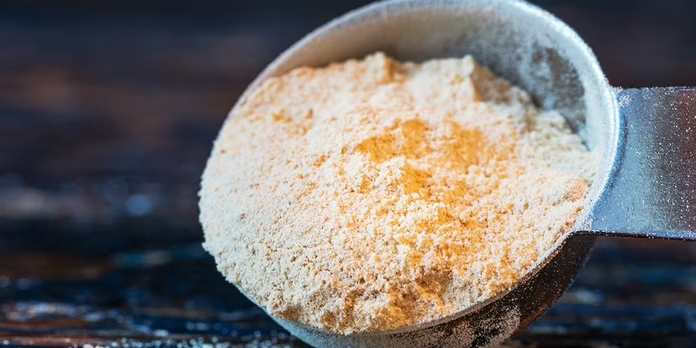
Maca root has quietly become one of those wellness staples that seems to show up everywhere, from smoothie powders to supplement aisles. The Peruvian plant, often called Peruvian ginseng, has a long history in the Andes as both food and traditional medicine. Now Maca root is being sold as an energy booster, fertility aid, and general health add-on, which makes it worth separating the marketing from the actual science.
That gap matters. A lot of wellness trends get packaged with the same polished language, whether they belong in a curated reading list about cultural meditation and ancestral roots or on a kitchen shelf next to your cold brew setup and meal prep containers. For people trying to figure out if Maca root is genuinely useful or just another powder in the mix, the answer is a little more measured than the hype suggests.
Here’s the clearer version of what this supplement is, what researchers think it may do, and what it probably won’t do.
What is maca root?
It’s a plant.
Dietitians describe maca as a cruciferous vegetable, in the same broader family as broccoli and Brussels sprouts. It grows in Peru and looks a bit like a turnip or beet. Nutritionally, it contains iron, potassium, calcium, amino acids, and other vitamins and minerals.
Most people encounter it in powdered form, which makes it easy to mix into smoothies, oatmeal, nutrition bars, or baked goods. It also comes in capsules and extracts. In practical terms, it fits into the same everyday routine as a portable espresso habit, a milk frother obsession, or any other small ritual people build around feeling a little more put together.
What are the health benefits of maca root?
There’s promise, but not proof.
Maca contains plant compounds including glucosinolates, sterols, polyphenols, and flavonoids. Researchers have looked at it for possible anti-inflammatory, antioxidant, and even anti-tumor effects. The catch is that much of that work has been done in animals or in lab settings, not in large, high-quality human studies.
The same caution applies to fertility and libido claims. Some research in men has shown modest improvement in seminal concentration, while other studies found little meaningful difference in sperm measures or hormone levels. So if you’ve seen maca presented as a miracle fix, that’s a stretch. At this stage, the evidence is still developing.
That doesn’t make it useless. It just puts it in a more realistic category: a nutrient-dense plant with interesting early data, not a guaranteed shortcut. Wellness culture loves a statement piece, whether that’s a tuxedo blazer, Tom Ford sunglasses, or a supplement with a dramatic reputation. Science usually moves slower than the branding.
What are the risks of maca root?
So far, it appears to be well tolerated.
Current research has not flagged serious adverse effects in humans, and maca has been consumed for generations. That said, “generally safe” is not the same as “for everybody.” If you take medication or have a health condition that could be affected by dietary changes, checking in with a doctor or registered dietitian is still the smart move.
That kind of caution may not sound glamorous, but it’s the part wellness coverage often skips. Real health advice is rarely as flashy as Y2K fashion, designer handbags, or the latest affordable luxury dupe. It’s usually more basic than that.
Should you supplement with maca root?
The short answer: maybe, but keep your expectations in check.
No supplement is going to overhaul your health on its own. A balanced diet, sleep, movement, and stress management still do the heavy lifting. If your eating habits are already solid, maca may be more of an optional add-on than a necessity.
If you want to try it anyway, standard supplement doses are often listed around 1,500 to 3,000 milligrams. Powdered maca root and water- or ethyl acetate-based extracts are common forms. Look for products that are third-party tested so you know the label matches what’s actually in the container.
That’s really the takeaway. Maca root isn’t a miracle, and it doesn’t need to be. For some people, it may be a simple addition to a broader routine, right there between the bamboo cutting board, the fridge organizer, and whatever health habit they’re actually able to maintain.
Perri O. Blumberg is a New York City-based writer with a background in psychology and culinary education. Her work has appeared in outlets including Rolling Stone, Oprah Daily, Men’s Journal, Insider, Architectural Digest, and Southern Living.
★f★