
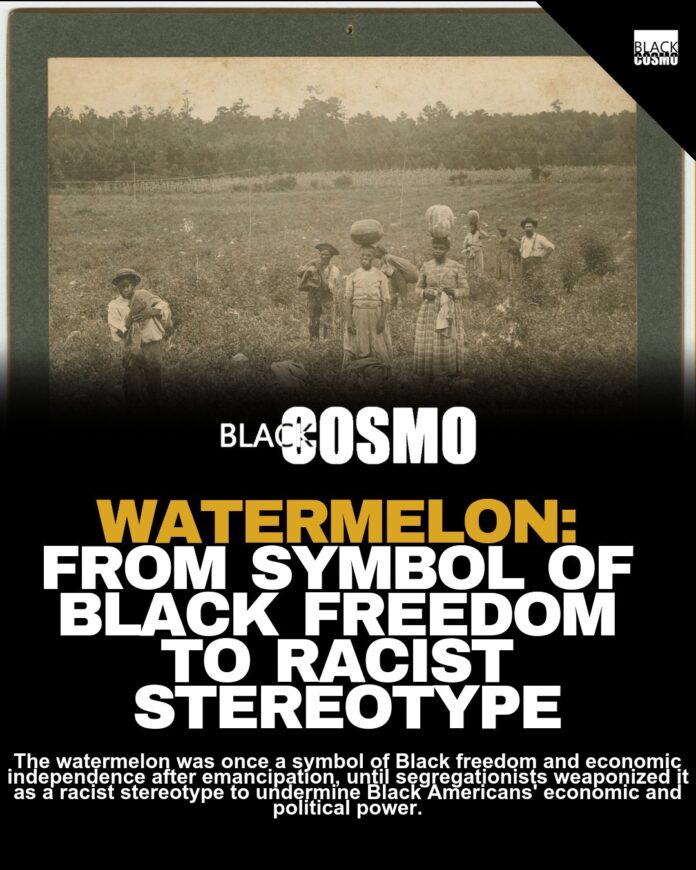
July is officially National Watermelon Month—a U.S. Senate-approved celebration of one of summer’s favorite fruits. But behind those family backyard barbecues lies a piece of history that textbooks left out. Long before watermelon was hijacked and weaponized as a racist stereotype, the fruit was actually a powerful symbol of Black freedom and economic independence.
Watermelon was first domesticated in Africa thousands of years ago and became prized for its ability to store water in brutal heat. The fruit arrived in the U.S. South in the 17th century when enslaved Africans brought seeds during the Trans-Atlantic slave trade. While working under oppressive conditions, enslaved people relied on watermelon for essential nutrients and hydration. After emancipation, everything changed. The fruit became a vehicle for self-reliance as newly freed Black Americans began growing and selling watermelons on their own land.
Black farmers became the nation’s largest producers of watermelon, according to the Southeastern African American Farmers Organic Network. The fruit had become a symbol of their freedom. That terrified white communities.
Sensing a loss of control, segregationists launched a deliberate propaganda campaign. They reframed the very tool of Black financial autonomy into a derogatory stereotype, one designed to suggest Black people were unfit for citizenship. The caricature painted Black people as “lazy,” “criminal,” and “simple creatures” who could be “satisfied” with nothing more than a slice of melon.
Popular culture in the 19th century became flooded with anti-Black propaganda to cement the narrative. “Frank Leslie’s Illustrated Newspaper” published one of the earliest documented caricatures of Black people eating watermelon in 1869. That sparked a wave of degrading “coon postcards” and toys that spread the poison further.
The film industry followed suit. Edison Studios released short silent films like “Watermelon Contest” (1896) and “A Watermelon Feast,” which depicted Black men uncontrollably devouring the fruit. The cultural messaging served a malicious purpose: dehumanize Black Americans and falsely paint them as too simple-minded to deserve basic voting rights.
The racism didn’t stay in the past. In 2009, less than two months into Barack Obama’s first term as president, Dean Grose, the mayor of Los Alamitos, California, sent an email from his personal account depicting watermelons instead of Easter eggs on the White House lawn. After complaints and an apology—where he claimed ignorance of the racial stereotype—he resigned.
The disrespect continued during Obama’s second term when the Boston Herald ran a controversial cartoon by Jerry Holbert. The drawing showed the nation’s first Black president brushing his teeth in a White House bathroom while a white intruder asked, “Have you tried the new watermelon-flavored toothpaste?” The newspaper initially doubled down, issuing a statement supporting Holbert’s “utmost integrity.” Later, Holbert himself admitted he “really did it wrong” and apologized for not thinking it through.
But decades of propaganda couldn’t erase deeper heritage. In the rural South, especially Mississippi, the Black community’s connection to watermelon endures as a celebrated tradition.
In Mississippi, that love has been famously immortalized on the cover of B.B. King’s iconic 1970 album, “Indianola Mississippi Seeds,” where a guitar is fashioned from a ripe melon. Every summer, Mize, Mississippi, hosts its annual watermelon festival with seed-spitting showdowns, eating contests, and hunts for the state’s heaviest melon. About 50 miles northwest in Jackson, the city celebrates its annual Fourth of July Watermelon Classic 5K.
“Watermelon is the pinnacle of Black agrarian legacy. It makes our land a portal—not just soil, but memory, spirit, and resilience,” the Southeastern African American Farmers Organic Network wrote on its website, describing the organization’s 2025 Watermelon Convergence. “Gatherings like this reclaim watermelon from the grip of racist caricature. That alone is a chapter in our story of how we got over.”
★TR★