
Black women in Mississippi have long been ahead of the curve in seeing what it takes to create systems in this country that work for the greater good rather than the privileged few. From Fannie Lou Hamer, who forced the nation to confront the violence of disenfranchisement, to Ida B. Wells, whose fearless journalism exposed America’s racial terror, they have never waited for permission to name the truth. They have been at the forefront of national change for generations, and we should be listening to them now, because the next chapter of this country will depend on whether we finally build policies that help people not just survive, but thrive.
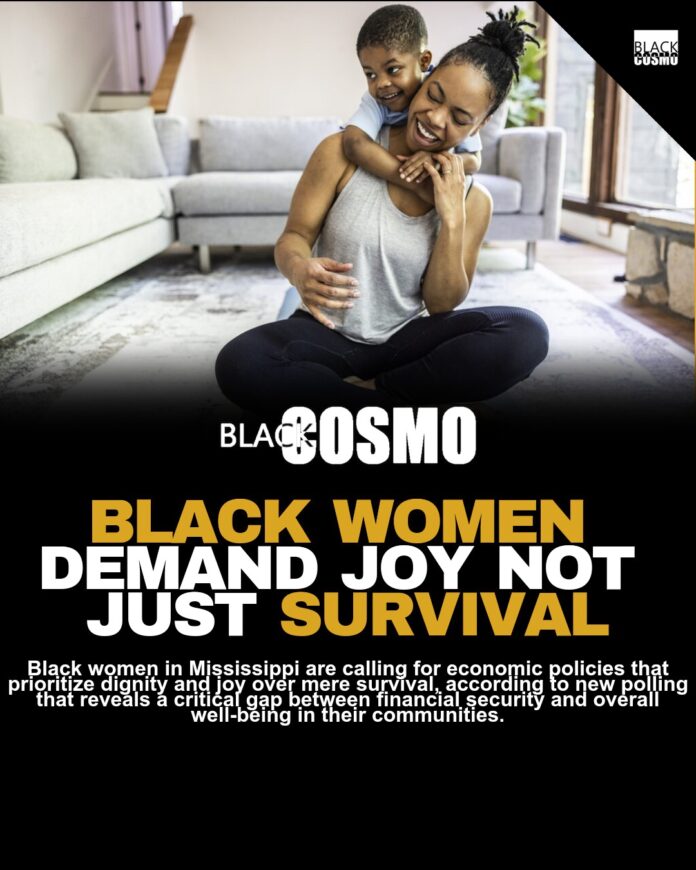
New polling from Springboard to Opportunities, The Highland Project, and Brilliant Corners Research Strategies shows what Black women in Mississippi are actually asking for. A staggering 90 percent of respondents say that economic conditions are worsening, and more than half report that their income is not keeping pace with the rising cost of living. They are not asking for extravagance. They are asking for breathing room. They want policies that help them live with dignity, take care of their families and create space for success alongside joy. The distinction matters, because when we talk about economic security only in terms of jobs, wages and spreadsheets, we miss what people are actually trying to build: a life that feels whole.
One of the most revealing findings is that having enough money to live comfortably scores higher for joy than for success. That may sound counterintuitive, but it makes deep sense. For Black women who are falling behind financially, money is not mainly about status. It is about peace of mind. It is about not having to choose between a student loan payment and groceries, between a child’s needs and your own rest, between making it through the week and making it through the month.
In other words, respondents are naming a gap between the life they feel they should live and the life that would actually make them feel good. That gap is narrowest around family and faith, the anchors of their lives. It is widest around money, where financial stability is more urgently tied to joy than to success, and around personal pursuits, which are seen as joyful but not always treated seriously.
These insights should reshape how we think about policy. Programs that provide economic relief are not simply meeting material needs. They are creating the conditions for joy. They are reducing stress, restoring dignity and making it possible for women to breathe without the toxic and constant weight of financial worry. If we want families to thrive, policy has to do more than keep people just barely above water. And we know that when Black women thrive, they never do so alone.
Like so many seemingly intractable problems in this country, the solutions exist, but the political will does not. More than two-thirds of those polled say lawmakers do not listen to Black women when designing assistance programs. That should not surprise us. Black women have long been expected to carry their families, their communities and this country’s conscience through their political activism without being centered in the decisions that affect their lives. Too often, policy is built around harmful narratives: that people are poor because they did not work hard enough, budget well enough or want success badly enough.
But many Black women know better because they live the truth every day. A mother working for $7.25 an hour cannot simply “work harder” into financial stability. No amount of grit or elite-level budgeting can erase wages that do not cover rent, food, transportation, childcare or the other costs of raising a family. What Black women need is not more blame and unrealistic expectations. They need fair wages, direct support, affordable access to child care and systems that trust them to know what their families need.
The data also makes clear that too many women feel disrespected by our current systems of support. Forty percent said they felt disrespected navigating the social safety net, a figure that should trouble anyone who believes public programs should serve people with dignity. Any other system with a “D” grade would be considered a failure, and our leaders should pay close attention to the lived experience of those who actually use public benefits. When women must jump through endless hoops to get help, when paperwork replaces compassion and when systems treat need like a moral failure, the harm is not just administrative. It is emotional, spiritual and generational.
There are antidotes to the problem. Springboard to Opportunities runs the Magnolia Mother’s Trust, the country’s longest-running guaranteed income program, giving monthly cash payments to low-income Black mothers with no strings attached, along with support for planning and connection to community resources. It is a powerful example of the kind of policy Black women are asking for, because it starts from the simple premise that mothers know best what their families need, and they should be trusted to use resources in the ways that make the most sense for their lives and create the conditions for joy.
Black women understand that success is holistic. It is spiritual. It is relational. It is grounded in family, faith and the ability to live without constant financial strain. That is not a narrow definition of well-being. It is a fuller one than many public policies are designed to recognize.
So if policymakers are serious about helping families thrive, they need to start by listening. Listen to Black women when they say financial stability creates joy. Listen when they say the safety net should not feel degrading. Listen when they say economic policy is not just about survival, but about the right to rest, to care, to hope and to enjoy life. Joy is not meant to be a crumb, especially in a country where we have enough for everyone to feast.
Aisha Nyandoro is the founder and CEO of Springboard to Opportunities, a Mississippi-based nonprofit working to end generational poverty.
★TR★