
★★★

★★★
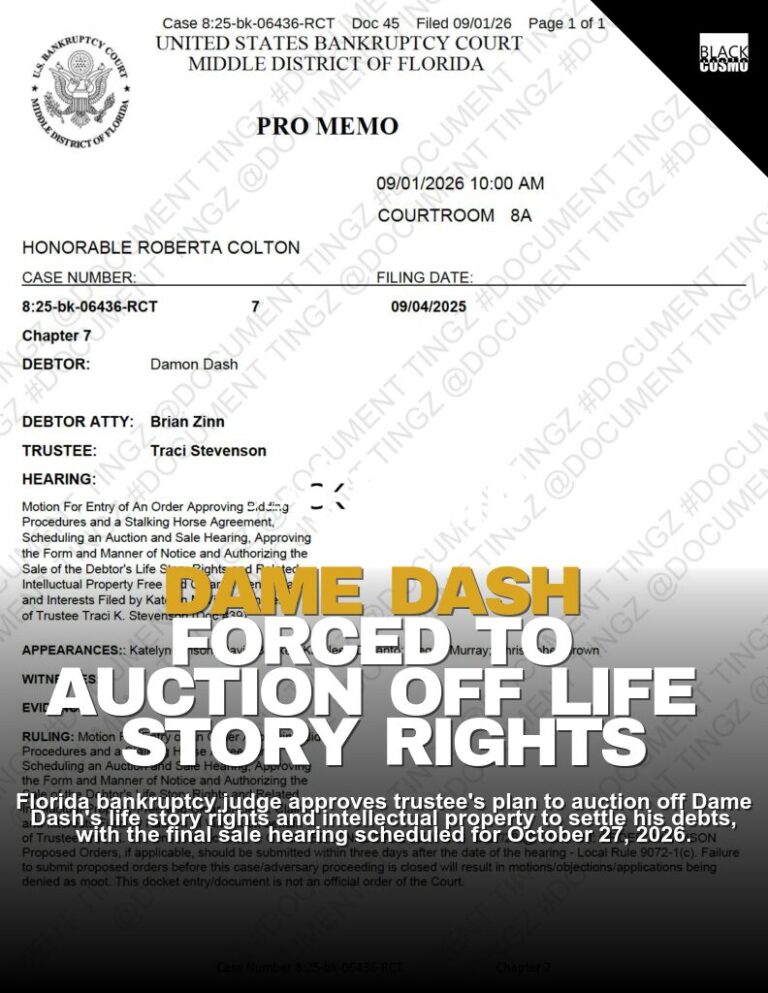
Honey, clear off your timelines because we’ve got the most shocking legal update shaking up hip hop biography circles and entertainment law right now. hip hop biography is about to get a whole new meaning, and not in a good way.
Legendary Roc-A-Fella Records co-founder Damon “Dame” Dash has been battling serious financial troubles and bankruptcy court struggles—but nobody expected things to escalate to this level. We’re talking about a Florida bankruptcy judge giving the green light to put Dame’s entire life story rights and intellectual property on the auction block to pay off his mounting debts. That’s a level of legal consequence that hits different.
During a September 1, 2026 hearing in Damon Dash’s Chapter 7 bankruptcy case, U.S. Bankruptcy Judge Roberta Colton officially granted the bankruptcy trustee’s motion to package and sell off Dame’s intellectual property:
Fans are rightfully losing their minds asking: how is it legal for a judge to force someone to sell their own life rights? Here’s the legal reality: when you file for Chapter 7 bankruptcy, a court-appointed Trustee’s job is to liquidate every valuable asset you own to pay back creditors.
Because Dame Dash previously signed agreements and developed movie projects around his personal narrative through his media companies, those life rights became legally classified as financial assets. Think of it like selling pre-loved luxury items to cover debt—except instead of designer handbags, we’re talking about someone’s entire story, legacy, and right to control their own narrative. The judge is allowing the Trustee to sell the rights to make movies, documentaries, books, and media projects based on Dame’s life to whoever bids the highest.
The internet immediately realized the historic implications here. Whoever wins this auction will own the legal right to produce the definitive Dame Dash biopic, documentary, or scripted series. That’s monumental considering Dame’s life story is inextricably linked to JAY-Z, the rise of Roc-A-Fella Records, Kanye West, and the entire late-90s hip-hop revolution.
Commentators are already joking about what could happen. Entertainment moguls, streaming giants, or even former rivals could swoop in to purchase his life story. It’s the kind of pop culture scenario that feels like it belongs in a curated reading list about the intersection of business, bankruptcy, and Black excellence in entertainment.
What do you think about this ruling? Should a court be allowed to sell someone’s life story rights, or has the legal system gone too far? Drop your thoughts in the comments below.
★m★
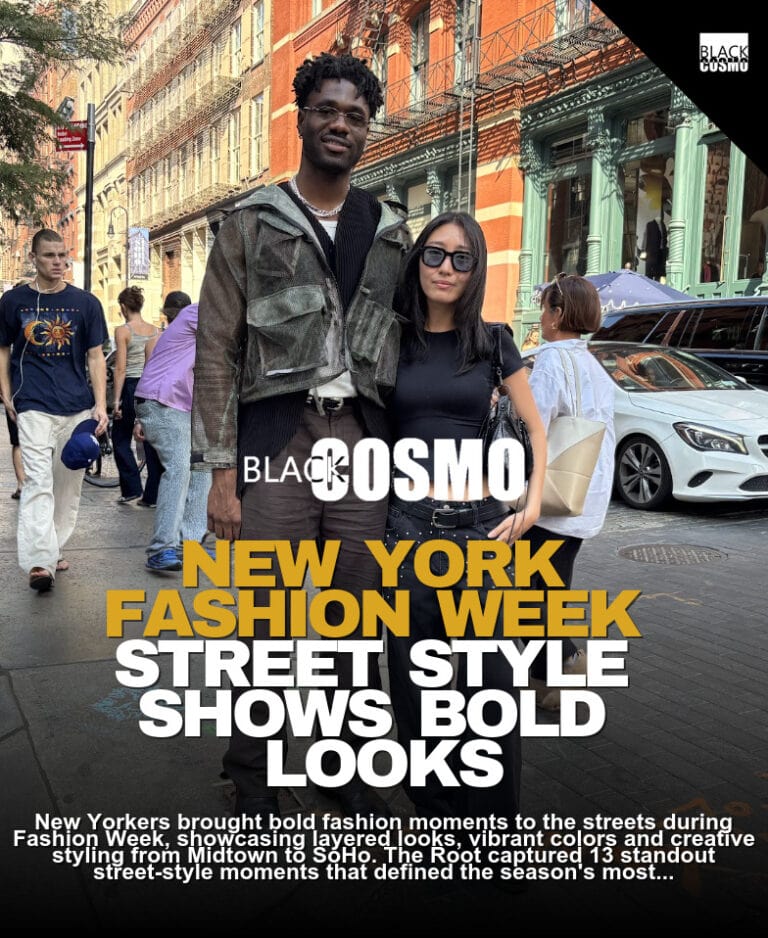
The Root hit the pavement to document 13 street-style moments that stood out. What emerged was a clear picture of how New York Fashion Week inspires personal style off the runway: bold layering, unexpected color pairings, and an overall refusal to play it safe.
Zenas nailed the layering game with a muted leopard print vest draped over a black knit, paired with straight brown pants and studded jeans. The combination feels both refined and effortless, the kind of look that makes you believe studded denim is having a proper moment.

Fashion influencer Dileiny Baron understood the assignment. Her powder blue jacket-style dress paired with slouchy burgundy boots is exactly what you want to wear when navigating Fashion Week shows as the weather starts to shift. The color combo feels both seasonal and bold.

Aissa’s look proves that less is often more. A simple statement piece—her woven shoulder bag—paired with muted accessories and basics creates that coveted model-off-duty vibe. It’s the kind of outfit that looks effortless until you realize how much thought went into it.

Eve Winter’s monochromatic ensemble sacrificed nothing in the style department. The slouchy denim paired with structured wool outerwear is a masterclass in balancing proportions and textures without losing sight of cohesion.

Sudani approached textures with fearlessness. This tonal combination stopped people in their tracks on Midtown streets and demonstrated how confidence is half the look.

These newlyweds leaned into a preppy casual look, mixing chocolate browns and neutrals while twinning in matching Adidas Samba OGs. The shoulder-tied sweater added a touch of polish, keeping the overall vibe warm and cohesive despite cooling temperatures.

DJ @cherrychy_ channeled fairy glam in a structured leather mini dress with billowing sleeves and a flowy necktie. Feminine without being precious, this look has a playfulness that feels fresh.

Ashley’s full-length denim skirt features a slit that becomes the focal point. Softened with an asymmetrical canary yellow knit, the look walks the line between bold and wearable.

Loafers continue their reign as a Fashion Week staple. Sporting Reps Capital, this outfit kept things sleek with muted jewelry and a crossbody bag. The overall vibe reads completely commanding.

The Wardrobe Therapist demonstrated that playing with proportions can be its own statement. A tailored striped button-down styled as a crop top paired with Bermuda shorts is the kind of calculation that feels like a risk but works.

This couple brought breezy nautical energy to SoHo. The tailored blazer, sharp stripes, and pops of red created a color-coordinated look that feels contemporary without trying too hard.

Rob’s outfit is a reminder that New York style thrives on simplicity. Good knits paired with good kicks exude a confidence that needs no explanation.

At 70 years old, fashion.Harris proves that fearlessness has no expiration date. Mixing textures, prints, and accessories with obvious ease, this look refuses to apologize. When asked the secret to staying fabulous, he keeps it simple: take care of yourself.
★TR★
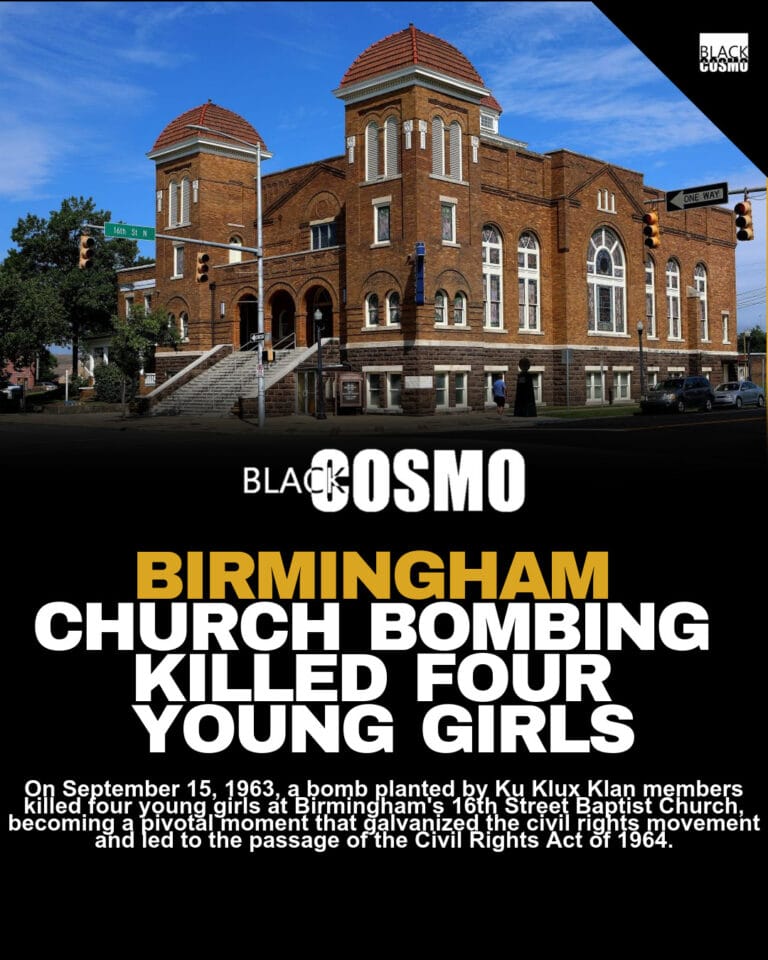
The 16th Street Baptist Church bombing of September 15, 1963, stands as one of the Civil Rights era’s most horrific acts of domestic terrorism. What unfolded that morning in Birmingham, Alabama wasn’t just a tragedy—it was a turning point in American history, a moment so devastating that it shifted the nation’s moral conscience and accelerated the push for federal civil rights legislation.
Martin Luther King Jr. had called Birmingham “probably the most thoroughly segregated city in the United States.” The city earned its bitter nickname, “Bombingham,” after enduring at least 21 separate bombings targeting Black homes and churches in the eight years leading up to 1963. Yet none had killed anyone—until 16th Street Baptist Church bombing changed everything.
It started with a phone call. At 10:22 a.m., 14-year-old Carolyn Maull, the acting Sunday School secretary, picked up the receiver at the church. An anonymous voice spoke just two words: “Three minutes.” Then silence.
Less than 60 seconds later, the bomb detonated.
Members of Eastview Klavern #13 of the Ku Klux Klan had planted at least 15 sticks of dynamite beneath the church’s steps. Thomas Blanton, Robert Chambliss, Bobby Frank Cherry, and allegedly Herman Cash orchestrated the attack. This same chapter had previously carried out the 1961 assault on Freedom Riders at the Birmingham Trailways bus station, establishing themselves as one of the South’s most violent white supremacist cells.
The church was hosting Youth Day that Sunday. The 16th Street Baptist Church, Birmingham’s largest Black congregation, had opened its doors for what should have been a celebration. Children filled the basement preparing for Sunday School while congregants gathered to hear Reverend John Cross Jr. preach. They never heard the sermon.

The explosion tore through the church with devastating force. A seven-foot hole ripped through the rear wall. A crater five feet wide and two feet deep opened in the basement restroom. The blast was so powerful it hurled a motorist from his car, destroyed parked vehicles, and shattered windows two blocks away.
Four young girls were found dead in the basement. Addie Mae Collins, 14. Cynthia Wesley, 14. Carole Robertson, 14. Carol Denise McNair, 11. The explosion was so severe that one girl was decapitated and could only be identified through her clothing and a ring.
Had they survived, none would be older than 77 today.

Reverend Cross later recalled finding the girls’ bodies “stacked on top of each other, clung together.” A fifth girl, 12-year-old Sarah Collins—Addie’s sister—survived but lost her right eye. Twenty-one pieces of glass were embedded in her face. More than 20 others in the church were injured.
Martin Luther King Jr. sent a telegram to Alabama Governor George Wallace, a segregationist who had physically blocked two African-American students from entering the University of Alabama: “The blood of our little children is on your hands.”
Rage ignited across the city. Within 24 hours, at least five businesses and cars owned by white people had been firebombed or stoned. Governor Wallace deployed 300 additional state police and 500 Alabama National Guardsmen as groups of Black and white youth clashed in the streets.

Three months earlier, President John F. Kennedy had called for swift congressional action on desegregation. “The events in Birmingham and elsewhere have so increased the cries for equality that no city or state or legislative body can prudently choose to ignore them,” he said in his televised civil rights address.
Two months after the bombing, Kennedy was assassinated in Dallas. The nation’s grief and fury over both tragedies converged. Many historians credit the bombing and the president’s death with generating the political momentum that led to President Lyndon Johnson signing the Civil Rights Act of 1964 into law—landmark legislation that prohibited discrimination based on race and ensured equal rights for African Americans.
But accountability came slowly. FBI Director J. Edgar Hoover blocked federal prosecutions and sealed files for years. It wasn’t until 1971 that Alabama’s Attorney General formally reopened the case.
Robert Chambliss was tried first, convicted of first-degree murder in 1977, and sentenced to life. He died in prison in 1985. Thomas Blanton was convicted in 2001 and died in 2020 while serving a life sentence. Bobby Cherry was convicted in 2002 and died in prison in 2004. Herman Frank Cash died in 1994 before charges could be filed.

This year’s commemorative events honored the four girls with a morning service at the church. Equal Justice Initiative Founder Bryan Stevenson, Birmingham Mayor Randall Woodfin, and Reverend Arthur Price shared remarks while the community participated in choral performances and quilting demonstrations.
The church also opened the 16th Street Baptist Church Education and Visitor Center—a new space designed to educate visitors and preserve this history for generations to come. The center stands as a testament to refusing to let these young lives fade from memory or meaning.

★TR★
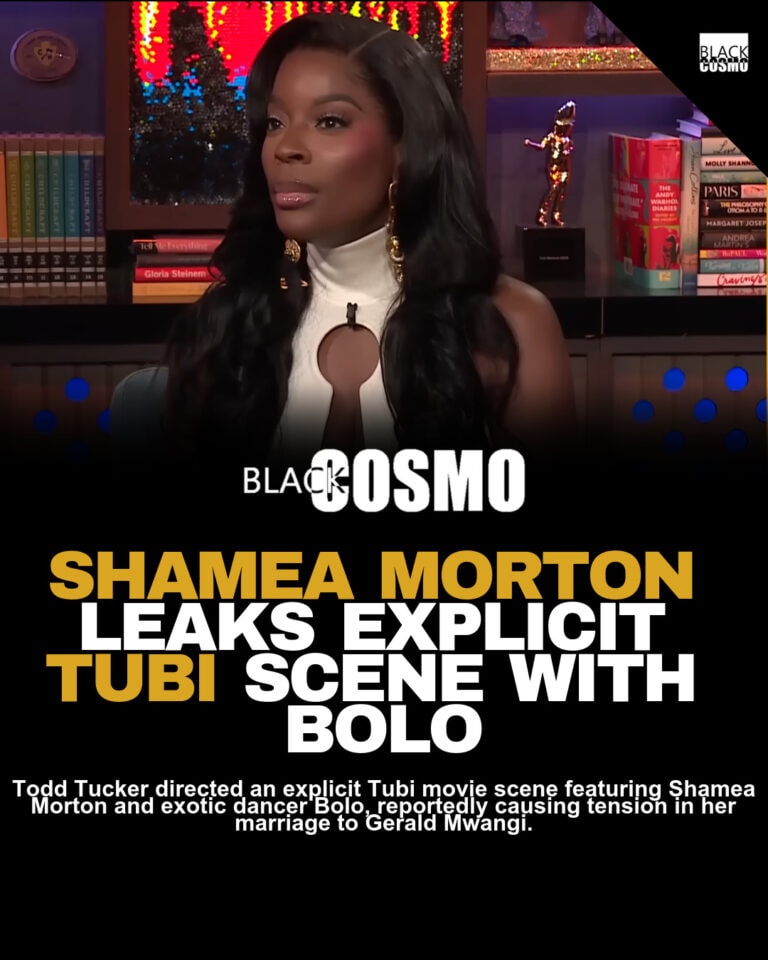
Honey, clear off your timelines, drop your popcorn, and grab a front-row seat, because we’ve got the absolute messiest, most jaw-dropping Real Housewives of Atlanta drama taking over the internet today! If you thought the drama on RHOA stayed in front of the Bravo cameras, think again. Producer Todd Tucker (husband of Kandi Burruss) just sent social media into an absolute tailspin after leaking graphic footage from a Tubi movie project he directed. This story has all the hallmarks of a hip hop biography—messy, scandalous, and impossible to look away from.
The star of the scene? Newly minted peach-holder Shamea Morton—and honey, she isn’t just acting, she is getting EXTREMELY intimate with famed Atlanta exotic dancer and actor Bolo the Entertainer. Fans are calling it everything from shocking to straight-up inappropriate, and we’re here for all the tea. When you’ve got hip hop biography-level scandal happening in real time, you know this is going to shake the entire community.
Fans who caught the leaked preview were left completely speechless by how far the scene went:
While Shamea has been trying to establish herself as a serious actress, her wealthy multi-millionaire husband, Gerald Mwangi, is reportedly NOT having it. During recent Real Housewives of Atlanta footage, a tearful Shamea broke down crying to her castmates, complaining that her husband was being completely “unfair” and unsupportive of her acting career. She claimed she was just “doing her job as an actress,” but insiders say Gerald felt completely disrespected seeing his married wife doing high-heat intimate scenes on camera. It’s giving major freedom struggle energy—the clash between personal autonomy and family expectations.
Now that the full, graphic clip with Bolo has leaked online, fans are questioning why a woman married to an ultra-wealthy businessman would risk her marriage for a low-budget Tubi scene. The tension between pursuing your dreams and respecting your relationship is real, and this situation is a masterclass in how things can spiral. Some might even say it’s becoming a freedom struggle moment for modern celebrities navigating fame and family.
As soon as the leaked footage hit Instagram blogs and Reddit, reality TV fans tore into the clip, calling the scene totally inappropriate for a married woman. One fan wrote on Reddit: “I’m an open-minded person, but damn Shamea! That scene with Bolo was shot like straight-up porn! She is married to a multi-millionaire… why is she risking her entire marriage and reputation for a Tubi movie?!”
Another commenter added: “Todd Tucker leaking this knowing Shamea’s husband was already upset is messy as hell! Shamea was crying on TV about her husband not supporting her ‘acting,’ but what husband is going to be okay with THAT?!” The internet has spoken, and it’s not in Shamea’s favor. People are bringing designer handbags levels of scrutiny to every detail of this scandal.
While Shamea continues to defend her craft, critics and fans alike agree that the graphic nature of the scene crossed a major line for a married mother. Honey, when you’re crying on camera about your husband being upset, dropping a graphic love scene with Bolo is definitely not going to smooth things over at home!
What do you think about Shamea’s graphic scene with Bolo? Was her husband right to be upset, or is it just acting? Let’s talk about it in the comments below!
★m★
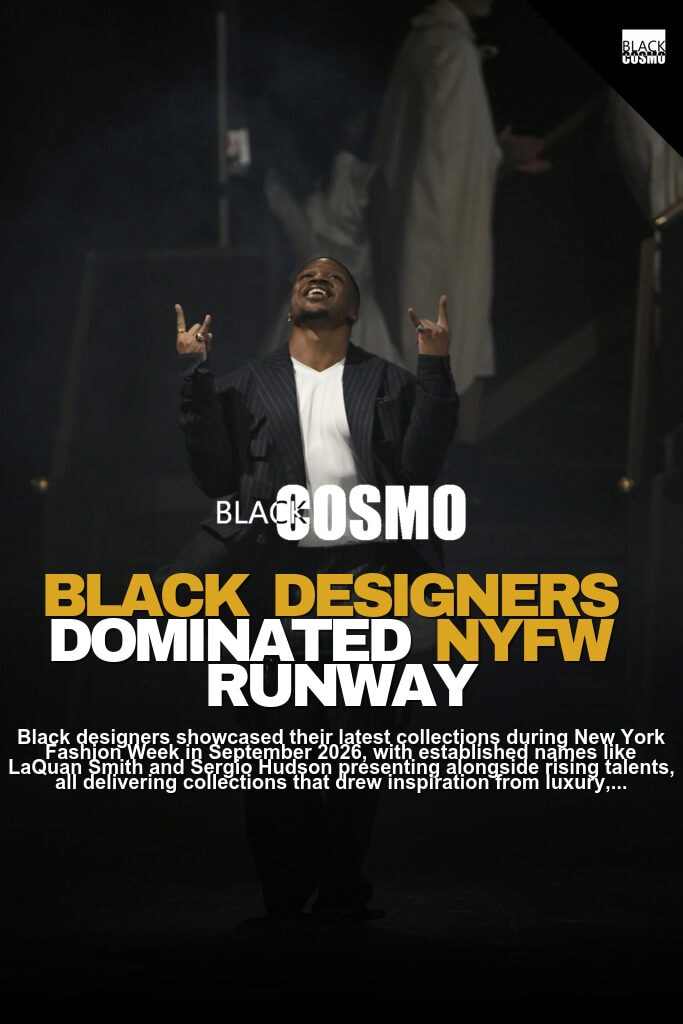
As New York Fashion Week wrapped, Black designers made their presence known from the runway to the front row, showcasing collections that redefined what American luxury looks like this season.
Established names like LaQuan Smith and Sergio Hudson shared the spotlight with rising talents including Rachel Scott’s Diotima, Keith Herron’s Advisry, and Jakarie Whitaker’s Hikari no Yami. With everything from sharp tailoring that commands attention to streetwear that pushes boundaries, Black designers delivered collections rich with Caribbean and African diasporic references, cementing their influence on the week’s most memorable moments.
Romeo Hunte’s “Ivy Noir” collection brought 30 looks to Times Square that felt like classic prep through a distinctly New York lens. The Brooklyn designer played with tailored silhouettes, statement outerwear, elevated denim and bold proportions that balanced polish with attitude.
Yaya DaCosta’s return to the runway was a highlight, sharing the space with a crowd that included Yung Miami, NLE Choppa, Rapsody, Key Glock and Trinidad James. The room had the kind of energy that only happens when the pieces on display actually matter.
The denim-forward approach gave the collection its backbone, but it was the details that made it memorable. That red collar jacket—oversized proportions layered with attitude—felt like prep flipped on its head, exactly what Hunte intended.


DaCosta delivered in a sharp tailored moment with layered prep and that signature New York confidence. Varsity knits mixed with oversized tailoring and a red bow tie pulled everything together into something that felt both familiar and fresh.

LaQuan Smith took over Brookfield Place with a Spring/Summer 2027 collection that proved why Rihanna, Zendaya and Beyoncé trust him with their red-carpet moments. The show was all glamour and those signature sexy silhouettes that Smith has made his calling card.

A gold mini that exists to be seen and remembered. This is the kind of dress that announces itself before the wearer even enters the room.

The mint green number played sporty against chic. An asymmetrical hem and functional front pockets kept it modern, while the python-print knee-high boots added the animal-print moment that threaded through the entire collection.
Sergio Hudson claimed the Rainbow Room at 30 Rock for a show built on a flipped James Bond fantasy. Traditional roles and power dynamics got turned inside out, resulting in sharp tailoring and sexy silhouettes dripping with old-school glamour.
Bold color did most of the heavy lifting. Rich, high-impact shades gave every look a sense of authority that paired perfectly with Hudson’s trademark confidence. The collection felt powerful and polished, designed for people who walk into a room and immediately command it.

Deep magenta power suit that knew exactly what it was doing. The structure was deliberate—strong shoulders, wide-leg trousers, cinched waist—but the matching headscarf and overall execution kept it glamorous rather than rigid. This was drama with sophistication.

Pure power dressing with cinematic edge. The strong shoulders and long skirt created sharp silhouette, while the headscarf, sunglasses and matched accessories gave it that sleek James Bond energy Hudson was reaching for.
Fashion Bomb Daily marked 20 years with its sixth annual Bomb Fashion Show, taking over Lavan Chelsea for a night that felt like a genuine celebration of what the platform has built. The champagne-themed event put both emerging and established designers—BruceGlen, FGM Bespoke, Jai Lyle and Mahogani Collections among them—on the same runway, creating moments rooted in fashion, culture and Black creativity.

The oversized printed jacket carried this whole look. Layered over a simple white set, it gave the outfit personality without overshadowing itself. The styling felt effortless but intentional, and the hair tied the whole moment together.

A long red coat worn open and fearless. Slim black pants, boots and dark shades completed the look with understated confidence. Sometimes simplicity hits harder than complexity.

Color was the entire story here. A head-to-toe mix of saturated brights and graphic blocks made the runway feel more energized. The long coat, crop top and mini skirt worked together playfully and boldly, designed to command attention.
★TR★

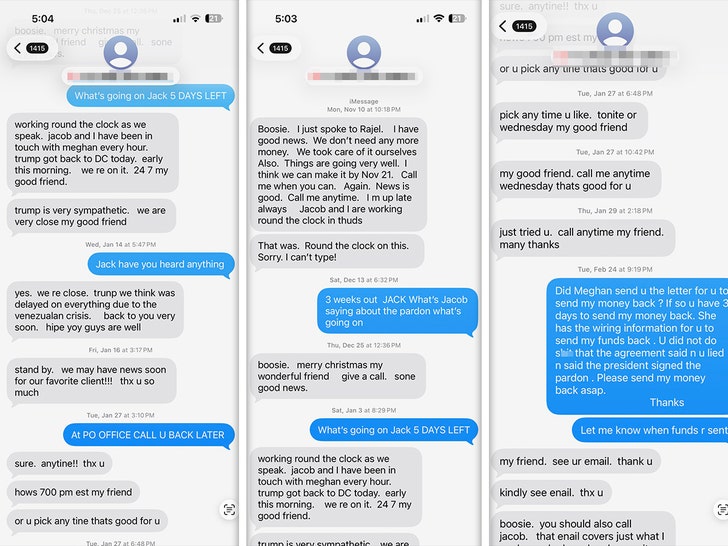
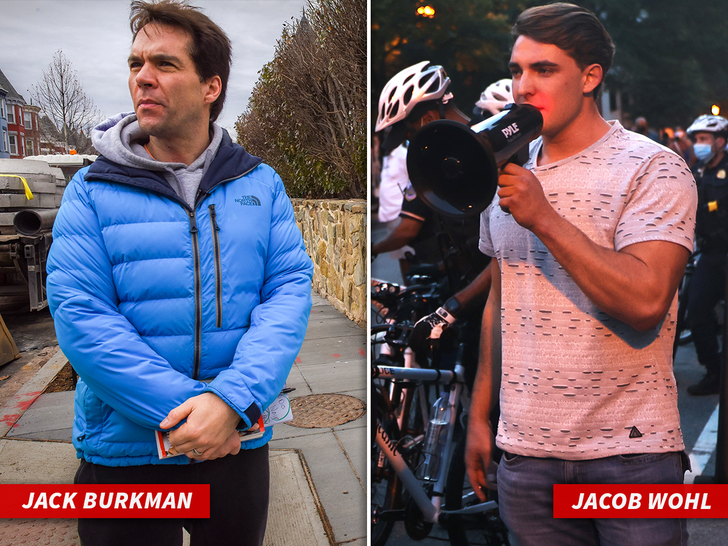
Boosie Badazz says he paid pardon brokers $600,000 upfront. But he never got a pardon. https://t.co/uBiTNKcqjc pic.twitter.com/CkJd3E9cdl
@60Minutes
★★★


★★★
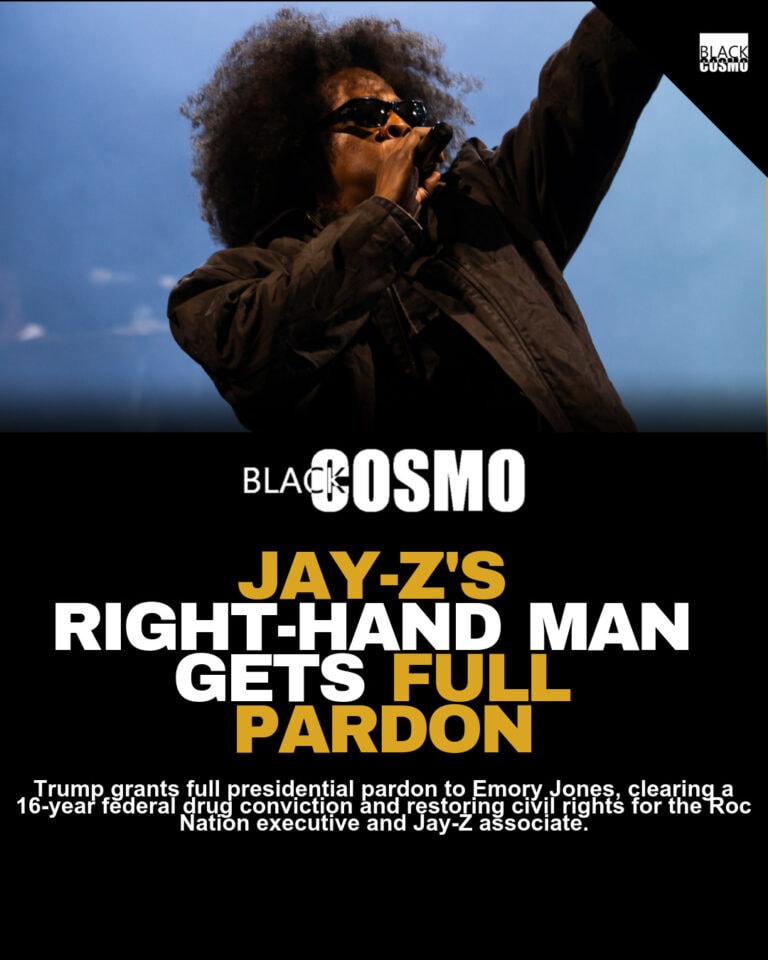
Honey, clear off your timelines, raise your glasses, and grab a front-row seat, because BlkCosmo has the absolute biggest breaking news sending shockwaves from Wall Street to hip-hop royalty!
In a massive, unexpected White House announcement, President Donald Trump officially granted a full presidential pardon to Emory “Vegas” Jones—the legendary executive, Roc Nation Head of Lifestyle, Paper Planes co-founder, and ultra-loyal best friend of hip-hop billionaire Jay-Z!
The historic pardon completely wipes the slate clean, formally clearing the federal drug conviction that kept Emory locked away in federal prison for nearly 16 long years. This is the kind of Roc Nation success story that reminds us about redemption and second chances in America.
The news was officially broken by White House “pardon czar” and advocate Alice Marie Johnson, who confirmed that Emory Jones was included in a select cohort of 30 Americans granted presidential clemency:
To truly understand how deep this pardon goes, you have to look back at the incredible history and brotherhood between Jay-Z and Emory Jones. This is the kind of loyalty and freedom struggle that speaks to freedom struggle narratives in hip hop biography and Black excellence:
As soon as news of the presidential pardon hit the blogs, music executives, celebrities, and hip-hop fans erupted with overwhelming love for Emory’s full-circle journey:
“Emory Jones did 16 years, never folded, came home, built Roc Nation & Paper Planes into an empire, and now got a full presidential pardon?! THAT is a movie script!” one top commenter wrote on X.
Another fan added: “Jay-Z’s loyalty to Emory is unmatched, and seeing Emory get his full freedom back after everything he rebuilt is beautiful to see!”
Honey, going from serving 16 years in a federal prison cell to co-founding a global brand and getting a full presidential pardon is the ultimate definition of second chances!
What do you think about Emory Jones receiving a full presidential pardon from Donald Trump? Let’s celebrate second chances in the comments below!
★m★