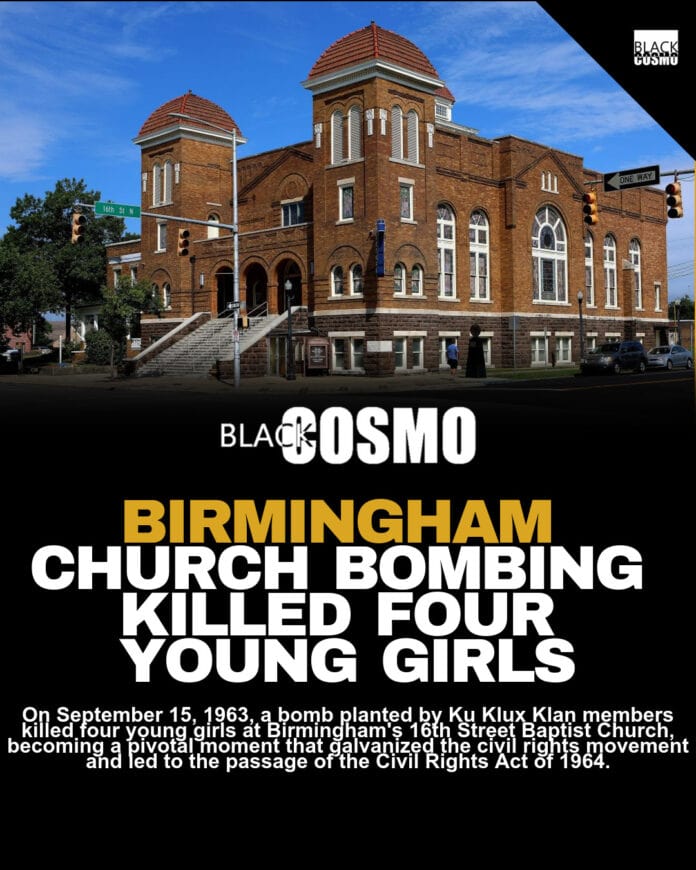
The 16th Street Baptist Church bombing of September 15, 1963, stands as one of the Civil Rights era’s most horrific acts of domestic terrorism. What unfolded that morning in Birmingham, Alabama wasn’t just a tragedy—it was a turning point in American history, a moment so devastating that it shifted the nation’s moral conscience and accelerated the push for federal civil rights legislation.
Martin Luther King Jr. had called Birmingham “probably the most thoroughly segregated city in the United States.” The city earned its bitter nickname, “Bombingham,” after enduring at least 21 separate bombings targeting Black homes and churches in the eight years leading up to 1963. Yet none had killed anyone—until 16th Street Baptist Church bombing changed everything.
The Warning
It started with a phone call. At 10:22 a.m., 14-year-old Carolyn Maull, the acting Sunday School secretary, picked up the receiver at the church. An anonymous voice spoke just two words: “Three minutes.” Then silence.
Less than 60 seconds later, the bomb detonated.
The Conspiracy
Members of Eastview Klavern #13 of the Ku Klux Klan had planted at least 15 sticks of dynamite beneath the church’s steps. Thomas Blanton, Robert Chambliss, Bobby Frank Cherry, and allegedly Herman Cash orchestrated the attack. This same chapter had previously carried out the 1961 assault on Freedom Riders at the Birmingham Trailways bus station, establishing themselves as one of the South’s most violent white supremacist cells.
Youth Day
The church was hosting Youth Day that Sunday. The 16th Street Baptist Church, Birmingham’s largest Black congregation, had opened its doors for what should have been a celebration. Children filled the basement preparing for Sunday School while congregants gathered to hear Reverend John Cross Jr. preach. They never heard the sermon.

The Blast
The explosion tore through the church with devastating force. A seven-foot hole ripped through the rear wall. A crater five feet wide and two feet deep opened in the basement restroom. The blast was so powerful it hurled a motorist from his car, destroyed parked vehicles, and shattered windows two blocks away.
Four young girls were found dead in the basement. Addie Mae Collins, 14. Cynthia Wesley, 14. Carole Robertson, 14. Carol Denise McNair, 11. The explosion was so severe that one girl was decapitated and could only be identified through her clothing and a ring.
Had they survived, none would be older than 77 today.

Survival and Loss
Reverend Cross later recalled finding the girls’ bodies “stacked on top of each other, clung together.” A fifth girl, 12-year-old Sarah Collins—Addie’s sister—survived but lost her right eye. Twenty-one pieces of glass were embedded in her face. More than 20 others in the church were injured.
Immediate Aftermath
Martin Luther King Jr. sent a telegram to Alabama Governor George Wallace, a segregationist who had physically blocked two African-American students from entering the University of Alabama: “The blood of our little children is on your hands.”
Rage ignited across the city. Within 24 hours, at least five businesses and cars owned by white people had been firebombed or stoned. Governor Wallace deployed 300 additional state police and 500 Alabama National Guardsmen as groups of Black and white youth clashed in the streets.

A Catalyst for Change
Three months earlier, President John F. Kennedy had called for swift congressional action on desegregation. “The events in Birmingham and elsewhere have so increased the cries for equality that no city or state or legislative body can prudently choose to ignore them,” he said in his televised civil rights address.
Two months after the bombing, Kennedy was assassinated in Dallas. The nation’s grief and fury over both tragedies converged. Many historians credit the bombing and the president’s death with generating the political momentum that led to President Lyndon Johnson signing the Civil Rights Act of 1964 into law—landmark legislation that prohibited discrimination based on race and ensured equal rights for African Americans.
Justice Delayed
But accountability came slowly. FBI Director J. Edgar Hoover blocked federal prosecutions and sealed files for years. It wasn’t until 1971 that Alabama’s Attorney General formally reopened the case.
Robert Chambliss was tried first, convicted of first-degree murder in 1977, and sentenced to life. He died in prison in 1985. Thomas Blanton was convicted in 2001 and died in 2020 while serving a life sentence. Bobby Cherry was convicted in 2002 and died in prison in 2004. Herman Frank Cash died in 1994 before charges could be filed.

Remembrance and Legacy
This year’s commemorative events honored the four girls with a morning service at the church. Equal Justice Initiative Founder Bryan Stevenson, Birmingham Mayor Randall Woodfin, and Reverend Arthur Price shared remarks while the community participated in choral performances and quilting demonstrations.
The church also opened the 16th Street Baptist Church Education and Visitor Center—a new space designed to educate visitors and preserve this history for generations to come. The center stands as a testament to refusing to let these young lives fade from memory or meaning.

★TR★