
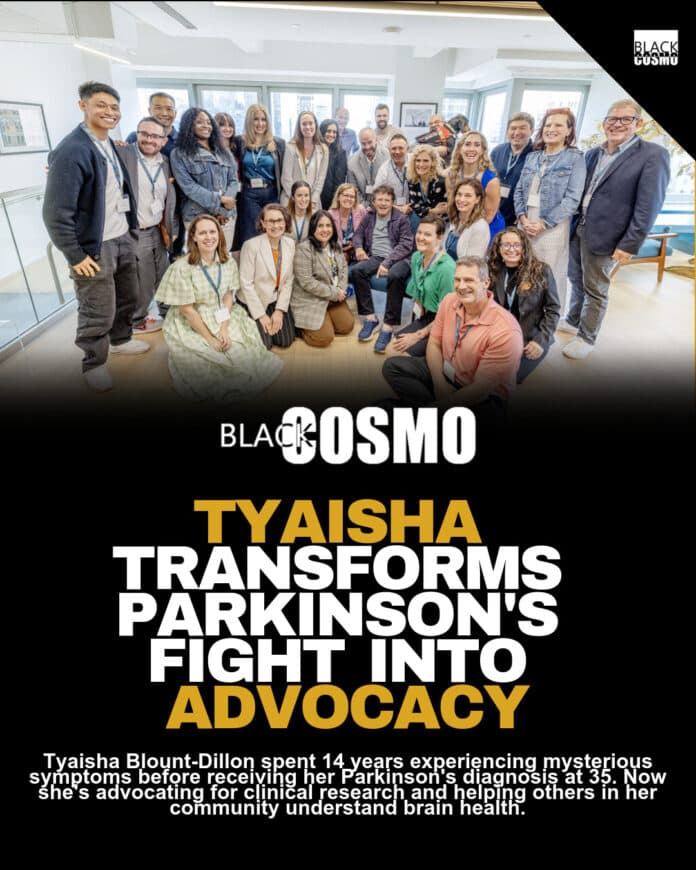
Tyaisha Blount-Dillon was working in sustainable operations for the USDA Forest Service when she received a Parkinson’s disease diagnosis at age 35. But the symptoms had been there since she was 21—years of unexplained cramping, rigidity, and mobility issues that doctors dismissed or failed to recognize. Rather than let the diagnosis become her identity, she channeled her experience into advocacy, connecting with Tyaisha Blount-Dillon and The Michael J. Fox Foundation to push for research and support within Black communities disproportionately affected by the world’s fastest-growing neurological disorder.
Her path to diagnosis reveals a familiar gap in healthcare: a young, athletic Black woman whose symptoms didn’t fit the stereotype of who gets Parkinson’s, whose concerns were minimized, whose body was read as an inconvenience rather than a signal. Getting doctors to listen took finding a care team willing to work together—a neurologist and gynecologist coordinating during her second pregnancy—and nearly a decade of her own detective work.
The Early Symptoms Nobody Took Seriously
The warning signs were there, unmistakable in hindsight. A grocery store trip cut short because her foot cramped so severely she had to walk on her toes just to leave. Field work for the Forest Service where rigidity would lock her body mid-stride, forcing her to pretend to tie her shoes while waiting for the episode to pass. Getting stuck in her own bathtub at home.
“How I looked was the barrier,” she explained. Young. Athletic. Someone who spent eight hours a day navigating uneven terrain in the woods collecting hydrology data. That physique didn’t match the internal reality—a body increasingly betraying her. Doctors saw the resume and the appearance, not the person telling them something was wrong.
One medical record she later discovered particularly stung: a South Carolina doctor had written that a “young 21-year-old has a very good job but is crying because she can’t walk in the field.” The dismissiveness was written right into her chart.
The Turning Point
Everything shifted when she learned to assemble her own care team—not settling for individual practitioners but finding ones willing to collaborate. During her second pregnancy, a neurologist and gynecologist worked in tandem, hospitalized her, and finally figured it out. She was, as she puts it, one step away from a wheelchair.
What came next was her blueprint. She didn’t accept the trajectory. She cycled, did HIIT workouts, made nutrition deliberate—dark leafy greens, colorful vegetables, sunlight. Mindfulness became non-negotiable because negativity bred stress, which elevated her symptoms. Within six months, she had fundamentally redirected her life.

From Patient to Advocate
She retired in 2018 to undergo deep brain stimulation surgery, but sitting still wasn’t an option. She saw where her professional experience intersected with her diagnosis: her work with communities facing food deserts. Proper nutrition directly impacts brain health. So she wrote “The Bayou Bounce,” a book that used bounce music—the soundtrack of her Baton Rouge upbringing and the house parties of her generation—as a cultural entry point to understanding brain health as something applicable to everyday life.
She founded Aly Creative to produce brain health educational materials and launched The Thriving Brain & Development Project, a nonprofit that gets information into communities and sponsors cooking classes on gut-healthy foods for people living with Parkinson’s and other neurological conditions.
On Representation and Research
Black patients remain underrepresented in Parkinson’s trials and dramatically underdiagnosed. When asked which problem needed solving first, she didn’t hesitate: underdiagnosis. “If you don’t get the problem addressed, that’s a recipe for disaster. If I didn’t have the wherewithal to fight, I would be in a wheelchair right now.”
She’s candid about hesitation in Black communities around participating in medical research, given the legitimate historical and ongoing concerns about bias in healthcare. Her response cuts through the paralysis: “Once you’re stricken with a disease, you change your tune about not participating. This is how we’re going to get the information to further our comfort with the medicine and further the development of treatments that cater to the specific symptoms we have. To impact change, we need to implant ourselves in places and spaces where we’re not traditionally represented.”

Her work demonstrates something crucial: being diagnosed isn’t the end of your agency. It’s the beginning of your responsibility to yourself and to the communities that come after you. That’s the kind of advocacy that actually moves the needle.
The Michael J. Fox Foundation supports research through the Parkinson’s Progression Markers Initiative (PPMI), an open-access landmark study. Participation is free, with multiple at-home options including smell tests, genetic testing, and online surveys. Learn more and sign up at the foundation’s website.
★TR★