
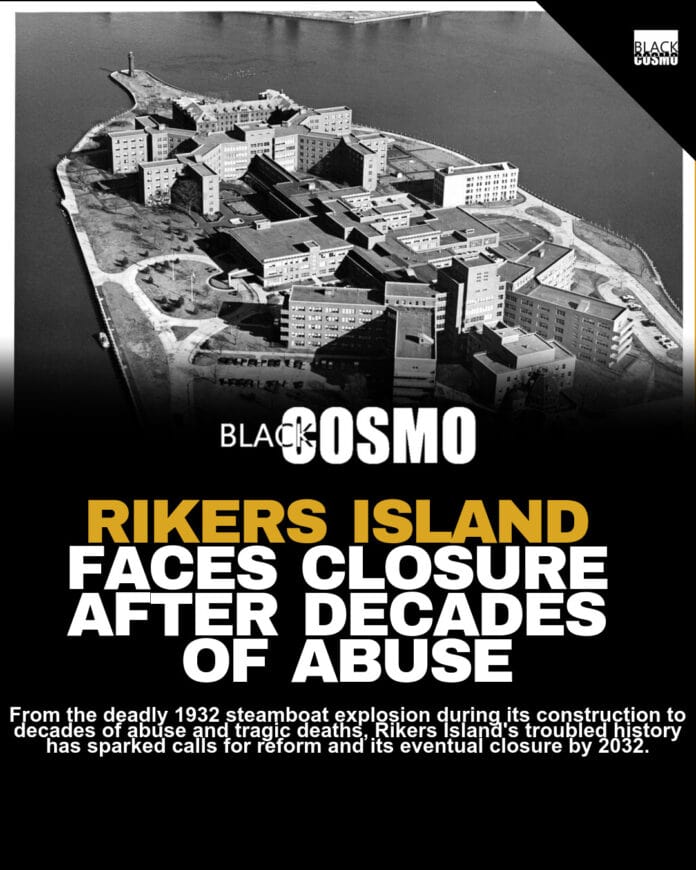
Rikers Island’s history is defined by systemic disasters. From the deadly 1932 steamboat explosion during its construction to decades of documented abuse, federal monitorships, and tragic deaths like Kalief Browder’s, the facility has become synonymous with failure. Mayor Zohran Mamdani’s Close Rikers Strategic Plan aims to finally end that era by 2032, calling the facility “a symbol of the failures of our criminal legal system” while pledging $146 million toward community alternatives and four borough-based jails. To understand how Rikers Island reached this breaking point, here are the defining crises—and the films, TV series, and documentaries that have chronicled its complex history.
The Opening of Rikers & The Observation Disaster (1932)
Construction started in 1932, and the complex began receiving incarcerated people as the city developed the island into a major correctional facility. Its expansion over the decades would turn Rikers Island into one of the country’s most notorious jail complexes. That same year, a deadly steamboat explosion took place in New York City’s East River, killing 72 construction workers being ferried to build the penitentiary. The disaster would foreshadow decades of tragedy to come.
The Prison Revolt of 1975

In November 1975, inmates at the Rikers Island House of Detention for Men seized control of cellblocks, arming themselves with makeshift weapons like pipes, broomsticks, and rocks. They held five correction officers for 17 hours in a dramatic uprising driven by complaints about overcrowding and denied rights. The ordeal caused significant damage to the facility, and over 300 incarcerated people were transferred to other buildings in the aftermath.
The 1986 & 1990 Uprisings

In October 1986, a series of riots exposed the dangerous conditions inside Rikers. A fight in the juvenile detention unit escalated into a 10-day series of disturbances across three buildings, leaving inmates and correction officers injured.
Four years later, in August 1990, three inmates attacked a correction officer. Hundreds of officers responded by blockading the bridge to Rikers for two days to protest how the incident was handled and the department’s use-of-force policy. The standoff triggered a violent outbreak inside the Otis Bantum Correctional Center, where more than 100 inmates and 21 corrections personnel were injured.
The Illegal Strip-Search Class Actions (1986–2007)

Beginning in 1986, a series of class-action lawsuits challenged the city’s practice of subjecting people arrested for misdemeanors and low-level offenses to invasive strip searches at Rikers Island without reasonable suspicion. Some female detainees also alleged they were subjected to nonconsensual gynecological examinations, prompting further legal action.
The city eventually revised its search policies and issued a $33 million settlement in 2010, covering roughly 100,000 people who were illegally strip-searched between 1999 and 2007.
The Kalief Browder Case (2010–2015)

Kalief Browder was just 16 when arrested in 2010 on suspicion of stealing a backpack. Despite his innocence, he spent three years at Rikers awaiting trial, including nearly two years in solitary confinement. His case was dismissed in June 2013, and he was finally freed. In June 2015, he died by suicide in his mother’s home. He was 22.
Browder’s death sparked national outrage and intensified calls to close Rikers and reform the criminal justice system. His case helped inspire changes to New York City’s bail system and became a rallying cry for advocates demanding an end to the inhumane conditions inside the jail.
The Death of Layleen Polanco (2019)

In 2019, 27-year-old Layleen Polanco, a transgender Afro-Latina woman, died from an epileptic seizure while being held in solitary confinement at Rikers Island. Despite her documented seizure disorder, Polanco spent nine days in isolation. Investigations uncovered serious failures in her medical care and supervision, leading to disciplinary action against correction officers and a wrongful-death lawsuit from her family.
Federal Oversight & Closure Delays (2024–Present)

Despite years of federal oversight and court-ordered reforms, Rikers continues to struggle with violence, excessive force, understaffing, and unsafe conditions. In January 2026, a federal judge appointed a remediation manager to oversee reforms after the city repeatedly failed to meet court requirements. Plans to replace the complex with four borough-based jails have faced mounting construction delays, rising costs, and questions about whether the new facilities can accommodate the city’s jail population.
Rikers Island’s Notable Detainees

Rikers has housed its share of recognizable names from hip-hop and entertainment. Rappers including Tupac Shakur, Lil Wayne, DMX, Ol’ Dirty Bastard, Slick Rick, Foxy Brown, Ja Rule, and The Notorious B.I.G. have all served time there. So have activists like Al Sharpton and jazz legend Sonny Rollins.
“Time: The Kalief Browder Story” (2017)
This six-part documentary tells the story of Browder through interviews with his family, attorneys, and others. The series gives insight into the abuse, solitary confinement, and systemic failures he endured, and how his time behind bars affected him after his release.
“Lock-Up: The Prisoners of Rikers Island” (1994)
Directed by Jon Alpert, this documentary takes viewers inside Rikers, capturing the people who inhabit it and their stories. It offers a rare glimpse into the challenges of surviving a jail like no other through firsthand accounts and gritty footage.
“Rikers” / “Rikers: An American Jail” (2016–2017)
Similar to Alpert’s project, this Bill Moyers-helmed documentary pulls back the curtain on Rikers through firsthand accounts from men and women previously held there. They share stories of violence, intimidation, solitary confinement, and the challenges of rebuilding their lives after release.
“Rikers: What’s Next? A Conversation” (2018)
In this follow-up special, “Rikers: What’s Next?” brings together criminal justice experts to discuss the push to shut down the jail, the obstacles standing in the way, and what replacing it could mean for the city’s incarcerated population.
“The Night Of” (2016)
While not a documentary, Riz Ahmed’s acclaimed HBO crime drama deserves inclusion for its unflinching depiction of Rikers. Ahmed stars as Nasir “Naz” Khan, a Pakistani-American college student whose life takes a dark turn after he’s arrested for murder and thrown into the criminal justice system. As he navigates violence and the harsh realities of awaiting trial, the series offers a hard look at how quickly someone’s life can change behind bars.
★TR★