
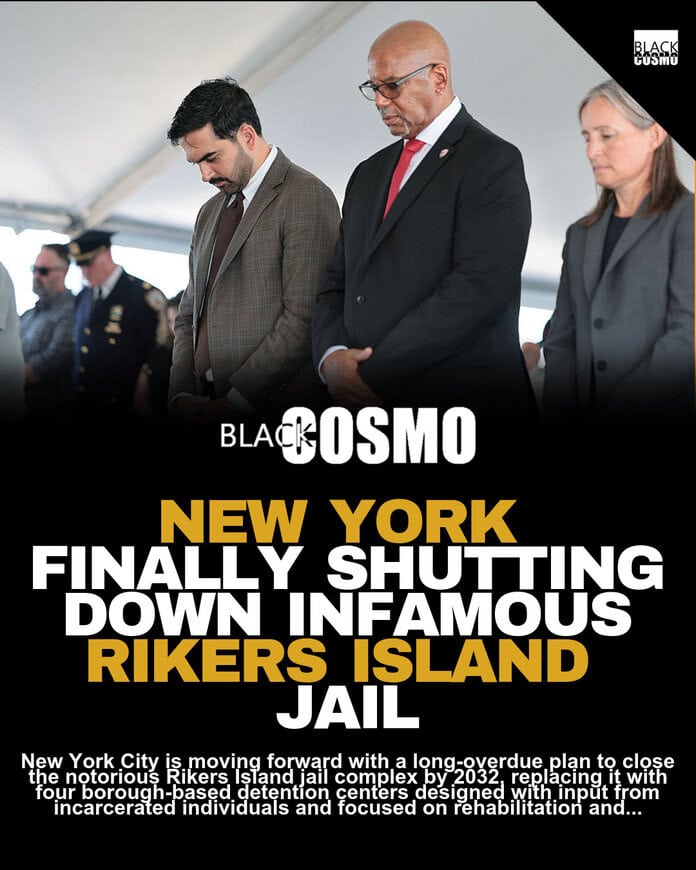
Cut off from the rest of New York City by a single bridge, Rikers Island has long stood as one of the country’s most notorious jails. Not just because it’s grueling to reach, but because of the systemic abuse and disproportionate harm inflicted on Black and brown men inside. Now, after decades of calls for change, the long-overdue push to finally shut its doors is moving forward.
The isolated facility has been the subject of conversation for nearly a century due to its inhumane conditions for both staff and inmates, who suffer assaults at eight times the rates of other jails. Getting there requires multiple train or bus journeys and proves tricky even by car. New York City Mayor Zohran Mamdani has made closing Rikers Island a centerpiece of his administration’s criminal justice reform agenda. “Closing Rikers, reducing pretrial detention, tackling the case delays that deprive people of their right to a speedy trial, and investing $130 million in the evidence-based supports that help break the cycles of incarceration,” Mamdani said. “We have a legal and moral obligation to close Rikers. Working alongside the City Council, courts, and nonprofit partners, we will meet it—for the people in our custody, the staff who serve them, victims of crime, and every New Yorker.”
When Will It Close?
The original deadline was set for next year, but the Eric Adams administration delayed it. Now the New York City Council is working on a plan to extend the closure deadline to 2032. Mamdani’s plan involves relocating inmates to four borough-based centers in Brooklyn, the Bronx, Queens, and Manhattan.
A History of Inhumane Treatment
In May, Rikers came under intense scrutiny after a report on the deaths of three inmates—Edwin Ramos, 38, Aramis Furse, 32, and Kyron Randall, 33—revealed a troubling pattern: lack of safety checks, inadequate medical care, and drugs slipping behind jail walls. The facility’s failures aren’t new. In 2015, Kalief Browder spent three years awaiting trial for a crime he didn’t commit. He endured prolonged solitary confinement and abuse from correction officers before dying by suicide upon his release, according to The Innocence Project.
Today, more than 6,000 inmates are held at Rikers Island. Fifty-six percent are Black. The mission to close the jail isn’t just about creating a more efficient system—it’s about building a network of care for staff, the incarcerated, and their families. People need adequate rehabilitation and medical facilities. They need pathways to avoid reoffending.
Working alongside Department of Correction Commissioner Stanley Richards, Mamdani has created a strategic plan to reform New York’s jail system and increase the city’s safety. Crime has already dropped significantly under the current administration. In August, murders and shootings fell 6.6%, with 724 fewer major crimes than in August 2025. The Bronx saw the most impressive reduction, down 10.5%, according to ABC Eyewitness News.
The next step is investing $130 million in a new system that supports inmates’ rehabilitation and reduces recidivism.
Three Guiding Principles
In a 75-page strategic plan, Mamdani outlined three “grounding principles” showing where the money will go: safety and fairness, timely resolution of criminal cases, and safe and humane jail conditions.
On safety and fairness, Mamdani argues that safety doesn’t begin with people behind bars. “It must be measured by whether New Yorkers are safe in their homes and neighborhoods, whether they can access the services they need, and whether government is meeting its responsibilities,” he wrote in a statement to reporters.
The first principle focuses on affordable housing, employment assistance, mental and physical health care, and placing inmates closer to their communities and courthouses. In February, Mamdani invested $2.9 million in job training for inmates while in custody and created pathways to employment upon release. He also shut down the North Infirmary Command and opened a 104-bed Outposted Therapeutic Housing Unit with NYC Health + Hospitals/Bellevue, which now provides specialty medical attention to those incarcerated.

Timely Case Resolution
For the second principle, Mamdani is focused on reducing time spent behind bars. “Time in jail can increase the likelihood of rearrest and pull New Yorkers away from their jobs, families, and schools. That is why we are investing in community-based services, addressing delays in courts and making sure that no New Yorker spends a day longer in jail than necessary,” he wrote.

Safe and Humane Conditions
The third principle examines how many people are held in jails at any given time. While Rikers currently holds more than 6,000 inmates, the strategic plan calls for detention centers to hold no more than 4,100 by the end of 2032. When the Brooklyn facility opens in 2029, the administration says there should be no more than 5,500 inmates. Less crowding means less burden on correction officers overseeing wards.
This restructuring is expected to save $1.2 billion annually, easing the burden on taxpayers.
Commissioner Stanley Richards emphasized that the future jails will be built with input from those who spend time in them. “It means designing our future jails with input from people in our care, understanding what they need to return to their communities prepared to succeed,” Richards wrote in a letter. Work is being done “in coordination with our federal partners, including the Remediation manager and the Nunez monitor, as well as the Board of Correction, the New York State Commission of Correction, advocates, community partners, and fellow New Yorkers.”

The Timeline
Brooklyn’s new facility arrives first in 2029, followed by the Bronx and Queens in 2031 and Manhattan in 2032.
Once the infamous jail complex closes, the island itself can be reformed. New York has an opportunity to make the space more environmentally conscious and reach climate goals set by the Mayor’s Office of Climate and Environmental Justice. Potentially, the space could be replaced with cleaner energy sources like solar, battery storage, and offshore wind to hit clean electricity targets by 2040.
In shutting down Rikers, Mamdani and Richards are optimistic about delivering a better future for all New Yorkers in terms of safety, care, and the environment. “It is a future we are set to deliver,” Richards wrote.
https://assets-server.theroot.com/wp-content/uploads/2026/11/20013456/CLOSE-RIKERS-Pro-Res-NO-CAPTIONS-1.mp4
★TR★