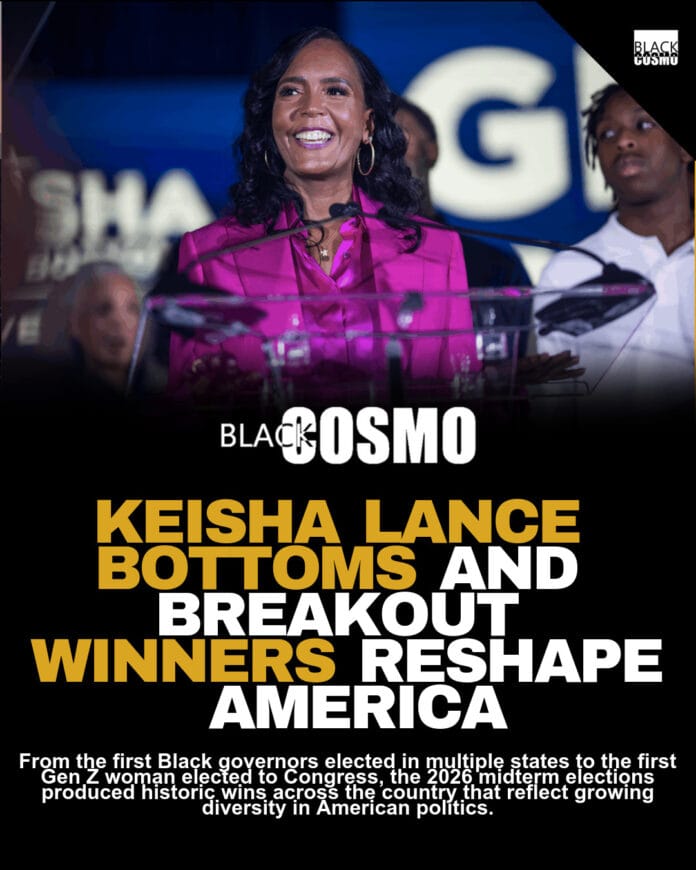
As the results of the 2026 midterm elections came in, a remarkable group of breakout winners began reshaping America’s political landscape. From Keisha Lance Bottoms making history as the nation’s first Black female governor to Aaron Ford bringing his vision to Nevada, these newly elected officials reflect the country’s demographic evolution and appetite for fresh leadership. They’re proof that representation matters, and change is happening at every level of government.
What makes this election cycle particularly significant is not just the individual achievements, but the collective message voters sent about who they want leading them forward. From state houses to Congress, these winners represent diverse backgrounds, ideologies, and visions for their communities. Keisha Lance Bottoms and her peers are walking into offices with mandates to deliver real change. Here’s what you need to know about the people steering the country into this new era.
Keisha Lance Bottoms
Bottoms made history by becoming the state’s first Black governor and the first Black woman elected governor in American history. Her campaign centered on kitchen-table issues: lowering everyday costs, cutting or suspending grocery taxes, and addressing rising insurance costs. Now that she’s officially been elected, the weight of those promises sits squarely on her shoulders.
Before the election, she told The Root how she approaches big problems: “We have to be thoughtful, and we’ve got to listen to people when they tell us that they are hurting. And when they’re asking, ‘What can you do to make a difference?’ It may not be that we have the big, perfect solution. But it’s how do you eat an elephant? One bite at a time. How do we move the needle and just give people some relief?”
Bottoms, who previously served as mayor of Atlanta, has already proven she can rally people around a cause. Her determination and ability to build coalitions will likely define her tenure in this new role.
Abdul El-Sayed

Michigan’s Democrat Abdul El-Sayed pulled off a significant upset, defeating Republican Mike Rogers to become the first Muslim elected to the U.S. Senate. His path to victory involved intentional outreach to Black voters and communities that have often felt overlooked in statewide races.
In previous interviews, El-Sayed has spoken about the role of the Black church and the Civil Rights Movement in expanding opportunities for all Americans. He understands that trust is currency in politics, and he invested heavily in building it. Some observers have drawn comparisons between El-Sayed and Zohran Mamdani, the mayor of New York City elected a year prior, suggesting both represent a new wave of younger, more progressive leadership willing to challenge the status quo.
David Crowley
Crowley’s win in Wisconsin carries particular weight given his personal history. He faced eviction growing up, a reality many Wisconsinites grappled with during the economic pressures of recent years. His victory over Trump-endorsed Republican Tom Tiffany marks another state achieving a historic first: its first Black governor.
During his acceptance speech, Crowley called for unity, emphasizing that what connects Wisconsinites runs deeper than what divides them. When reflecting on his win, he struck a note of humility mixed with hope, saying he’s proud to be the first but hopeful he won’t be the last Black person to occupy the Governor’s mansion.
Aaron Ford

Nevada’s new governor and Kappa Alpha Psi member Aaron Ford is carrying real momentum into his administration. As the state’s first Black governor, he’s positioning himself as someone ready to chart a more equitable path forward for his constituents.
His victory speech captured something fundamental about his candidacy: “This campaign didn’t happen by accident. It happened because of faith. Because of family. Because of hard work. And because the people of Nevada decided our best days are still ahead of us.” That combination of gratitude and forward-looking optimism suggests a leader aware of both where he came from and where he’s headed.
Melat Kiros

Colorado voters sent a powerful signal by electing Melat Kiros to Congress, making her the first Gen Z woman to reach that chamber. She’s also the first Black woman to represent Colorado in Congress, and she’s endorsed by the Democratic Socialists of America.
Kiros comes from a lineage she’s openly proud of: Black socialists, radicals, and fighters who understood the connection between racial and economic justice. Before her win, she spoke about carrying that legacy forward: “I’m coming from a long generation of proud, proud black socialists and radicals and fighters that have been naming the fact that racial justice and economic justice are inevitably intertwined. And our responsibility is to hold these institutions accountable for failing to respect our dignity and our basic rights.”
Juliana Stratton
Illinois is getting a significant boost in representation with Juliana Stratton’s election to the U.S. Senate. She now joins Sen. Tammy Duckworth, marking the first time the state will have two women of color serving together in that chamber.
Beyond Illinois, Stratton’s win carries national implications. She becomes the sixth Black woman to serve in the U.S. Senate and will join Angela Alsobrooks of Maryland and Lisa Blunt Rochester of Delaware. For the first time, three Black women will serve in the Senate simultaneously, a milestone that speaks to shifting power dynamics in American politics.
Byron Donalds
Florida delivered a curveball with Republican Byron Donalds winning the gubernatorial race. Taking over from two-term Governor Ron DeSantis, Donalds became the first Black governor in the state’s history. But he made clear during his victory speech where his allegiances lie, declaring the state “still red” even as a blue wave swept through much of the country.
It’s a stark reminder that Black voters and Black leaders don’t vote as a monolith. Donalds represents a conservative vision within the Black electorate, one that clearly resonated with enough Floridians to put him in office. His tenure will test whether he can govern differently from DeSantis or if he’ll largely continue the same trajectory.
Peggy Flanagan & Deb Haaland

Minnesota took its time counting votes, but Peggy Flanagan eventually emerged victorious, defeating Michele Tafoya in the U.S. Senate race. She’s now the first Native American woman elected to the Senate. Her background includes service as lieutenant governor and state representative, giving her legislative experience she’ll bring to Capitol Hill.
Similarly, Deb Haaland won New Mexico’s gubernatorial election, defeating Republican Greggory Hull to become the first Native American woman elected governor in U.S. history. Haaland previously served as Interior Secretary under President Joe Biden and brings that national experience to her new role. She’s part of a larger movement: the Washington Post reported at least 355 Native American and Indigenous candidates ran in races this year, signaling growing representation across political levels.
★TR★