The public unpacking of recent magazine features exposed the deep, unspoken reality of entering elite entertainment circles as a young Black woman. When the casting announcement for a live-action fairy tale broke the internet years ago, the vitriol that followed was unprecedented. It was not a typical critique of film aesthetics. It was a targeted, racialized campaign aimed directly at Halle Bailey. Studios often frame these casting decisions as progressive milestones. They happily claim the cultural capital. They rarely stand at the front lines when the digital mobs arrive, leaving their stars completely vulnerable to toxic Hollywood fandoms.
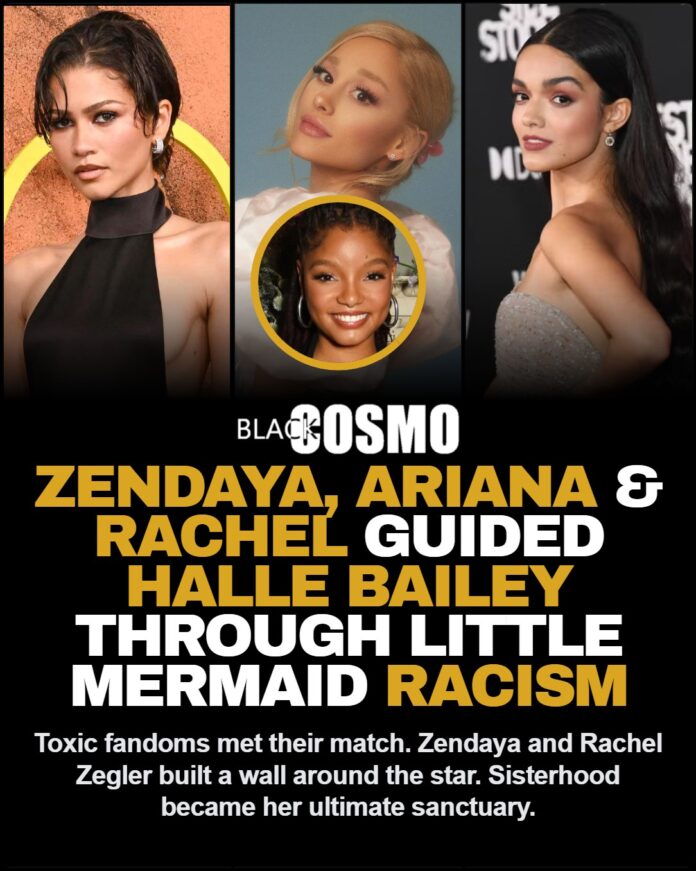
In her viral press run, the narrative shifted from victimization to an unyielding display of solidarity. Halle Bailey revealed the existence of a protective bubble built by her peers. Zendaya, Ariana Grande, and Rachel Zegler stepped out of their respective orbits to form a human shield around the young star. They understood the assignment. The industry machine demands vulnerability but offers zero sanctuary in return. These women bypassed the publicists and the studio handlers to create a fortress of sisterhood against toxic Hollywood fandoms.
The concept of a protective bubble is a direct response to the weaponized nature of modern audience entitlement. Legacy reboots carry aggressive nostalgia. When a Black woman occupies a space historically reserved for whiteness, that nostalgia turns into a hostile occupation. Studios left their leading lady to weather a category-five storm of racist backlash alone. Zendaya recognized the pattern. Having navigated her own alignment into hostile fanboy territories with mega-franchises, she offered guidance and quiet intervention. She brought the kind of grounding that only comes from shared survival.
Ariana Grande and Rachel Zegler brought their own armor to the perimeter. Zegler faced a mirror image of the harassment when cast in her own legacy fairy tale. The shared trauma of facing down coordinated internet hatred bonded them instantly. Their solidarity was not an orchestrated press strategy. It was a lifeline. Young women navigating the machinery of toxic Hollywood fandoms require more than a sympathetic text message. They need active, visible defense. They need peers who will risk their own fan capital to draw a line in the sand.
TikTok immediately caught the frequency of this revelation. Massive discussions erupted across the platform analyzing the profound necessity of safe spaces. Users bypassed the surface-level celebrity gossip to dissect the anatomy of the backlash. Young women shared their own experiences navigating hostile spaces, drawing direct parallels to the celebrity sisterhood. The digital conversation reframed the narrative entirely. The story was no longer about the hatred aimed at a rising star. The focus became the radical act of women protecting women.
Entering these spaces requires carrying the immense weight of representation. The public expects a flawless performance while simultaneously hurling abuse. Studio public relations departments issue generic statements denouncing racism, hoping the news cycle will simply turn over. They fail to understand the psychological toll of standing in the center of a global firestorm. Peer intervention acts as a crucial psychological anchor. When a peer validates the insanity of the moment, it breaks the isolation. The protective bubble serves as a reality check against the gaslighting of toxic internet mobs.
The discourse on TikTok identified a term for the fandom behavior: weaponized nostalgia. Users pointed out that adult fans disguise their racial bias as a pure devotion to historical accuracy in fictional, animated worlds. The absurdity of the argument became a focal point for thousands of video essays. Young creators dismantled the talking points of the toxic Hollywood fandoms piece by piece. In doing so, the digital community built an outer layer of defense that mirrored the inner circle of celebrity solidarity. The fans themselves became part of the protective bubble.
Hollywood historically pits young women against each other. The media apparatus feeds on rivalry narratives, turning casting calls into gladiatorial combat. The refusal to participate in that bloodsport changes the temperature of the industry. Forming a protective bubble around a peer actively dismantles the old systems of competition. It replaces it with a collective defense protocol.
When the studio system fails to provide a buffer between talent and toxic Hollywood fandoms, the talent must build its own walls. The viral response to the interview proves the audience is watching the mechanics of this failure closely. They see the lack of studio protection. They also see the undeniable strength of women choosing solidarity over silence. Sisterhood in the face of coordinated aggression is the ultimate form of rebellion. It ensures that the next generation of stars will not face the fire alone. They will walk into the flames surrounded by a shield of their own making.