The tension of elite sport often spills off the pitch, but what transpired in Philadelphia after France’s hard-fought victory over Paraguay crossed into territory that demands a firm, unyielding stand. When Kylian Mbappé responds to racist remarks, he does so with the precision of a world-class striker and the dignity of a captain. The latest target of his sharp tongue is Celeste Amarilla, a senator from Paraguay’s Liberal Radical Party who chose to degrade a moment of athletic excellence with old-school racial slurs.
The controversy began after France secured a 1-0 win in the Round of 16, thanks to a penalty kick converted by Kylian Mbappé. Instead of focusing on the physical grit of her own country’s squad, Amarilla posted a long tirade on X, calling the French captain a ‘colonised Cameroonian’ who was ‘desperately trying to pass himself off as French’. She went on to call him a ‘brute’ who lacked education and suggested that Paraguayan players should have slapped him.
The bigotry did not emerge in a vacuum. Before the whistle even blew in Philadelphia, former Paraguayan goalkeeper José Luis Chilavert set a hostile tone by publicly referring to the French squad as a team from Africa. This line of attack is a tired trope used to undermine the achievements of European teams with diverse rosters. When the match ended with Mbappé converting the decisive penalty, the frustration of defeat turned into a targeted campaign of personal and racial abuse from a high-ranking politician.
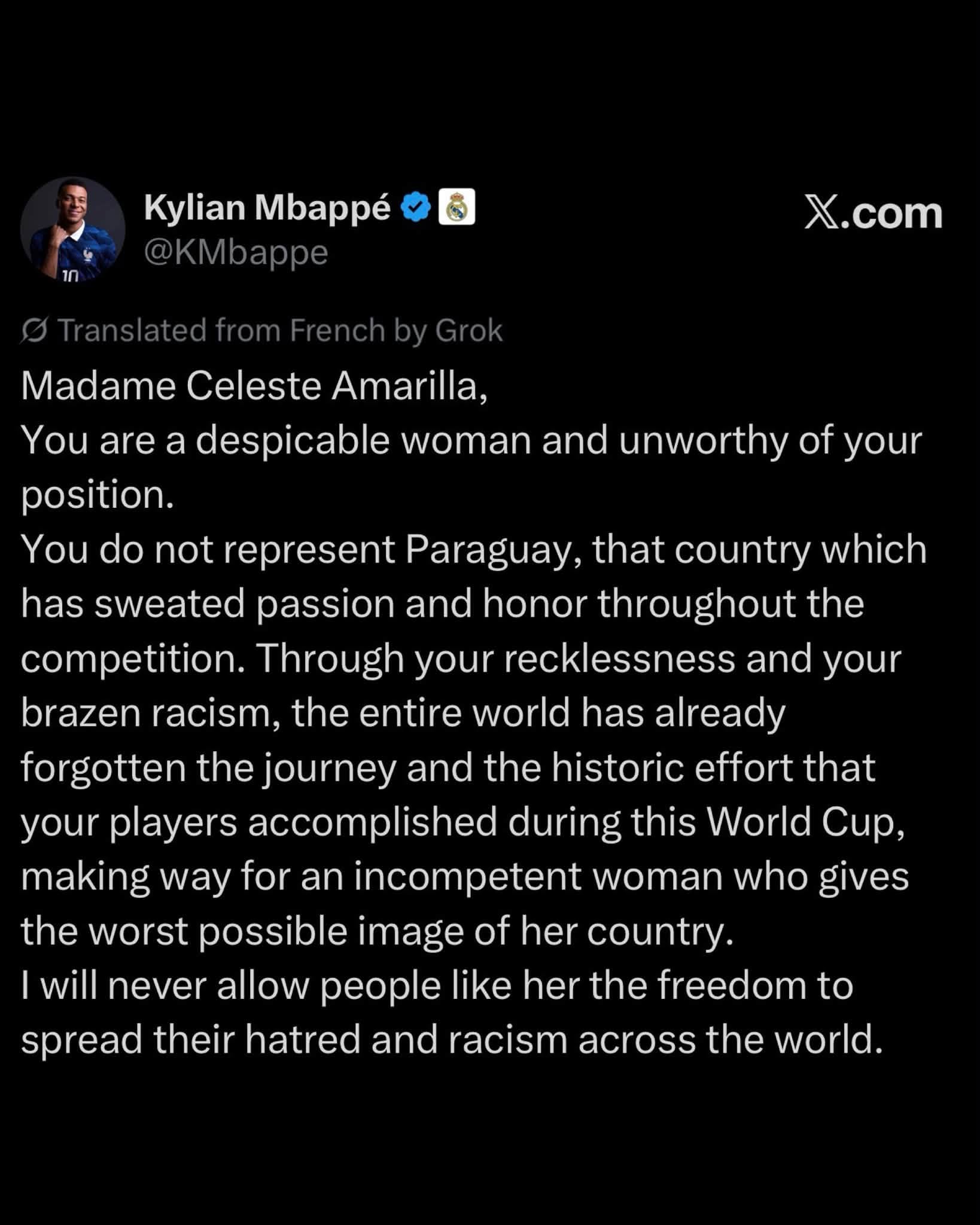
The response is part of a broader, systemic issue that Black athletes continue to face on the international stage. As Kylian Mbappé responds to racist remarks, he challenges the expectation that Black players must quietly absorb abuse. Rather than staying quiet, the French captain chose direct confrontation. He called out her behavior in a statement that protected both his dignity and the honor of the Paraguayan players who left everything on the field. He wrote that she is a ‘despicable woman’ and ‘unworthy’ of her senate seat, pointing out how her actions disgraced the country she claims to represent. He emphasized that her comments made the world forget the remarkable run and historic effort of her own country’s team. He refused to allow public figures the freedom to spread hatred unchecked.
This incident has now escalated beyond social media back-and-forth. The French Football Federation took swift action, lodging a formal complaint with French prosecutors, who have launched an investigation into aggravated public insult and incitement to hatred. Since the victim is a French national, Paris prosecutors have the jurisdiction to pursue charges even for comments made abroad. In France, these offenses carry a penalty of up to one year in prison and a substantial fine of forty-five thousand euros.
The political support for the captain has been swift. French President Emmanuel Macron and other government officials immediately voiced their support, reinforcing that such bigotry has no place in sport or society. Meanwhile, the Paraguayan government took steps to protect its own international standing by officially distancing itself from the senator. Their statement made it plain that her comments do not represent the values or principles of respect and human dignity that their country promotes.
For her part, Amarilla attempted a quick retreat, posting an open letter in French and Spanish. She claimed she deleted her posts and regretted using terms that mirrored the insults she has received as a mixed-race person. Yet, in the same breath, she demanded an apology from the football star, accusing him of gender-based violence for his response. Such defense mechanisms are all too common in these controversies. When public figures are called out for bias, they frequently attempt to reposition themselves as victims.
Framing a direct defense against racism as gender-based violence is an attempt to muddy the waters of accountability. The reality remains that global figures of color face an exhausting dual expectation: they must deliver elite athletic performances while remaining the front lines of defense against bigotry from official halls of power. By meeting this abuse with sharp, public resistance, the French captain sets a standard for how athletes can protect their humanity in the face of political hostility.
Editor’s Picks: For more on understanding global racial dynamics, browse our recommended list of Black literature focusing on identity and diaspora. To block out the noise of bad takes, try these premier active noise cancelling headphones. Elevate your everyday aesthetic with our curated luxury fashion selections, or discover fresh seasonal scents in our collection of perfume options.