Rihanna has quietly become the standard-bearer for how fashion and beauty should evolve. While Anne Hathaway’s recent maternity looks have earned praise for “reinventing” pregnancy fashion, the conversation often overlooks who actually shifted the entire landscape: the Bajan superstar has spent years proving that inclusivity and bold creative risks aren’t just nice-to-haves—they’re essential.
Across beauty, fashion, and lingerie, Rihanna has built something larger than herself. She’s created entire brands grounded in a simple belief: that style, confidence, and beauty belong to everyone. Here’s how she’s fundamentally changed the industries she touches.
Maternity as a Fashion Statement
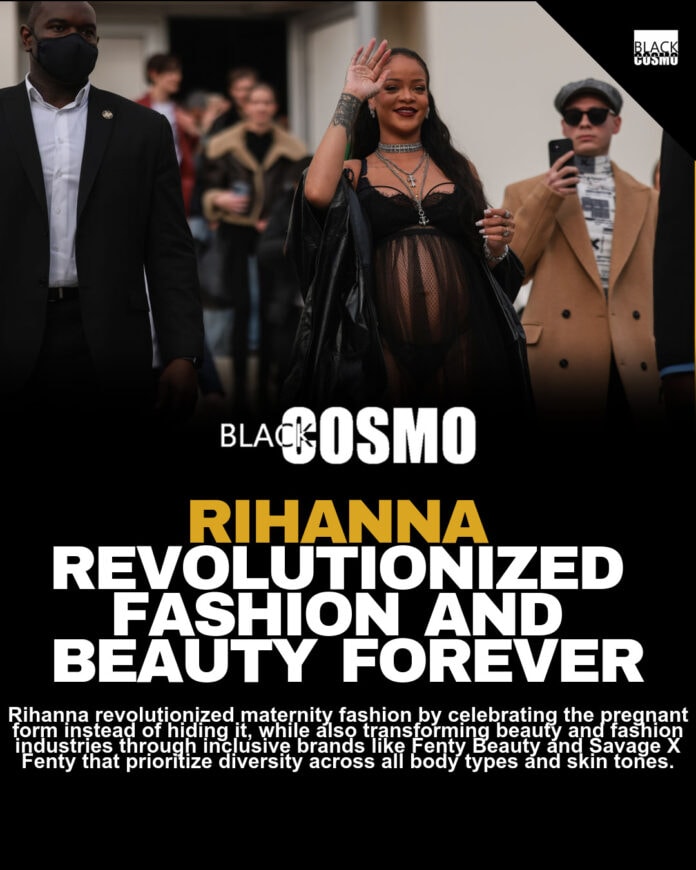
Before Rihanna’s first pregnancy in 2022, maternity wear lived in a narrow lane. Long, shapeless dresses. Oversized shirts designed to hide rather than celebrate. The bump was treated like something to conceal, not showcase. Then she walked through Harlem with her belly on full display, jeweled and unapologetic in a hot pink puffer coat on a freezing winter day.
Paris Fashion Week saw her in a sheer dress that made the bump impossible to ignore. Milan gave us latex and purple fur. Her second pregnancy brought intentional silhouettes that honored the body’s shape. By the 2025 Met Gala, she was wearing a custom Marc Jacobs suit designed to accentuate her stomach. The message was clear: pregnancy is not something to dress around. It’s something to dress into.
That shift has rippled through the entire industry. Maternity wear is bolder now. More daring. The focus flipped from hiding to celebrating, and that’s directly traceable to her influence on the red carpet.
Fenty Beauty Filled a Market Gap

The beauty industry had a problem it wasn’t addressing: Black women couldn’t find foundation that matched their skin tone. The solution involved mixing shades, endless swatches, and settling for something close enough instead of right. When Fenty Beauty launched in 2017, it was less of a brand launch and more of a correction.
Forty foundation shades. An Instagram caption: “Foundation for all. What’s yours?” Models of every conceivable skin tone representing the brand. It wasn’t subtle, and it wasn’t meant to be. The message was that the old gatekeeping was over.
The impact spread beyond Fenty itself. Black-owned beauty brands like Danessa Myricks gained visibility and traction. The broader industry started paying attention to shade ranges, finally recognizing what Black women had been saying all along: inclusivity isn’t a nice marketing angle. It’s good business.
Savage X Fenty Redefined the Runway

Victoria’s Secret owned lingerie fashion for decades. Tall, thin, toned models in a specific mold. That was sexy. Everything else was an exception. In 2018, Rihanna looked at that formula and rejected it entirely.
Her New York Fashion Week show featured pregnant models, curvy bodies, short frames, tall ones, tattooed skin, and everything in between. The runway became a reflection of actual humanity instead of an impossible standard. She spoke about it plainly: women should feel confident in lace, in corsetry, in a simple T-shirt bra. The body wearing it doesn’t determine whether that’s possible.
Lingerie competitors noticed. They began reimagining their own shows, broadening their casting, shifting their messaging. One brand’s creative decision rippled outward, forcing an entire industry to reconsider what it had assumed about desirability and luxury.
Rihanna’s influence isn’t about one viral moment or a perfectly timed campaign. It’s about sustained creative conviction. She identified what was missing—inclusive maternity wear, shade-matched foundation, lingerie that fit all bodies—and built infrastructure around those ideas. That’s not just cultural impact. That’s business strategy rooted in actually listening to who gets left behind.
★TR★