
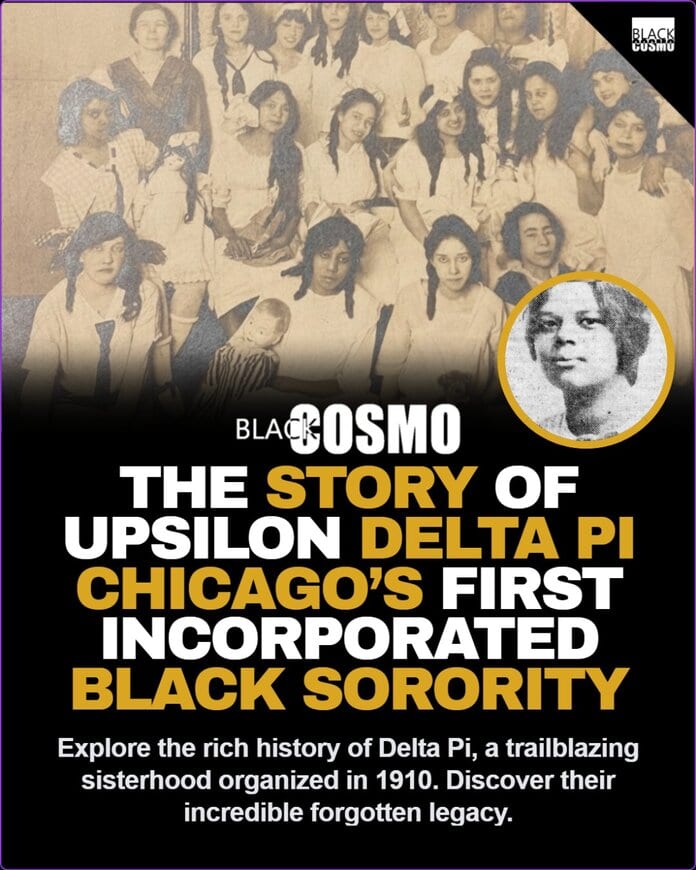


THE FORGOTTEN STORY OF UPSILON DELTA PI — CHICAGO’S FIRST INCORPORATED BLACK SORORITY
Long before many of the nationally known Black Greek organizations expanded across the country, a group of young women in Chicago quietly made history.
In 1910, society matron Shelley Parker organized a club for young Black women called the Do-Li-So Club. The organization focused on domestic skills, social development, and literary engagement for Black women in Chicago during a time when opportunities for them were limited.
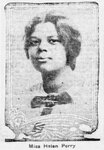
The club started with nine members, including Helen Perry, who served as president, Ethel Mitchell as secretary, and Norma Kennedy as treasurer.
At the time, the influential Black newspaper The Chicago Defender encouraged similar organizations to form across the city, noting that groups focused on the welfare and development of young Black women were “badly needed.”
The Birth of Upsilon Delta Pi
Between 1910 and 1911, the Do-Li-So Club reorganized and adopted a new identity: Upsilon Delta Pi Sorority.
Most members were high school students attending Englewood High School or Wendell Phillips High School.
But their organization quickly faced a major obstacle.
In 1911, the Chicago Board of Education banned secret societies, fraternities, and sororities in public schools, forcing students to choose between their memberships or their education.
Rather than dissolve the organization, the women made a bold move.
On December 7, 1911, Upsilon Delta Pi formally incorporated.
That decision made them the first incorporated Black sorority in American history.
The incorporators were:
• Helen Perry
• Beatrice Lee
• Ethel C. Mitchell
Chicago’s Black Social Elite
Upsilon Delta Pi quickly became known within Chicago’s Black social scene.
The sorority hosted elegant gatherings and cultural events that regularly appeared on the city’s social register. One New Year’s party in 1915 was described by the Chicago Defender as “one of the most brilliant affairs of the holiday season.”
Their meetings blended social life with intellectual engagement — music, games, discussion, and community building were all part of the experience.
A Hidden Link to Major Black Sororities
What makes Upsilon Delta Pi even more fascinating is its connection to nationally recognized Black sororities.
Many of its members later joined or helped build organizations such as:
• Alpha Kappa Alpha Sorority
• Delta Sigma Theta Sorority
In fact, when Alpha Kappa Alpha chartered its Beta Chapter in Chicago in 1913, the entire charter membership came from women who were also members of Upsilon Delta Pi.
Some members held dual affiliations across organizations during that early era of Black Greek life.
Notable Women of Upsilon Delta Pi
The sorority’s members went on to accomplish remarkable things.
Helen Perry
Later joined Alpha Kappa Alpha and helped establish the Theta Omega graduate chapter in Chicago.
Beatrice Lee
A University of Chicago graduate who later built a life in Paris as a businesswoman after marrying actor Opal Cooper.
Netta Paullyn Garner
An internationally recognized pianist who performed in London and Paris.
Eva Overton
A University of Chicago graduate who helped establish Alpha Kappa Alpha’s Beta Chapter.
Geraldyn Dismond Major
Later became an associate editor at Ebony Magazine and senior editor at Jet Magazine.
Vivian Harsh
Became the first Black head librarian in the Chicago Public Library system and built one of the most important collections of Black historical materials in Chicago.
Why the Sorority Disappeared
By the late 1920s, Upsilon Delta Pi began to fade.
The rise of national Black Greek-letter sororities shifted attention away from local organizations.
As chapters of Alpha Kappa Alpha, Delta Sigma Theta, and Sigma Gamma Rho expanded in Chicago, national sororities also began implementing policies preventing women from holding membership in multiple organizations.
These changes gradually led to the decline of local sororities like Upsilon Delta Pi.
A Legacy That Deserves Recognition
Although Upsilon Delta Pi eventually faded from prominence, its impact remains significant.
It helped nurture a generation of Black women who went on to shape education, journalism, music, and civic leadership.
More importantly, these young women proved that Black women in early 20th-century America were already organizing, leading, and building institutions long before many of their stories were widely documented.
Sometimes history doesn’t disappear.
It simply waits to be rediscovered.


. High school pioneers defied bans, shaped AKA/Delta chapters, and launched icons like Vivian Harsh. Hidden Black Greek history unveiled.)