
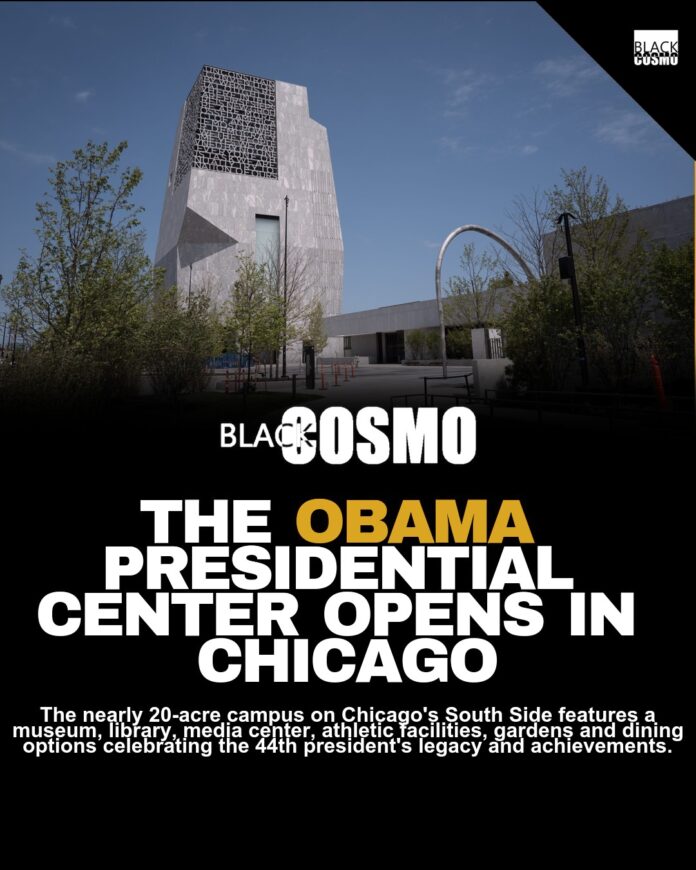
The Obama Presidential Center opened its doors on Chicago’s South Side this year, cementing the legacy of the nation’s first Black president in architecture and public space. The nearly 20-acre campus in Jackson Park is more than a museum. It’s a complete community hub featuring a library, media center, athletic facilities, gardens, and dining spaces designed to engage visitors of all ages.
What makes this accomplishment particularly meaningful is its location. The center sits near the University of Chicago, where President Obama taught constitutional law for over a decade. That connection to the South Side neighborhood feels intentional, grounded in place rather than abstracted into some distant memorial. Walking through Obama Presidential Center, visitors encounter both intimate and expansive moments designed to inspire reflection.
Inside the Museum

The museum itself is a study in light and openness. Sunlit spaces flow naturally, designed to welcome rather than intimidate. Exhibits showcase President Obama’s major legislative achievements and the evolution of his presidency. One standout installation, “Yes We Can,” captures the spirit that defined his campaign.
The centerpiece of the museum includes a full-scale replica of the Oval Office where Obama signed critical legislation, including the Child Care and Development Block Grant Act of 2014 and the Bipartisan Budget Act of 2015. Walking through that space offers a tangible sense of the decisions made there.

Artist Njideka Akunyili Crosby created a portrait of the former President and First Lady using mixed media, capturing them in a moment of grace. The work demonstrates the kind of cultural meditation the center encourages throughout its galleries.
Michelle’s Fashion Legacy
A dedicated section honors former First Lady Michelle Obama’s influence on style and culture. Her wardrobe choices during eight years in the White House weren’t just fashion. Each outfit was a statement piece, representing Black excellence and cultural pride. The museum preserves key looks from her time as First Lady, offering visitors insight into how she wielded fashion as soft power and representation.
The Sky Room and Beyond

At the top of the museum sits The Sky Room, a luminous space offering sweeping views of Chicago. Artist Idris Khan’s “Sky of Hope” installation anchors the space, creating a moment of contemplation and perspective. It’s the kind of detail that shows thoughtfulness in design.

The Media Suite includes a recording studio and production spaces where visitors can engage with digital storytelling and content creation. These facilities serve After School Matters programming, extending the center’s reach beyond adults into youth engagement.
Community Spaces
The campus features an impressive 60,000-square-foot athletic and event space with an NBA regulation basketball court. Obama’s belief in sports as a community connector runs throughout the design. The space hosts wellness workshops and gatherings that activate the grounds beyond ceremonial visits.

A new branch of the Chicago Public Library anchors the campus with diverse collections and a 70-foot mural by artist Aliza Nisenbaum. The library functions as a true civic resource, open to the community with e-books, magazines, and reading spaces designed for both casual browsing and serious study. It signals that the center exists for public use, not just tourism.
Food and Gardens

Two dining venues serve visitors. The Cafe, named after activist and musician Mahalia Jackson, offers casual refreshment. Tafari’s Kitchen, led by local chef Cliff Rome, pays tribute to beloved Obama White House chef Tafari Campbell, who died in a drowning accident in 2023. The kitchen demonstrates how food becomes memory and honor.

The Eleanor Roosevelt Fruit and Vegetable Garden includes a Teaching Kitchen where visitors learn to grow and prepare fresh produce. It connects to Michelle Obama’s work on childhood nutrition and community wellness, giving practical education alongside cultural history.

For families, a nature-inspired playground features slides, swings, and activities designed for children to move and explore. It’s a reminder that presidential legacies belong to everyone, especially those growing up in the shadow of history.
The Obama Presidential Center doesn’t feel like a traditional presidential library. It functions as a living community space that honors the past while remaining oriented toward the future. That distinction matters, particularly for a center built on Chicago’s South Side, grounded in the neighborhood where Obama’s political identity was forged.
★tr★