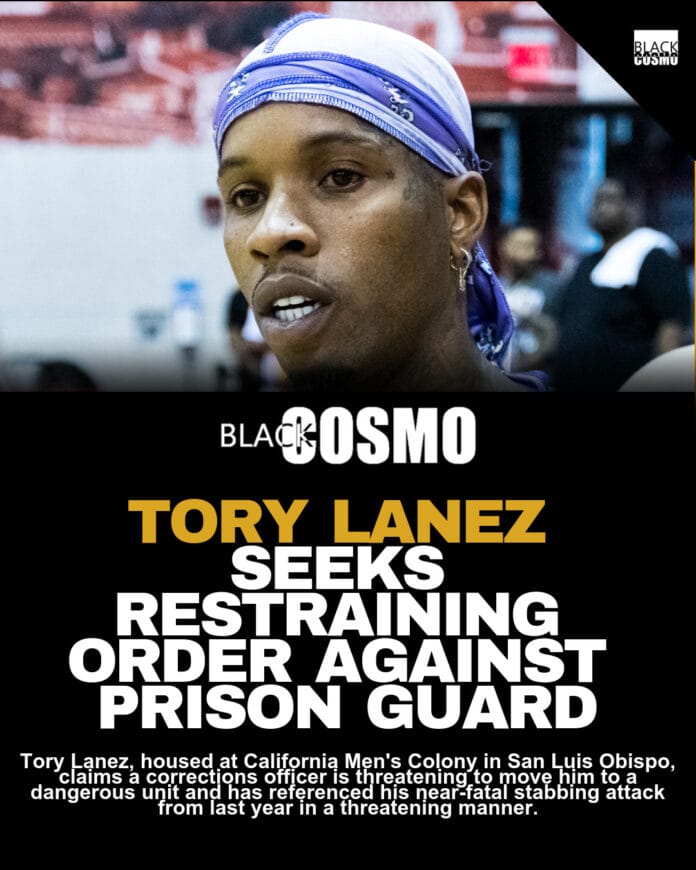
Tory Lanez is seeking a federal restraining order against a corrections officer at his current prison facility. According to court documents obtained by BlkCosmo, the artist claims he’s facing ongoing threats, intimidation, and harassment while housed at the California Men’s Colony in San Luis Obispo, causing him to fear for his safety.
The court filings allege that a prison guard plans to move Tory Lanez to a more dangerous housing unit. His legal team also contends that a corrections officer recently made threatening references to his near-fatal attack from last year, creating what they describe as a hostile environment.

Last year, Lanez was stabbed 14 times during a brutal prison attack that resulted in two collapsed lungs. The incident left both physical and emotional scars. Following that assault, he filed a $100 million lawsuit against the California Department of Corrections and Rehabilitation, the prison warden, and multiple corrections officers, alleging negligence in housing him with an inmate known for violent behavior.
The lawsuit detailed how the fellow inmate had a documented history of violence and should never have been placed in the same cell. Now, with his civil case pending, Lanez’s team fears retaliation. They’re asking the court to issue a restraining order limiting the officer’s direct contact with him to essential prison functions only, and to prohibit the facility from retaliating against him.
The request reflects growing concerns about his safety inside. Lanez emphasized in the filings that he nearly died from the stabbing and views the current situation as a continuation of the danger that should have been prevented.
His legal team believes the restraining order is essential protection given the circumstances. Without it, they argue, Lanez remains vulnerable to further harm from someone in a position of authority within the prison system.
The case underscores ongoing concerns about inmate safety and accountability within California’s correctional facilities. Lanez’s situation has drawn attention to questions about how prisons handle protection and prevent conflicts when individuals housed together have incompatible backgrounds.
★★★