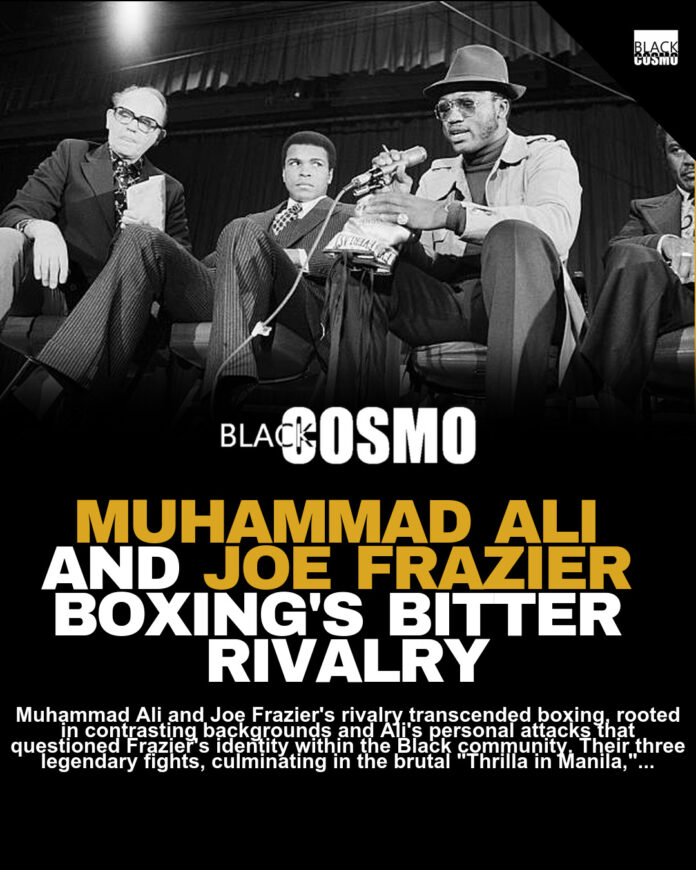
Boxer Muhammad Ali steps away from a punch thrown by boxer Joe Frazier during their heavyweight title fight at Madison Square Garden in 1971. Frazier became the undisputed heavyweight champ of the world by winning a unanimous 15-round decision.
Today marks the 51st anniversary of the “Thrilla in Manila,” the October 1, 1975, showdown between the late Muhammad Ali and Joe Frazier that became one of boxing’s most brutal fights. But the fight wasn’t just happening in the ring. Ali famously called Frazier an “Uncle Tom” and compared him to a gorilla, turning their once-friendly relationship into a bitter rivalry.
We’re exploring the devastating fallout of a rivalry that played out across three fights and included questions of Black identity, class, colorism and pride. By the end, Ali described their final bout as being “like death” and reflected that they both “came back as old men.” Here’s what you should know about their historic feud.
The Rivalry Started as Friendship
Muhammad Ali and Joe Frazier weren’t always enemies. The two heavyweight champions first met in 1967 and developed a friendship and mutual respect that would later become complicated by their fierce rivalry.
Two Black Fighters, Two Very Different Images
Muhammad Ali was born Cassius Marcellus Clay Jr. on January 17, 1942, and grew up in a relatively stable, middle-class neighborhood in Louisville. He was introduced to boxing by police officer Joe Martin after his bike was stolen. Joe Frazier, born January 12, 1944, in Beaufort, South Carolina, grew up on a southern farm where he worked from an early age to help support his family. By age 6, he was already working 12-hour days for a dollar, according to the Ali Center.
These vastly different backgrounds shaped not just their boxing styles, but how they presented themselves to the world. Ali embodied a new generation of Black pride and visibility, while Frazier represented a different path, one rooted in quiet determination and working-class resilience. That distinction would become central to their conflict.
Frazier Defended Ali When He Refused to Fight in Vietnam
In 1967, Ali refused induction into the U.S. Army, citing his religious beliefs and opposition to the Vietnam War. He was stripped of his heavyweight title and banned from boxing, leaving him struggling financially during his exile. Frazier, then a young fighter and rising rival who admired Ali’s conviction, publicly supported his right to refuse the draft. He gave Ali money, advocated for his reinstatement and called for his boxing license to be restored. It was a moment of genuine solidarity between future opponents.
Ali Went After Frazier

When Ali returned to the sport, he declared that Frazier’s belt didn’t mean a thing and that he was still the champion. What had been genuine friendship curdled into something uglier. Ali began throwing insults with surgical precision, words that would later be exchanged in the ring. The crowds were captivated, but Frazier felt betrayed.
Attacks That Cut Deeper Than Boxing
Ali’s verbal assault was relentless. “We have to whoop Joe Frazier, because Joe Frazier is too ugly to be the World Heavyweight Champion,” he told crowds at various press conferences. But the worst was still coming.
Ali repeatedly called Frazier an “Uncle Tom” and later compared him to a gorilla, taunts that hit at something deeper than boxing technique or ring performance. These insults questioned Frazier’s identity and how he was perceived within the Black community. “He’s not like me,” Ali said, a loaded statement that suggested moral or cultural superiority. The verbal warfare had transformed a once-supportive relationship into one of boxing’s bitterest rivalries.
How “Thrilla in Manila” Got Its Name
Ali’s words cut during the press run leading up to their third fight. He carried a small gorilla toy and taunted reporters with a rhyme: “It will be a killa, and a thriller, and a killa, when I get the gorilla in Manila.” The nickname stuck, and so did the insult—a reminder that this wasn’t just a sports rivalry but a personal attack on Frazier’s dignity.
Fight One: “The Fight of the Century”
Their first official matchup took place at Madison Square Garden on March 8, 1971. Frazier won by unanimous decision after 15 rounds, handing Ali the first professional loss of his career and stunning boxing fans around the world.
The Rematch: “Super Fight II”
Ali and Frazier met again in January 1974. This time Ali won by decision, evening their rivalry at one victory apiece. But the personal tension between them had only intensified, fueled by Ali’s relentless verbal attacks and Frazier’s simmering resentment. A third and final meeting was inevitable.
The “Thrilla in Manila” — October 1, 1975
On that October night in the Philippines, Ali and Frazier met for the third and final time, with Ali defending his heavyweight title. The fight was scheduled for 15 rounds, but Frazier’s trainer stopped it before the final round, giving Ali a technical knockout victory. What transpired was one of the most physically punishing heavyweight bouts ever contested.
The Physical and Emotional Toll

By the end, both men were physically spent. Frazier’s left eye had swollen shut. Ali was so exhausted that he collapsed onto the canvas after the final bell. Ali later described the bout as being “like death,” saying it was the closest thing to dying he knew. He reflected with a rawness that haunts decades later: “We went to Manila as champions, Joe and me, and we came back as old men.”
Neither fighter fully recovered from what that night took from them. The physical damage was visible, but the emotional scars ran deeper.
The Legacy of Overshadowing

Ali’s repeated insults left Frazier feeling that his accomplishments were forever overshadowed by their rivalry and that he was denied the respect he believed he had earned. “I do all the right things. And this is the way people look at me because of him,” Frazier said regarding his feud with Ali. “I know things would have been different for me if Clay hadn’t been around. I’d have gotten a lot more respect. I’d have had more appreciation from my own kind.”
The tragedy of the Ali-Frazier trilogy is that it wasn’t just about who was the better fighter. It became about whose version of Blackness, whose story, would be remembered. Ali’s charisma and eloquence dominated the narrative. Frazier’s quiet strength, his loyalty when it mattered most, faded into the background. That imbalance is something Frazier carried for the rest of his life, and it’s worth acknowledging when we celebrate one of boxing’s greatest rivalries.
★TR★