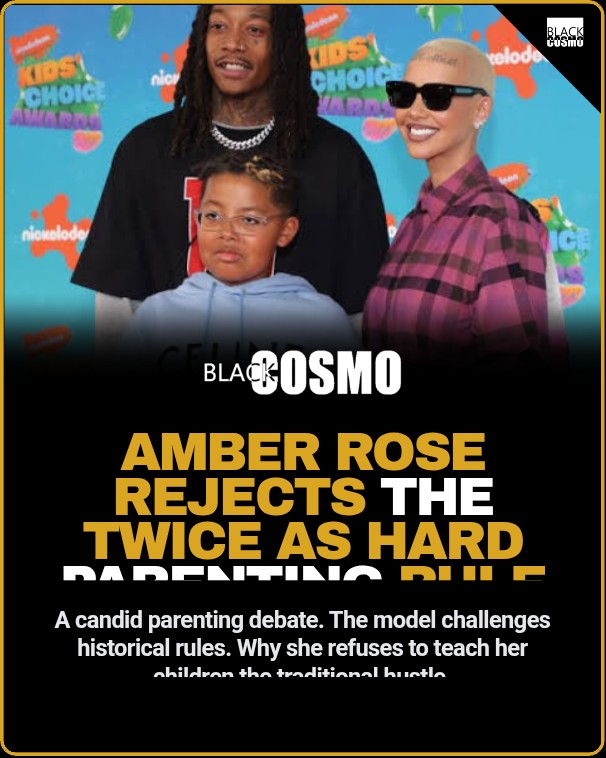
A public conversation on the realities of Black parenting has opened up after a prominent celebrity shared her perspective. During an appearance on the Truth After Dark podcast, hosted by Paul Pierce and Azar Farideh, Amber Rose openly shared why she rejects traditional advice on race when it comes to raising her children. The media personality, known for her candid and often polarizing stances, explained that she intends to shield her children from what she views as a restrictive mindset, sparking intense discussion about how Black children are prepared for the world today.
In her discussion, Amber Rose elaborated on her parenting philosophy, explaining that she will not instruct her kids to overcompensate due to their skin color. She declared that she refuses to tell her children they must work ten times harder than their peers simply because of their racial identity. For generations, the idea of having to perform twice as well to get half as far has been a foundational talk in many households, passed down as a shield against systemic hurdles. By stating she rejects traditional advice on race, she is actively steering away from a playbook that she believes instills an early sense of defeat before a child even begins to chase their dreams.
Her comments focused heavily on personal agency and self-belief. She noted that while hard work is necessary for greatness, she believes everyone faces that same requirement. She cited professional basketball as an example, stating that if you want to reach the level of an all-star player, intense labor is non-negotiable. She argued that skin color in America will not prevent her children from achieving greatness, emphasizing her desire for them to focus on tangible goals. She expressed a firm belief that children should be raised to see themselves as equals in a free nation, capable of pursuing any career path they choose without feeling inherently disadvantaged.
This perspective has naturally met with significant pushback. Critics suggest that ignoring the structural barriers that persist in corporate spaces, the justice system, and daily life does her children a disservice. Many commentators, including figures on Joe Budden TV, have raised questions about whether her stance ignores the lived experiences of millions who have faced bias despite their qualifications. Preparing children with both confidence and a realistic awareness of historical hurdles is viewed by many parents as essential survival training. Her critics argue that skipping these conversations leaves young people unprepared for the subtle and overt forms of discrimination they might face.
This dialogue is not new for the mother of two, who shares her eldest son with rapper Wiz Khalifa. She has previously made headlines for her unconventional parenting methods, such as teaching her son about consent at a very early age and allowing him to express himself freely. Her latest statements point to a growing generational divergence in how mothers approach the preparation of their children. While some parents view the traditional warnings as essential protection, others are beginning to question whether those very warnings inadvertently impose psychological boundaries on young minds.
By centering self-determination over systemic limitations, the conversation highlights a deeper philosophical debate. Is it better to equip children with the hard truths of racial bias to prevent shock, or is it healthier to foster an unrestricted sense of possibility? As the debate continues, it becomes clear that there is no single consensus on the matter. The choices made by individual families remain deeply personal, reflecting the complex task of raising children in a society that continues to grapple with its own historical inequities.
The conversation also touches on class privilege and how it shapes one’s view of opportunity. Having achieved substantial financial security and social status, her children will grow up in environments that differ vastly from those of working-class families. This distinction is crucial, as wealth can often act as a buffer against some of the more immediate effects of institutional bias. For a child with access to elite networks and resources, the path to greatness is inevitably different from that of an ordinary kid from Philadelphia or Chicago. Recognizing how wealth intersects with race is a key piece of the puzzle that many observers feel was missing from her podcast remarks.