
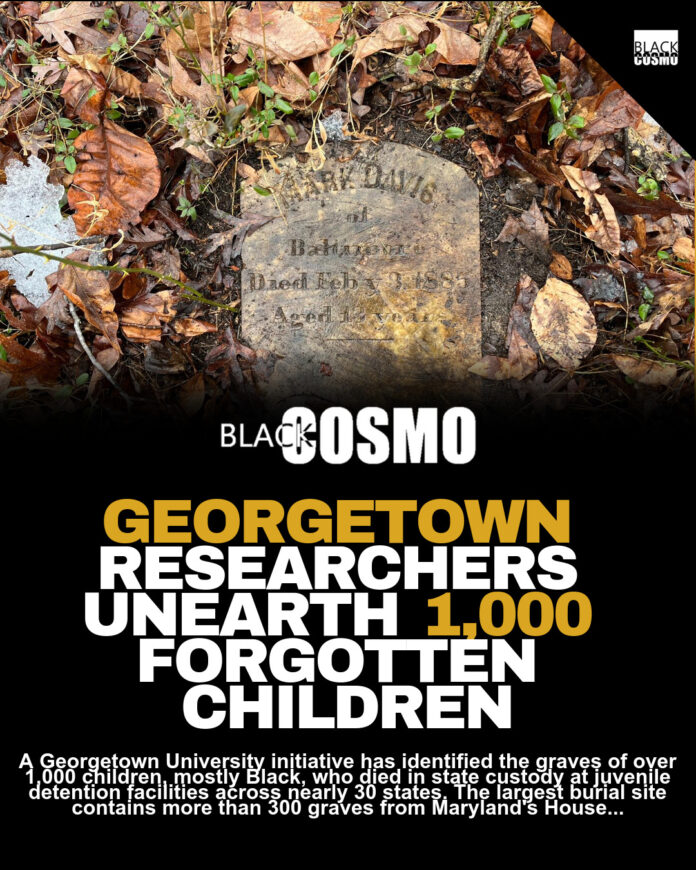
An abandoned 19th-century grave is seen on the grounds of the House of Reformation for Colored Children, a closed down segregated juvenile detention facility that operated in the late 19th and early 20th century, in Cheltenham, Maryland, on February 17, 2026. Mark Davis was 13 years old when he perished in a juvenile detention facility for Black boys in the eastern US state of Maryland some 140 years ago. Today, his remains lie in an abandoned graveyard in the woods, covered by dead leaves and snow, along with the graves of some 200 other Black boys and teenagers held at the facility in conditions that researchers describe as inhumane. A team from Georgetown University is investigating their deaths and memorializing them. (Photo by Victoria LAVELLE / AFP via Getty Images)
The Georgetown University initiative identifies children—predominantly Black—who died in state custody, locates their graves, and when possible, reconnects them with surviving family members. In “Nickel Boys,” the bodies of detained boys were placed in unmarked graves near the fictional Nickel Academy, inspired by the real-life Dozier School for Boys in Florida. That burial pattern mirrors what happened at other segregated institutions, including the Forgotten Children Initiative‘s findings at the House of Reformation and Instruction for Colored Children in Maryland.
As of October 2026, the initiative has located graves of over 1,000 children across nearly 30 states, according to NPR. The largest burial site sits near the House of Reformation, now called the Cheltenham Youth Detention Center. Founded in 1870, it was the South’s first juvenile detention facility exclusively for Black children, some as young as five. Researchers document the horrific abuse and conditions these children faced.
The Maryland Department of Juvenile Services documented systemic cruelty: boys forced to work without food, beaten by white guards wielding brass-studded belts, sent to nearby farms for unpaid labor. More than 300 Black boys and young men died at Cheltenham, their graves marked with stones, concrete blocks, or nothing at all.
The Forgotten Children Initiative’s work prompted Maryland to establish a commission including descendants of the forgotten children. This body will shape the site’s future and determine how the state should reckon with its institutional violence.
Maryland Senator Will Smith told NPR: “Understanding this history is tremendously important, but understanding how this history connects to our current practices is almost probably more important.”
The commission expects to release its initial report by the end of 2027.
★TR★