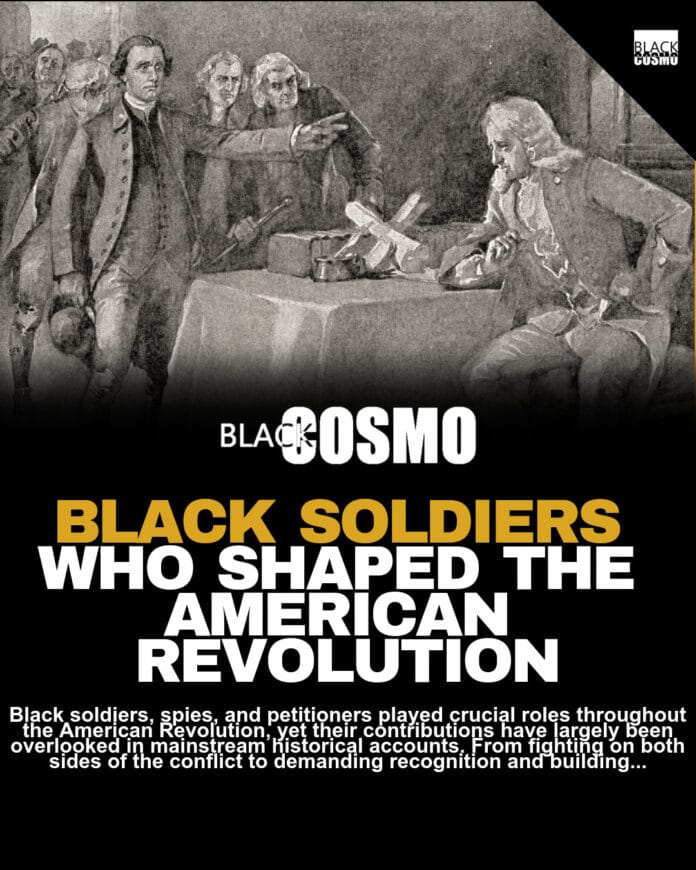
The 250th anniversary of America arrives as historians continue to confront the full, complicated truth of the American Revolution and the Black soldiers, spies and petitioners whose stories have often been pushed to the margins. While Crispus Attucks is often remembered as a symbol of resistance after his death in the Boston Massacre, the American Revolution was shaped by many more Black lives in motion—fighting, escaping, gathering intelligence and demanding recognition in a nation still defining its meaning of freedom.
While it’s estimated that around 5,000 Black men fought on the Patriots’ side, thousands more Black people—enslaved and free alike—fought for the British, according to the Museum of the American Revolution. From double agents whose intelligence helped secure victory at Yorktown to the historic 1775 proclamation that pulled thousands of enslaved people into British lines, Black contributions to the war effort were vast, timely and often crucial to the Patriots’ victory. Beyond battle, figures like Prince Whipple and Dinah Whipple show how the American Revolution extended into petitions, education and early Black community building. Together, their stories reveal a founding era defined not only by independence and exactly who was excluded from it.
The Consequences of Dunmore’s Proclamation
Dunmore’s Proclamation by Virginia’s royal governor promised freedom to enslaved people who left Patriot enslavers and joined British forces in 1775, according to the Gilder Lehrman Institute of American History. It led hundreds of the enslaved to escape and fight for Britain, while intensifying fears among slaveholders and pushing Virginia toward rebellion. As a result, more Black soldiers enlisted with the British, slave patrols intensified and long-term resettlement of Black Loyalists continued well after the war ended.
The Rise of the Royal Ethiopian Regiment
After the proclamation, Dunmore organized runaway enslaved people into an armed unit known as the Ethiopian Regiment, which provided military labor, intelligence and limited combat support, according to the American Battlefield Trust. The regiment assisted British operations in Virginia, including clashes like Kemp’s Landing and Great Bridge, but suffered heavy losses from disease, warfare and evacuation. As Patriot resistance strengthened, Dunmore was forced to retreat from Virginia, and the Ethiopian Regiment was eventually broken up and absorbed into other British units or dispersed. Still, this band of Black soldiers stands as one of the most effective defenses in the Revolution.
Cato

An enslaved man known as Cato, likely associated with the Schuyler family, may have helped Revolutionary spy Hercules Mulligan relay intelligence that exposed a British plot to assassinate George Washington in 1779, Smithsonian Magazine reported. Recent historical research suggests Cato carried Mulligan’s warning from New York to Patriot contacts. However, evidence remains partly circumstantial, and his exact role and identity are still debated among historians.
James Armistead Lafayette

James Armistead Lafayette was born into slavery in Virginia and became a Patriot double agent during the war, according to the American Battlefield Trust. Pretending to be a runaway, he gained British trust, gathered vital intelligence and supplied misleading information that helped secure victory at Yorktown. After years of petitioning and with Marquis de Lafayette’s support, he gained freedom in 1787 and later adopted Lafayette’s surname.
Pompey Lamb

Pompey Lamb is traditionally remembered as a Black spy during the American Revolution who allegedly helped Patriot forces at the Battle of Stony Point by gathering intelligence while posing as a fruit seller inside the British fort, according to the American Battlefield Trust. Historians aren’t certain he really existed. The story is largely anecdotal because it lacks primary-source evidence. Still, his legend highlights the possibility that many Black spies’ contributions remain undocumented.
Austin Dabney

Austin Dabney was an enslaved Black man who became one of Georgia’s most recognized Black Patriots. According to All Things Liberty, he was sent as a substitute for his enslaver and served in the Georgia militia under Elijah Clarke during the Revolutionary War. He was seriously wounded at Augusta and later cared for by a white family. In 1786, Georgia granted him freedom, a pension and land, making him one of the few Black veterans formally rewarded for service.
Belinda Sutton

Belinda Sutton was an African-born woman enslaved by the Royall family in Massachusetts who became one of the most important early Black petitioners for compensation after the American Revolution, according to the Royall House and Slave Quarters. After Isaac Royall Jr. fled as a Loyalist, Massachusetts seized his estate, and in 1783 Belinda petitioned the legislature for reparations based on her decades of forced labor and suffering.
In her petition, she described her kidnapping from Africa, long enslavement and argued that the wealth of her enslaver was built through her labor. The legislature granted her a yearly pension, though payments were inconsistent and she had to re-petition multiple times over the following years.
Ishmael Titus

Ishmael Titus was born into slavery in Virginia around 1743 and earned his freedom by serving in the American Revolution in place of his enslaver, according to the Charlotte Museum of History. He later re-enlisted voluntarily and fought at the Battles of Kings Mountain and Guilford Courthouse. Although his Revolutionary War pension application was denied, he became recognized as an important Black Patriot whose service is commemorated today.
Peter Salem

Peter Salem was born into slavery in Massachusetts and gained his freedom so he could enlist in the Patriot militia during the American Revolution. He fought at Lexington and Concord and is widely remembered for his role at the Battle of Bunker Hill, the American Battlefield Trust reported. That’s where he may have mortally wounded Major John Pitcairn. Salem continued serving throughout the war but died in poverty despite his distinguished military service.
Salem Poor

Salem Poor was born enslaved in Andover, Massachusetts, and purchased his freedom in 1769. He later joined Patriot forces and fought at the Battle of Bunker Hill in 1775, where officers praised his extraordinary bravery and petitioned for his recognition as a “brave and gallant soldier,” according to the American Battlefield Trust. He continued serving in the Continental Army through the Revolutionary War but faced poverty after the war, ultimately dying in 1802 in Boston.
Barzillai Lew

Barzillai Lew was a free Black man born in Massachusetts in 1743 who became a skilled fifer and drummer during both the French and Indian War and the American Revolution. He enlisted in 1775 and fought at the Battle of Bunker Hill, where his music helped boost Patriot morale during combat, according to the African American Registry.
After the war, he and his family built a stable life as landowners and farmers in Massachusetts, raising a large family. Lew’s life reflects both Black military service in the Revolution and the possibilities of limited postwar freedom and community building.
Prince Whipple

Prince Whipple was an enslaved African man who fought on the side of the Americans while serving under New Hampshire officer William Whipple. In 1779, he joined a petition demanding freedom, arguing that liberty was a natural right the new nation was supposed to uphold, Civics For Life reported. The request was ignored, exposing the gap between Revolutionary ideals and the reality of slavery.
Dinah Whipple

Dinah Whipple, a formerly enslaved woman in Portsmouth, New Hampshire, played a central role in early Black education and community life right after the American Revolution, according to the New Hampshire Women’s Foundation. Emancipated at age 21, she married Prince Whipple and later raised their family after he died in 1797.
Around 1807, she founded and ran the Ladies Charitable African Society School in her home, likely the only school in New Hampshire for Black children. She operated it for decades while supporting her family in difficult economic conditions. Though little of her own writing survives, historical records show her lasting impact as an educator and community leader.
★TR★