Black folklore has shaped our cultural identity since long before the Transatlantic Slave Trade. Many stories emerged from spiritual beliefs and cultural practices, while others drew directly from the lived experiences of enslaved people—documenting horrors, building collective memory, and kindling the will to survive and resist.
The tales range from trickster stories that make you laugh to ghost stories that keep you awake at night, many tied to specific regions across the country and beyond. As Halloween approaches, here’s a look at some of the most compelling Black folklore stories that have endured through generations—some you might recognize, others that deserve to be rediscovered.
Candyman, Candyman, Candyman
The 1992 horror film drew its inspiration from Clive Barker’s short story “The Forbidden,” but the legend behind Candyman runs deeper. The story centers on the ghost of a Black artist and son of an enslaved man, murdered by a white mob after his relationship with a white woman became public. His hand was sawed off and coated with honey, leading to his death by bee stings.
Director Bernard Rose remixed this tragedy into the tale of a phantom who haunted Chicago’s Cabrini Green public housing development—the site where his corpse was burned centuries before. In the legend, he taunted children with candy laced with razor blades and kidnapped them with the hook he wore in place of his severed hand. The ritual summoning is simple and terrifying: say his name five times into a mirror.
Blue Paint Keeps Away Haints
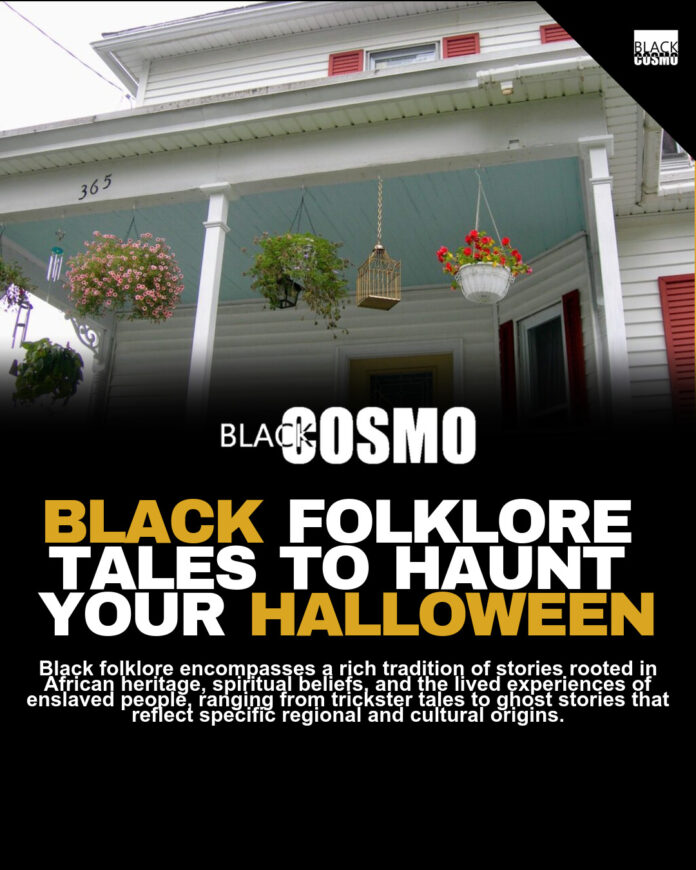
The Gullah Geechee people—descendants of enslaved Africans from the Lowcountry of the American Southeast—carry stories of “haints,” or evil spirits that stalk the living because they haven’t accepted their own death. These malevolent beings prey on disobedient children and attempt to inhabit the homes of the living. To ward them off, many houses across the Southern region are painted “haint blue,” a practice rooted in the belief that spirits cannot cross water or certain colors. The tradition persists today as both spiritual protection and visual marker of cultural continuity.
Boo Hag

Another Gullah Geechee tale, the Boo Hag traces back to West African folklore—a shapeshifting vampire that hunts at night. The creature sheds its skin to prey on sleeping people, either draining their blood or stealing their breath. To protect yourself, tradition says to keep a broom or pile of straw near your bed. The hag supposedly becomes so distracted counting the straw that she forgets about you entirely, a detail that speaks to the ingenuity embedded in these survival stories.
Dancing Devils

These are not spirits but people embodying them. Originating in Liberia, dancing devils are tribal deities venerated by the Poro men’s society and Sande women’s society. Their performances tell folklore stories that reinforce social order through ritualized punishment and wisdom.
The group operates in secrecy, accepting members only through initiation. When they emerge in their grand displays—towering on stilts or covered in dense straw—they command attention and reverence, their masked forms carrying the weight of ancestral presence and cultural continuity.
Big Liz

The most famous ghost of the Chesapeake Bay is Big Liz. While versions of her story vary, the most widely known tells of a large enslaved woman on a plantation near Greenbriar Swamp. Her enslaver ordered her to carry a chest full of his possessions to the swamp. After she dug a hole and placed it inside, he drew his sword and beheaded her without warning. Swamp visitors report strange sightings and chilling presences around the area ever since, with locals claiming Liz still haunts the water.
Some say you can summon her by honking your horn or flashing your headlights on the swamp’s bridge.
Voodoo Queen Marie Laveau

Laveau was no mere urban legend but the Voodoo Queen of late 1800s New Orleans. Working as a hairdresser to wealthy white women, she heard their secrets and leveraged that knowledge shrewdly. Initially a devoted Catholic, she began incorporating Voodoo practices into her work, trading spiritual services for status and financial gain. She died peacefully at 79, but locals swear her spirit still wanders St. Louis Cemetery.
Visitors to her tomb report drawing three X marks, turning around three times, knocking, and making a wish. Legend has it the ritual works.
The Ghost of Myrtle’s Plantation

The story of Chloe at Myrtle Plantation in St. Francisville centers on an enslaved girl allegedly targeted for assault by Judge Clark Woodruffe. When caught eavesdropping on plans to send her to fieldwork, the judge mutilated her ear. She covered the wound with a turban and devised a dark plan: poison the family’s birthday cake. The judge didn’t eat any. When locals learned what she’d done, they lynched her.
Visitors to the mansion report seeing a shadowy female figure in photographs, and many believe it’s Chloe, still present within those walls.
Anansi

One of the most celebrated tricksters is Anansi, a spider-like creature from Ghanaian folklore adopted across the Caribbean. Originally regarded as a world creator, Anansi is known for outsmarting oppressors through cunning and quick thinking—employing tactics both clever and brutal, from exploitation to betrayal. For enslaved people, Anansi represented something profound: the possibility of escape, resistance, and survival through wit.
The Boogeyman

Most cultures have a version of the boogeyman—a dark figure that preys on disobedient children. In Haiti, he goes by Tonton Macoute (“Uncle Gunnysack”), a mythological being who kidnaps kids by throwing them into a sack and eating them for breakfast.
The name took on sinister new meaning in the 1950s when dictator Francois Duvalier created the Haitian secret police and named them after this folklore creature. For decades, Haitians lived in genuine terror, fleeing from what felt like the real-world boogeyman.
Shango

The Yoruba people of Nigeria recognize Shango as the God of Thunder—a deity distinct from the Zeus of Western mythology. Connected to a king of Oyo who reigned for over 500 years, Shango’s legend centers on his fateful experiments with magic to create lightning. His attempts destroyed both his palace and family. Consumed with shame, he took his own life.
But Yoruba belief holds that he ascended as an orisha, a divine being who now wields lightning to defend Oyo from its enemies. His story embodies transformation through catastrophe.
High John Roots

The root medicinal herb appears regularly in spells meant to provide protection from evil spirits, bring good fortune in money and love, and instill strength. Its magical properties trace back to High John the Conqueror, a legendary conjure maker and enslaved trickster. According to African American folklore, High John possessed the ability to appear as a fool in the presence of an oppressor—a survival mechanism encoded in spiritual practice.
Flying Africans

This legend speaks directly to the desire for liberation. It claims some Africans possessed the ability to escape bondage through flight, using a magical passage to return to their homeland. The tale may have roots in documented 1800s events—some scholars connect it to the mass suicide of the Igbo people in 1803, who drowned themselves in refusal to be enslaved, hoping the water would carry them home.
Uncle Monday

Author Zora Neale Hurston documented the legend of Uncle Monday, born in Africa as a practiced shaman. After enslavement brought him to the Carolinas, he escaped and traveled to Florida, where he taught Indigenous people herbal magic. But Uncle Monday’s power extended beyond plants: he could shapeshift into an alligator and commanded other reptiles as well.
He reigned as one of the most formidable Hoodoo practitioners in recorded folklore. Whether his spirit still moves through the streets of Eatonville, Florida, remains an open question.
Sukey and The Mermaid
Sukey’s story follows a girl who sneaks away from garden work to sing to the sea and summon “Mama Jo”—in Caribbean folklore, the “water mother” or mermaid. The two become companions, and Mama Jo begins gifting Sukey coins, which her father seizes. Eventually, Mama Jo offers a grand dowry of jewels and gold on one condition: Sukey must marry a man named Dembo. When he arrives, her father kills him and takes the treasure, fleeing by sea. The waves swallow him whole. Mama Jo revives Dembo through magic, and he and Sukey find happiness together.
This version presents a gentler take on mermaid folklore. The Igbo people passed down stories of half-fish, half-human water spirits, with Mami Wata being the most celebrated—known for healing the sick. In the Caribbean, mermaids often appear as sinister tricksters who seduce men to watery graves.
The Badman

One trickster tale managed to transcend folklore into contemporary culture: The Badman. Unlike the clever Br’er Rabbit, The Badman appears as a sly, dark outlaw—someone who breaks rules and lives by his own code. This archetype became the blueprint for the “gangsta” figure that would later emerge in hip-hop culture. Author John W. Roberts traces this evolution directly to the outlaw persona of “Stag” Lee Shelton, the man who allegedly killed another over a stolen hat, a story that kept evolving until it bloomed into the personas of modern rap artists and street legends we recognize today.
★TR★