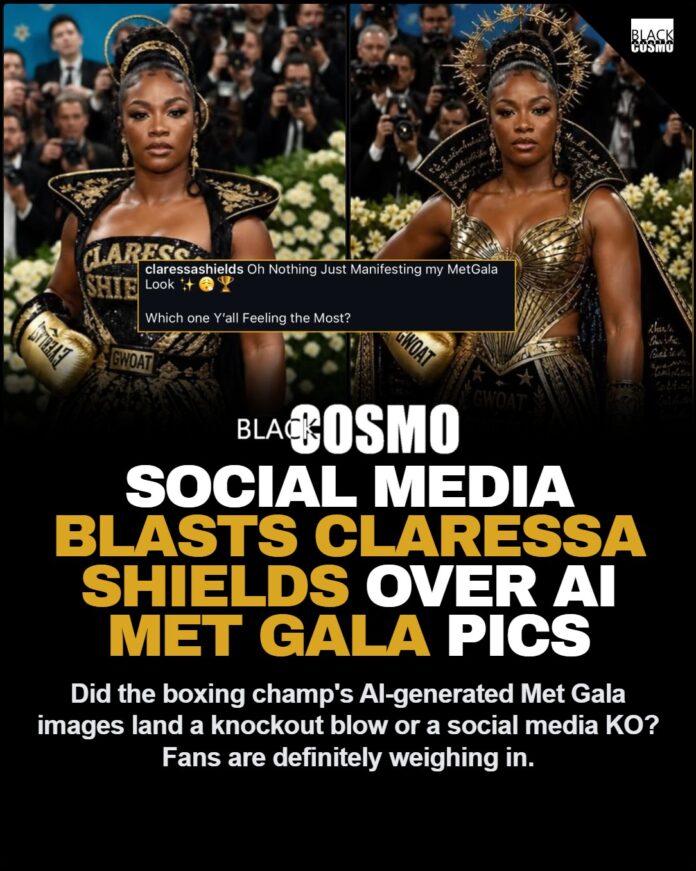
Claressa Shields is facing a barrage of social media commentary after sharing Claressa Shields, shared what many believed were her interpretations of a Met Gala appearance, only to reveal they were, in fact, AI-generated. The move has ignited a fierce debate about authenticity, representation, and the increasing role of artificial intelligence in celebrity culture.
The images, posted across multiple platforms, initially drew praise for their avant-garde designs and striking visual elements. However, once the truth was revealed, the tone shifted dramatically. Now, Claressa Shields finds herself at the center of a complex conversation about the ethics and implications of using AI-generated photos to create a public persona.
The Digital Dress: A Breakdown of the AI Designs
The AI-generated photos depicted Shields in a series of fantastical gowns that pushed the boundaries of high fashion. One image showcased a dress constructed from what appeared to be molten gold, cascading down her figure in liquid-like folds. Another featured a gown adorned with oversized, iridescent petals, creating a surreal, almost otherworldly effect. A third design seemed to draw inspiration from Afrofuturism, blending traditional African patterns with futuristic, geometric shapes.
The expectation was that these were real. The deception, intentional or not, is where the controversy began. The execution was flawless, highlighting the increasing sophistication of AI in generating photorealistic images. The question is no longer *if* AI can create believable images, but *should* it be used in this way, particularly by public figures?
Social Media Erupts: Authenticity vs. Artifice
The reaction on social media has been swift and divided. Some users have criticized Shields for what they perceive as a deceptive tactic, arguing that it sets an unrealistic standard of beauty and promotes a false image of celebrity life. One Twitter user wrote, “So, we’re not even seeing real fashion anymore? Just AI fantasies? What’s the point?”
Others have defended Shields, arguing that the images are simply a form of artistic expression and that she should be applauded for exploring the creative possibilities of AI. “People are acting like she committed a crime,” commented one Instagram user. “It’s art, people! Get over it!” The debate highlights the growing tension between authenticity and artifice in the digital age.
The Athlete and the Algorithm: Aligning With High Fashion?
Shields is no stranger to breaking barriers. As a multi-division boxing champion, she has consistently challenged expectations and redefined what it means to be a successful female athlete. Her foray into the world of high fashion, even through AI-generated photos, could be seen as a natural alignment, expanding her brand and influence beyond the boxing ring.
In an interview last year, Shields spoke about her desire to use her platform to inspire young women to pursue their dreams, regardless of societal expectations. “I want to show them that anything is possible,” she said. “You can be a boxer, a businesswoman, a fashion icon – whatever you set your mind to.” This incident raises the question of whether the ends justify the means, even when those means involve artificial intelligence.
The Future of Fashion: AI as Muse or Manipulator?
The controversy surrounding Shields’ AI-generated photos raises broader questions about the future of fashion and the role of AI in shaping our perceptions of beauty and style. Will AI become an indispensable tool for designers and stylists, helping them to create innovative and breathtaking designs? Or will it lead to a homogenization of fashion, blurring the lines between reality and illusion?
For this exclusive feature, BlkCosmo reached out to a leading AI ethicist, Dr. Amara Okoro, for her perspective. “We need to have a serious conversation about the ethical implications of using AI in this way,” Dr. Okoro stated. “It’s not just about creating pretty pictures. It’s about the potential for manipulation and the erosion of trust.” That’s the crux of the debate. The impact of the incident is yet to be seen.