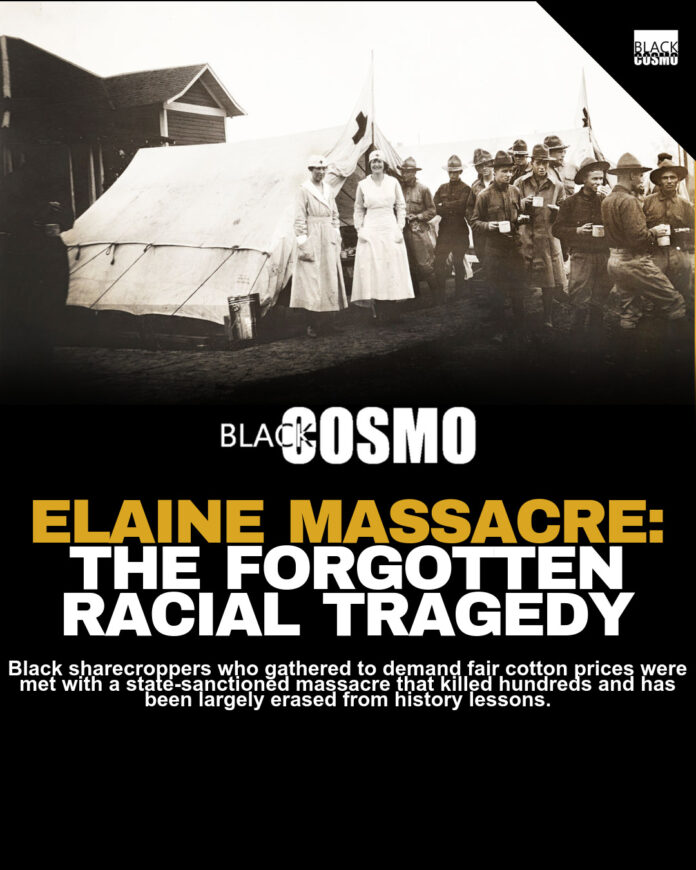
Two years before the Tulsa Race Massacre in 1921, one of the bloodiest racial slaughters in American history occurred in Phillips County, Arkansas. This week marks the 107th anniversary of the Elaine Massacre, when hundreds of Black sharecroppers gathered to organize for fair cotton prices. For that simple demand, they were met with a state-sanctioned manhunt that history class conveniently forgot to mention.
Following World War I, Black sharecroppers in the Arkansas Delta were trapped in extreme economic exploitation by white landowners who controlled the economy and sold cotton on their own schedule. To fight back, Robert L. Hill, a Black farmer from Winchester, Arkansas, founded the Progressive Farmers and Household Union of America to secure fair prices for disenfranchised Black farmers’ cotton crops and break free from predatory contracts, the Smithsonian reported.
On the evening of September 30, 1919, approximately 100 Black sharecroppers attended a union meeting at a church three miles north of Elaine, with armed guards posted outside to prevent disruptions and intelligence gathering by white opponents, according to NPR. Then, the first gunshot rang out.
Gunfire erupted after two white men approached the church, though who fired first remains contested. A brutal shootout followed between the armed Black guards and three individuals. W.A. Adkins, a white security officer for the Missouri-Pacific Railroad, was killed. Charles Pratt, Phillips County’s white deputy sheriff, was wounded, and word spread immediately.
When a Black trustee alerted officials, a massive white mob formed. Arkansas Governor Charles Hillman Brough called in nearly 600 federal troops to fight what he characterized as a “Negro uprising.” Rather than keeping the peace, a mob of 500 to 1,000 armed white men and military forces hunted down Black residents for three days.
Black people, who outnumbered whites in the Elaine area by a ten-to-one ratio, were randomly attacked and killed on site. The terror claimed entire families who thought they were safe, including a soldier returning home from World War I, only to be dragged from a train and murdered before he ever made it back to his front porch, the Guardian reported.
An eyewitness recalled how soldiers “committed one murder after another with all the calm deliberation in the world, either too heartless to realize the enormity of their crimes, or too drunk on moonshine to give a continental darn,” in his book, “What a Preacher Saw Through a Key-Hole in Arkansas.”
Historians estimate at least 200 Black Americans were killed, though the true toll is likely much higher. Local observers suggest that more than 800 Black lives were lost, a figure that would make the Elaine Massacre the deadliest racial conflict for African Americans in U.S. history, per the Guardian.
Federal troops disarmed both parties on October 2, 1919, but instead of justice, Black victims received handcuffs and murder charges. Troops arrested hundreds of Black residents and kept them in makeshift enclosures. If their white employer couldn’t vouch for them, they remained jailed and lost their land. While no white perpetrators were ever prosecuted, authorities charged 122 Black individuals with murder or threatening behavior.
A dozen Black sharecroppers, later known as the Elaine 12, were wrongfully convicted of murder and sentenced to death by an all-white jury in trials that averaged 5 to 10 minutes, the University of Arkansas reported. Eventually, the U.S. Supreme Court found their convictions unconstitutional due to lack of due process, and their sentences were commuted. They were never exonerated.
On the massacre’s 100th anniversary, the Elaine Massacre Memorial was unveiled across from the very courthouse where the trials for the Elaine 12 were held. “The Elaine Massacre marked one of the darkest moments in our state’s history,” Arkansas Governor Asa Hutchinson’s office said at the time. “The lessons we can learn from 100 years ago are relevant today as we navigate race relations in the 21st century. I’m grateful that we as a state are taking the opportunity to remember this history and learn from it.”
★TR★